Showing posts with label book. Show all posts

Wednesday

Skeleton Tracks (2022)


Michelle Elvy & Marco Sonzogni, ed.: Breach of All Size:
Small Stories on Ulysses, love and Venice
(2022)


Skeleton Tracks

Tell me the word, mother, if you know now. The word known to all men.
You know how it is when you’re in a strange city, especially if you don’t speak the language well? The books you brought with you dry up, and you become desperate for new reading material. You can usually find a book exchange of some sort in most hostels: French and German paperbacks, English potboilers – even some more serious books among them: Goethe’s Faust or (as in this case) Joyce’s Ulysses, left behind, no doubt, by travellers who’d repented of their self-improving zeal.

This time I was in Venice, on Giudecca. I’d just finished reading Snow Falling on Cedars, and was desperate to exchange it before leaving next morning to catch my train south. Ulysses it was.

Not just any copy of Ulysses, though – the one I’d picked up was a special ‘corrected’ version prepared by some German Professor called Hans Walter Gabler. He’d also included a long preface explaining how, by dint of comparing all the manuscript remnants, he’d managed to reconstruct parts of the book even its author had failed to comprehend.

In particular, in the Nighttown sequence, when the ghost of Stephen Dedalus’s mother appears and he asks her for that word, the ‘word known to all men’, Gabler had actually managed to find out what that word was, even though Joyce himself left it out. Not to keep you in suspense, the word turned out to be ‘love’.

Unfortunately for Gabler, the previous owner had included a few press cuttings denouncing the impudence of presuming to know better than a book’s author what it should and shouldn’t contain.

But that’s not what I want to talk about here. Even though I had doubts about reading Gabler’s rather than Joyce’s version, there’s not much else to do on long train journeys, so I did get a chance to study the book in some detail.

In particular, since this was clearly a student text, I was on the lookout for underlinings or marginal notes. There were none. What there were – in Chapter XV: Circe, the one I mentioned above – were little pinprick dots under some of the words. I’d read my fair share of prison-camp books, and I knew that during World War II people used to send coded messages like that.

I started to jot them down as I came to them. This was the result:
the gondola
wait my love
behind the stable
great light
still young
Make of that what you will.


Michelle Elvy & Marco Sonzogni, ed.: Breach of All Size (2022)


•


(18-19/11/21)

Breach of All Size: Small Stories on Ulysses, love and Venice. Ed. Michelle Elvy
& Marco Sonzogni. Wellington: The Cuba Press, 2022. 80-81.

[423 wds]


•


Welcome to Novella (2017)


Leicester Kyle: Letters to a Psychiatrist (2017)

Afterword:
Welcome to Novella


Leicester Kyle: Letters to a Psychiatrist (c.1975)


Novellas … boy, as far as marketability goes, you in a heap o’ trouble.

This quote from Different Seasons (1982), bestselling author Stephen King’s first collection of novellas, gives a pretty accurate picture of the received wisdom about the form: amongst publishers and agents, at any rate – the views of readers tend to be far more positive.

King’s book did, after all, inspire three feature films: Rob Reiner’s Stand by Me (1986), Frank Darabont’s Shawshank Redemption (1994), and Bryan Singer’s Apt Pupil (1998). The first two of these are now regarded as modern classics, and are certainly among the most successful among the many, many screen adaptations of his work.

King has gone on to publish three more such collections: Four Past Midnight (1990), Hearts in Atlantis (1999), and Full Dark, No Stars (2010). Clearly, then, the novella form appeals to him strongly. No fewer than five movies have been made, to date, of the thirteen stories in these three books.

The reasons for this are not too difficult to ascertain. Novellas make good films because they contain the thematic scope and heft of a novel without its immense weight of detail.

Despite the brilliant acting and production which distinguishes both Stand by Me and Shawshank Redemption, their success as films can be laid solidly at the door of story. In each case certain things may have been left out and added to the original novella, but the narrative remains essentially intact.

So, if a good novella can be equated with box-office gold, why do they continue to be regarded as a drug on the market?

First of all, what exactly is a novella? Stephen King’s quick, workmanlike definition in the afterword to Different Seasons specifies any story between 25,000 and 35,000 words, which he refers to as ‘numbers apt to make even the most stout-hearted writer of fiction shake and shiver in his boots.’ He goes on:
There is no hard and fast definition of what either a novel or a short story is – at least not in terms of word-count – nor should there be. But when a writer approaches the 20,000 word mark, he knows he is edging out of the country of the short story. Likewise, when he passes the 40,000 word mark, he is edging into the country of the novel.

Mary Doyle Springer, in Forms of the Modern Novella (1975), is somewhat more liberal in her choice of vital statistics. She defines it as ‘a prose fiction of a certain length (usually 15,000 to 50,000 words).’ She does, however, go on to stress that ‘this is a length equipped to realise certain formal functions better than any other.’

What this appears to mean in practice – to booksellers, at any rate – is a story too short to be marketed successfully by itself. It therefore has to be shoe-horned in somehow with a group of other pieces as part of a larger collection.

This prejudice against the commercial possibilities of the form does not seem to weigh so heavily on publishers in other languages. Novellas continued to be available as single volumes in French, German, Russian and Spanish bookshops, and many of the most celebrated works by authors in those languages have always been issued in this way.

The aversion to the risk of the single-volume novella runs deep in the English-speaking world, however. Even such classics of Modernist fiction as Henry James’s The Turn of the Screw, Joseph Conrad’s Heart of Darkness, and James Joyce’s The Dead, were all first issued as parts of a larger collection: James’s in The Two Magics in 1898; Conrad’s in Youth (1902); and Joyce’s in Dubliners (1914).

And yet, properly packaged, there can be little doubt that readers do respond positively to short focussed pieces in pocket-sized volumes. Certainly that is the philosophy espoused by American publisher Melville House in their new series “The Art of the Novella,” dedicated to celebrating ‘this renegade art form and its practitioners.’

Melville House confines itself, for the most part, to the classics of the genre. Turning to the New Zealand publishing scene, I would note that there’s been considerable success here for works of non-fiction presented in single volumes.

Lloyd Jones’ Four Winds Press essay series (2002-2003) was succeeded (from 2004) by Awa Press’s “How to” series, and (more recently) by Bridget William Books’ BWB texts – accompanied, now, by Martin Conrich’s NZ film studies series. In each case a piece of prose of roughly 25,000 words (give or take 10,000 or so) is presented for purchase at a very reasonable price.

So why has the same not been done here for fiction?

To which, of course, the answer is that it has.

In May 2005, at Diamond Lil’s bar in Auckland, hot on the heels of Peter Simpson’s successful anthologies of classic New Zealand novellas (Seven New Zealand Novellas, 2003, and Nine New Zealand Novellas, 2005), local publisher Brett Cross, of Titus Books, kicked off the Titus Novella series. Distinguished novelist Mike Johnson was on hand to launch the first three volumes: William (Bill) Direen’s Coma, Olwyn Stewart’s Curriculum Vitae, and my own Trouble in Mind.

In her Landfall review of these books, Katherine Liddy remarked that:
the Titus novella series presses ahead of the pack with something new, smart and strange. Kiwi literature just got a whole lot more interesting.

Titus Books soon shifted to publishing full-length novels, as well as short fiction and poetry collections, and their novella series did not continue. The positive response to this initiative – as well as to Peter Simpson’s anthologies – seemed, however, highly suggestive of things to come.

All of which serves as a preamble to the present project: Paper Table Novellas. This is intended as a stand-alone series, with its own aesthetic and mission statement: to publish contemporary novellas in attractive standalone volumes, and – by doing so – to assert their importance not only to modern fiction as a whole, but to New Zealand writing in particular.

•


How many recent novels (both here and overseas) are simply bloated novellas?

After a hundred or so pages of gold – sharp, focussed writing – the narrative meanders off into supernumerary scenes and plotlines, with occasional spasms of dialogue.

Why is this? Could it be that the superior saleability of any work marketable as a novel outweighs the aesthetic advantages of conciseness and relevance?

That’s not to say that there aren’t many excellent novels out there, but invariably these are works which demand that length and weight of considered detail to make their point, whatever that may be.

The temptation must be strong to pretend that you’re writing a novel when actually what you have on your hands is a potentially fine novella. But what shame can there be to add to a form which can boast such masterpieces as Thomas Mann’s Death in Venice (1911), Stefan Zweig’s The Royal Game (1942), Gabriel García Márquez’s Leaf Storm (1955), Aleksandr Solzhenitsyn’s One Day in the Life of Ivan Denisovich (1962), and Marguerite Duras’ The Lover (1984), as well as such local classics as Katherine Mansfield’s Prelude (1918), Frank Sargeson’s That Summer (1946), and Kirsty Gunn’s Rain (1994)?

•


The first book chosen for the Paper Table Novellas series, Letters to a Psychiatrist, was originally self-published by its author, poet, priest, and ecologist Leicester Kyle (1937-2006), in a small cyclostyled edition in the mid-1970s. It received little attention at the time, and has since become fabulously rare – as have his other three novella-length works, issued at roughly the same time: The Abbot and the Rock; Deosa Bay: A Pastoral; and The Visitation; An Account of the Last Diocesan Visitation of John Mowbray, Bishop of Calcutta.

Though Leicester’s reputation rests mainly on his poetry, written from the early 1990s onwards, there is much of interest in these early prose works. By far the best of them – to my mind, at least – is Letters to a Psychiatrist. Its topographical and botanical exactness about the South Island seashore below Karamea, based on his own intimate knowledge of the West Coast, are combined with a vivid account of a spiritual vastation, drawn again – I suspect – from the deepest roots of the author’s own experience.

I first read this story (along with the others listed above) at Leicester’s house at Millerton, in the hills above Westport, on a visit in the late 1990s. Perhaps one of the reasons it appealed to me more than any of the others was because he had guided me to one of those very beaches – accessible only on foot – only the day before. We had walked together through the dense bush, explored those strange, magical landscapes.

Letters to a Psychiatrist has the specificity characteristic of Leicester’s best poetry, still decades in the future when he wrote these stories in his late thirties. As one of his two literary executors (along with poet David Howard), I was overjoyed to discover a copy of it among Richard Taylor’s wonderful collection of Kyle-iana a few years ago, while working on the comprehensive online index of his surviving work now to be found at the Leicester Kyle website [http://leicesterkyle.blogspot.co.nz/].

Leicester’s story is roughly 23,000 words long, right in the middle of the novella range. It seems to strike an ideal tone for the launch of the Paper Table series. It has enough action and ideas for a full-length novel, but is composed with the concentration and precision of one of its author’s own short stories.

My own pair of twin novellas, The Annotated Tree Worship, completed in 2015 (some forty years after Leicester’s) will be the next in the series. I can see, now, that many of the thematic links between them are not accidental, but were motivated by this early reading of his novella. I wasn’t at all conscious of that at the time I was writing, but it now seems to me another good reason for placing them side by side.

In any event, let’s hope they’ll be the first of many more to come!


•


Works cited:

King, Stephen. Different Seasons. 1982. London: Futura, 1984.

Liddy, Katherine Liddy, “Something Strange: Reviews of Coma by William Direen, Trouble in Mind by Jack Ross & Curriculum Vitae by Olwyn Stewart.” Landfall 212 (Spring 2006): 185-88.

Springer, Mary Doyle. Forms of the Modern Novella. Chicago: University of Chicago Press, 1975.


•


(29/4-7/6/17)

“Afterword: Welcome to Novella.” In Leicester Kyle: Letters to a Psychiatrist. ISBN 978-0-473-41327-9. Paper Table Novellas 1. Auckland: Paper Table, 2017. pp 81-87.

[1726 wds]


•


Sunday

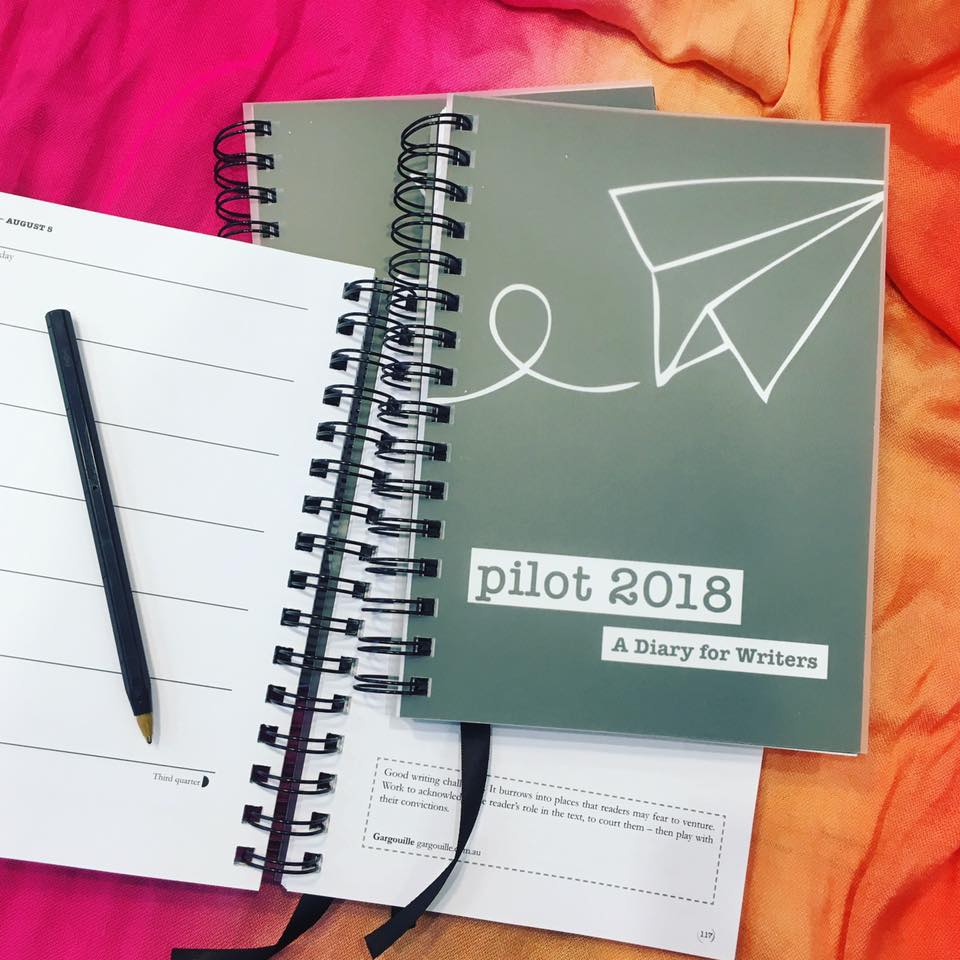
Pilot 2018: A Guide for Writers (2017)


Karen Bateman, ed.: Pilot 2018: A Guide for Writers (2017)


Starting (and Stopping) a Poem

I find it almost impossible to start writing a poem. Some of my friends tell me that they sit down and begin doodling on a piece of paper until a few words start to hang together, and then, before they know it, they have a poem!

It doesn’t work like that for me at all. I have to hear a phrase sounding over and over again in my head. When it really begins to nag at me, I try to write it down.

I once went to a poetry workshop by the South Island poet Brian Turner, where he told us always to try and pursue the poem for a few lines past where we thought it should end, just in case. This advice has served me well.

On the other hand, it’s equally hard to stop writing a poem. Paul Valéry once said, “a poem is never finished; it is only abandoned.” There’s a lot in that. It’s tempting to think that your piece is good to go after you’ve read through it and tweaked it a few times, but I find that it’s best to do so again and again, at intervals of days and weeks and even months, before you can feel reasonably certain it’s giving all it’s got to give.

Above all, be gentle with yourself. If your first draft sounds like illiterate dreck – as mine almost always do – so what? You have to start somewhere, but that somewhere can be a long country mile from the finished product, some hours (or days, or years) down the track. But isn’t that the fun of the thing?


(5/4/17)

Karen Bateman et al., ed. Pilot 2018: A Diary for Writers. Melbourne & South Gippsland: Pilot Press, 2018. 12 [available at: http://www.pilotpress.com.au].

[275 wds]


•


Thursday

Catching a ride on a paradox (2016)


Keith Nunes: catching a ride on a paradox (2016)


It was apparent to me when I first started to read Keith Nunes' poems - at any rate those first few that crossed my desk as an editor - that there was a freshness and directness to his view of the world which I found immensely appealing. I don't mean to imply that they seemed artless - rather, that they were artful in the best way: concealing their subtleties of craft beneath that effortless vernacular voice Keith can, apparently, summon at will. They were about very real things, too: love, lust, landscape, leisure, longing. Since then he's gone on from strength to strength, but never losing that initial acuity and lack of vainglorious display.


(28/9/16)

Keith Nunes, catching a ride on a paradox: poetry and short fiction (Rotorua, 2016): blurb.

[114 wds]


•


Saturday

On the Road to Nowhere (2016)


Ingrid Horrocks & Cherie Lacey, ed.: Extraordinary Anywhere: Essays from Aotearoa New Zealand (2016)

On the Road to Nowhere:
Revisiting Samuel Butler's Erewhon


Samuel Butler: Erewhon (1872 / 1973)


Over the Range

The Erewhonians say that we are drawn through life backwards; or again, that we go onwards into the future as into a dark corridor. Time walks beside us and flings back shutters as we advance; but the light thus given often dazzles us, and deepens the darkness which is in front. We can see but little at a time, and heed that little far less than our apprehension of what we shall see next . . .
(Samuel Butler, Erewhon)[1]

Samuel Butler's Erewhon is, literally, nowhere: an inversion of Utopia, Thomas More’s imaginary state in (or near) South America. It is, however, reachable from somewhere — or rather, from Erewhemos, the state contiguous to Erewhon described at the end of its 1901 sequel, Erewhon Revisited.

People often forget that the subtitle of Erewhon is ‘Over the Range.’ I have in my mind’s eye the cover of the mid-1970s edition of Erewhon, in the Golden Press series of New Zealand classics. It shows a lone rider in a Southern Alpine landscape — a detail from a 19th-century realist landscape painting called ‘The Waimakariri River Bed’.[2] This image, evoking the mood of James K. Baxter’s ‘High Country Weather’ (‘Upon the upland road/ Ride easy, stranger’), certainly had the effect of reinscribing the story’s New Zealand setting in my imagination when I first came across it as a teenager.

As a born-and-bred Aucklander, I had few associations with the South Island and the Canterbury Plains beyond a few family camping trips. My father lived in Templeton, outside Christchurch, for a single year during his childhood, but his principal memory seemed to be of the long straight roads, with deep drainage ditches on either side, which my grandfather would cycle along—his two boys taking turns to ride pillion behind him.

Nevertheless, when I came across the following description of Erewhon in Alberto Manguel and Gianni Guadalupi’s otherwise authoritative Dictionary of Imaginary Places (1980), I felt almost offended:
. . . a kingdom probably in central or northern Australia [my emphasis], though its location has been deliberately concealed by travellers who have visited it. Those geographers who have placed it in New Zealand (Upper Rangitata district, Canterbury) have not taken into account the sheer immensity of its land surface.[3]
Given the deliberately over-literal and tongue-in-cheek nature of Manguel and Guadalupi’s book, it would be silly to resent too strongly their reassignment of Erewhon to our larger, brasher neighbour (though precedents such as Pavlova, Phar Lap and Crowded House do spring to mind). It still seems a bit odd, though, that a place so unequivocally nowhere should have to be so firmly located somewhere.

Perhaps that subtitle ‘Over the Range’ becomes particularly significant here. It denotes movement from here to there, from the known to the unknown, from the closely observed (by Butler himself, among others) Canterbury of the 1860s, to the Otherwhere of the imagination.

We need to go somewhere else to see where we’ve been: to the unknown place to look back on what we thought we knew. And, like all binaries, this dichotomy between nowhere and somewhere, Erewhon and Erewhemos, suggests something in between: the true subject of investigation, albeit one which can only be taken by surprise, as in a Knight’s move.


•


Arthur’s Pass


An old friend of mine, whom I’ll be calling Graeme for the purposes of this essay, owned a bach in Arthur’s Pass for a few years in the late 1990s. We were close at school and university, but I’d seen little of him since he moved to the small Canterbury town of Darfield to work as their rural GP.

I only visited his bach (or should I say ‘crib’?) once, for a single night. I’d often wondered why he talked about it so much, and went to such extraordinary lengths to get there. From the road it looked like nothing much: a rough discoloured shed with walls of corrugated iron.

But then I walked inside and saw the view.

It’s not that it was particularly grandiose: no Albert Bierstadt ranges of snowy mountains towering up into infinity. Rather, it was the more intimate charm of forest and valley, with a single rocky stream. When I awoke next morning, the fog had already rolled in.

Graeme had gone for a walk, and I was left alone in the cabin. I looked out the window at the trees looming through the mist, and felt a kind of joy at the perfection of this place, a mood of quiet contentment such as I hardly remember experiencing anywhere else.

‘This would make the perfect location for a writers’ retreat,’ I thought, and later, after we’d driven back down to the Plains, hinted as much to Graeme. He didn’t take the bait. I never succeeded in making my way back there again—though not for want of trying.

Later, when he moved down to Dunedin after a marriage breakup, he was forced to sell it in order to make up the price of a house deposit. I’m sure he’s regretted it many times since—as have I. Perhaps it couldn’t have lived up to that miraculous first impression if I’d gone back there later, on my own, but I doubt that. It was just a magical spot, a place of peace and refreshment.

My friend the Christchurch poet John O’Connor once told me of an experience he’d had during his teens, when he and a few friends drove out of the city and the working-class suburb he’d grown up in, and stopped for a short walk in the hills on the way to Arthur’s Pass.

The others got bored quite fast, he said, but (as he put it), ‘I felt like I wanted to sing, as if I couldn’t believe anything could possibly be so beautiful.’ John died earlier this year, but I can’t help remembering that story whenever I think about Canterbury and the Southern Alps.


•


The Statues

A few steps brought me nearer, and a shudder of unutterable horror ran through me when I saw a circle of gigantic forms, many times higher than myself, upstanding grim and grey through the veil of cloud before me.
One of the strangest things in Erewhon (not to mention its sequel) are the repeated references to the ring of statues which guard the unnamed colony the narrator lives in from the imaginary country which borders it: ‘a sort of Stonehenge of rude and barbaric figures . . . [with a] superhumanly malevolent expression upon their faces.’

It actually takes the narrator some time to realise that these ‘were not living beings, but statues.’
They were barbarous — neither Egyptian, nor Assyrian, nor Japanese—different from any of these, and yet akin to all. They were six or seven times larger than life, of great antiquity, worn and lichen-grown. They were ten in number.
What’s more, not only do they look forbidding — ‘Each was terrible after a different kind. One was raging furiously, as in pain and great despair; another was lean and cadaverous with famine; another cruel and idiotic’ — but they sound frightening, too:
The inhuman beings into whose hearts the Evil One had put it to conceive these statues, had made their heads into a sort of organ-pipe, so that their mouths should catch the wind and sound with its blowing. It was horrible. However brave a man might be, he could never stand such a concert, from such lips and in such a place.[4]
In narrative terms, too, one could say that these figures constitute a barrier: between the circumstantial verisimilitude of his opening chapters, so clearly drawn from Butler’s own observations of the Canterbury colony (as recorded in his 1863 book A First Year in Canterbury Settlement)[5] and the fantastic inversions which characterise the No-place his protagonist would shortly enter.


•


The Cautery


It was the early 90s. I’d been at an academic conference in Dunedin, and thought I’d take the opportunity to drop in on Graeme on my way home. I accordingly took the bus from Dunedin to Christchurch, which was (in retrospect) a pretty stupid thing to do.

Tempers were already wearing thin when I came rolling into the depot a couple of hours late—due to various misadventures on the way— and I could see that Graeme’s family could probably have done without this lengthy interruption to their day. So tense, in fact, was the atmosphere on the way back to his place that I began to wonder if it would even be possible to last out the weekend I’d budgeted on staying.

I mentioned to Graeme, more to make conversation than anything else, that I’d been having trouble with nosebleeds all through my stay in Dunedin, and had had to run out of a couple of sessions with blood on my shirt and two fingers pinched shut on my nasal passages.

Nothing could be easier to fix, he told me. He could cauterize my nose: seal shut the vein which must be causing the problem. He had the tools to hand in his surgery down the road.

Since both of my parents were GPs, I’d got into the bad habit of relying on family and friends for medical advice, and — as the youngest of three brothers — had (in any case) a certain ingrained tendency to see doctors as authority figures. Reluctant though I was to go along with this plan, I let him persuade me to climb back into the car.

It was long after hours, and we were the only ones in the surgery. It was a modern pre-fab, but the garish religious pamphlets and posters which his partner, an evangelical Christian, had left lying around the place gave it a strange gothic atmosphere. He told me to strip, then strapped me down on the table (‘In case you flinch too much when I put it in and it ends up in the wrong place.’)

The cautery, the small metal rod he was proposing to stick up my nose, took a while to heat up, and — in the meantime — he took a good look up my nostril to see the exposed vein. It was, it seemed, quite visible and ready to be seared shut.

The process was quite intrusive (as you might expect): not directly painful, exactly, but certainly very uncomfortable. Nor is snuffing the scent of one’s own scorched flesh ever exactly pleasant.

I did think of some things while I lay there, though. What was I doing there, for one thing? Why had I agreed to this bizarre procedure in the first place? ‘Never again, under any circumstances,’ was my main thought. The next was to wonder how many more minutes I would have to endure before I could leave.

After that trip we didn’t make contact again for several years.


•


Leap, John, leap!


However peculiar Erewhon may seem to contemporary readers, so many of the attitudes and controversies it mocks having faded away over the intervening century and a half, Erewhon Revisited is stranger.

Even the way it’s told, a deathbed account by ‘George Higgs’ (the original narrator, named now for the first time) of his return to Erewhon, recounted secondhand by his son John, seems so diffuse and clumsy as to call into question the accuracy of everything that’s being reported.

Perhaps this was originally designed as a sly dig at the authenticity of the Gospels—the main target of Butler’s satire this time round—but it ends up sounding more like a tribute to other fin-de-siècle novels by the likes of Conrad and James, with their unreliable narrators and obsession with the vagaries of human psychology.

Even the ring of statues appears to have changed in the intervening twenty years. His English-born son John reports that his father found them ‘smaller than he had expected’:
He had said in his book—written many months after he had seen them—that they were about six times the size of life, but he now thought that four or five times would have been enough to say.
But if these statues had ‘grown’ in his imagination, what of the far more startling discoveries he had made in Erewhon itself? Were those to be called into question, too? Certain other important aspects of their appearance seem curiously altered, also:
Their mouths were much clogged with snow, so that even though there had been a strong wind (which there was not) they would not have chanted.
The statues recur in the story when Higgs is being assisted in his escape over the range by his newly encountered Erewhonian son George: ‘Towards noon they caught sight of the statues and a halt was made which gave my father the first pang he had felt that morning, for he knew that the statues would be the beginning of the end.’ Higgs and his son do, however, make a ‘solemn covenant’ at the statues that they will meet again:
‘XXI. i. 3, i.e. our December 9, 1891, I am to meet George at the statues, at twelve o’clock, and if he does not come, I am to be there again on the following day.’
Higgs adds one proviso: ‘if I cannot come I will send your brother.’

The next chapter of the book, however, is headed ‘My Father reaches Home, and Dies not long Afterwards.’

John is nevertheless determined to meet his long-lost Erewhonian brother, and travels out to the colonies to try to make this rendezvous. He finally succeeds in reaching the statues on the appointed day, but ‘could not refrain from some disappointment at finding them a good deal smaller than I had expected’:
My father, correcting the measurement he had given in his book, said he thought that they were about four or five times the size of life; but really I don’t think they were more than twenty feet high, any one of them . . . There was no wind, and as matter of course, therefore, they were not chanting.
This constant insistence that they are somehow reducing in size – from the forty or fifty feet of the first estimate, to the thirty-odd feet of the second, to no ‘more than twenty feet high, any one of them’ — seems a curious point to stress, even in context. Why, too, should their failure to chant be considered such a ‘matter of course’?
. . . when sleep came it was accompanied by a strange dream. I dreamed that I was by my father’s bedside, watching his last flicker of intelligence, and vainly trying to catch the words that he was not less vainly trying to utter. All of a sudden the bed seemed to be at my camping-ground, and the largest of the statues appeared, quite small, high up the mountain side, but striding down like a giant in seven-league boots till it stood over me and my father, and shouted out, ‘Leap, John, leap!’ In the horror of this vision I woke.[6]
The meeting of the two brothers takes place a day late, due to the fact that ‘the year XX had been a leap year with the Erewhonians, and 1891 in England had not.’ This, it appears, is the true meaning behind that strange cry in his dream: ‘Leap, John, leap!’ Our narrator also remarks that ‘George gained an immediate ascendancy over me, but ascendancy is not the word—he took me by storm; how, or why, I neither know nor want to know.’

Disproportionate emphasis is, I think, the predominant impression given by the constant recurrence of these statues in Butler’s two books about Erewhon. They are (we are told initially) ‘terrible,’ ‘barbarous’ — and musical, but only in a ‘horrible’ way. Their size, moreover, seems to fluctuate inexplicably.

Either, one is forced to conclude, they serve as a rather redundant addition to Butler’s otherwise fairly straightforward satire on the mores and opinions of Victorian England, or they have some other function in his narrative, express some anxiety which cannot find a clearer voice there.


•


North East Valley


Last year I visited Graeme again, this time at his house in North East Valley, Dunedin.

I’d stayed there before a couple of times, and had watched its gradual decline from a basically functional living space — albeit with a few too many boxes stacked in odd corners — into a warren of unread papers and books. Even so, seeing it now came as a bit of a shock.

The steeply sloping section was completely overgrown. The lawn had been left unmown for so long that the grass was higher than my waist. Neighbourhood cats had scoured tunnels through the high grass, and mewed in protest as I tried to beat a way up along the path.

I’d warned him what time I’d be arriving, but even so there was no answer to my repeated knocking and ringing of the bell at the back door. In desperation, I made the long, perilous journey to the front door, which had not been used for years, and could only be reached by pushing right through the heart of the jungle.

No answer there, either: I could see that there was a light on inside, but the porch was overgrown and dusty, with an old rotting cushion disintegrating on one of the wicker chairs.

I made my way back. Eventually, after further knocking, he did answer the door, explaining that he’d been listening to the radio and had lost track of time.

It didn’t look as if there had been any attempt to tidy up in advance of my visit, but Graeme claimed this was not the case—that if I’d come to the house a week or so before I’d have found it impossible to move from room to room.

He admitted to suffering from a lack of energy and motivation, and even to the probability that one might have to describe this condition as a kind of depression. He did not, however, think that treatment or counselling would be likely to help (‘There are so many factors involved, most of which they wouldn’t be able to help with.’)

The visit cannot be said to have gone well. I learned quite quickly that it was unwise to let him drive me anywhere (he had a habit of overtaking trucks on blind corners which was disconcerting, to say the least). It was his behaviour in public which was really awkward, though.

On the one occasion we went out to dinner together, he distinguished himself by dropping his fork on the floor and demanding a clean one to replace it. No sooner had the new one arrived than he dropped that on the floor, too — or, rather, catapulted it there while banging the table to emphasise some loud point he was making. He was about to call out for a new one when he caught my eye. After that he contented himself with making an immense fuss over the amount of butter they’d put on the Naan bread, then complaining about the dessert.

His property in the valley was a couple of blocks down from that ‘steepest street in the world’ which the local scarfies like to roll down in wheelie bins (until one of them got killed doing it, that is). It’s a beautiful spot, with a great view of the wooded hills opposite, and even a certain amount of sunlight — for Dunedin.

As for the house itself, it’s well-built and sound, though certainly suffering from neglect. Before flying out, I took the gamble of doing some tidying up: pinning up a few of the beautiful Indonesian and Indian artefacts Graeme had picked up in his travels, purging a few hundred kgs of old magazines and waste paper, and rearranging his lounge and dining room so one had space to sit down in them.

Graeme seemed quite grateful that I’d taken the trouble, which was a relief. People don’t always like you to go sorting through their stuff while they’re out for the day. Who knows what you might find?


•


A Field Guide to the Other World


I remember once trying to explain to the arch-sceptic Graeme my interest in occultism and the supernatural. I’d just been reading Patrick Harpur’s Daimonic Reality: A Field Guide to the Other World, so I tried to account for this fascination using one of Harpur’s paradigms:
The Otherworld mirrors ours. It can be benign, like the paradises that reverse this world’s suffering; or it can be uncanny, like the realm some tribes ascribe to witches who walk or talk backwards, wear their heads upside down, their legs back to front.
What better analogy could one find to Erewhon? Its names — ‘Senoj Nosnibor, Ydgrun, Thims’ — that run backwards; its location in the Antipodes where everything is ‘upside down’; even its clothes worn, like Professor Panky’s, ‘like an Englishman . . . but turned the wrong way round, so that when his face was towards my father his body seemed to have its back towards him and vice versa’?

The basic point of Harpur’s book, I told Graeme, was to postulate a ‘daimonic reality’ which exists — either literally or psychologically (Harpur sees little distinction between the two) — as a contrast to our world of causation and certainty. Ghosts, poltergeists, UFOs, lake monsters, Bigfoot, the yeti, fairies, angels, demons all inhabit this reality, but not — for the most part — as we see them.

The ‘glamour’ which these beings are able to throw across the perceptions of mortals who chance into this uncanny sphere means that the size, shape and essential nature of all that they see there, including its inhabitants, is always open to question: hence Harpur’s contention that the description of a haunting and a UFO abduction narrative may be basically the same thing.

This approach is indebted to C.G. Jung’s classic Flying Saucers: A Modern Myth of Things Seen in the Sky, where the Swiss psychologist sets to one side the question of the objective existence of such phenomena, but rather looks into the psychological implications of this transformation of the more traditional apparitions of folklore into spaceships and aliens. Fear was behind it, he concluded: anxiety over the atom bomb and the accelerating rate of post-war technological change.

Harpur, too, wishes to see some larger significance in the exponentially multiplying field of anecdotal and analytical accounts of paranormal events. The fact that people continue to experience such things and to ascribe so much personal significance to these encounters and sightings is, in his view, far more important than whether they can be claimed to be ‘real’.

Real in what sense? The fact that such phenomena can seldom be persuaded to recur in laboratories does not, in itself, render them ‘non-existent’. Can feelings such as love, hatred or even pain be measured according to objective outside criteria? Does this make them, too, unreal?

Pain is only too real to those who suffer from it. It can come as a shock to the congenitally literal-minded to realise that the extent of any pain — physical or psychological — can only be determined anecdotally, by asking the person experiencing it.

My own repeated readings of Samuel Butler’s Erewhon at different points of my life cannot be said to add to much more than a series of indeterminable questions.

Where is the book set? What is the true significance of the statues? Why does Butler (or rather, his narrator) stress their reduction in size over time? Why, in particular, does he take the trouble to transcribe the particular musical phrase from Handel that their moanings most resemble?

One of the few constants at all stages of my friend Graeme’s life has been a love for music: choral music in particular. He’s sung in choirs for many years, and can improvise effortlessly on virtually any musical instrument: pianos, recorders — organs.

I suppose, for him, this constitutes the best way to step out of his life: ignore the frustrations and rages which seem to haunt him like furies, and disappear into a counter-realm of order and harmony.

The composition of Erewhon must have served a similar purpose for Butler: a way of examining the assumptions — religious, colonialist, racist — of his upbringing: from the distance not just of the farthest point on Earth from the oppressive values of his father’s rectory, but from a new world altogether. He stepped through the looking-glass into another place in order to look back. Or, as he himself puts it in ‘the world of the unborn’:
. . . we presage the leading lines of that which is before us, by faintly reflected lights from dull mirrors that are behind.
For me, I suppose that this account of a few visits to the South Island is a way of talking about how the story of a friendship can mirror our feelings both about a place and the progress of a life. For me, Dunedin and the Alps are inextricably bound up with my meetings with Graeme: the original affection overlaid with a certain frustration at where he’s ended up now. But it also constitutes a gauge: a mirror of the nowheres I’ve been, in light of the somewhere I hope I’m approaching.

Patrick Harpur’s rules for travel in the Otherworld seem to ring only too true for all these contingencies:
Travel light. Don’t believe everything you’ve been told, either for good or ill . . . Observe local customs; respect local gods. Talk less than you listen. Try to see as well as sightsee. Be polite but firm; take advice but do not be gullible. If in doubt, smile. Do not laugh at the natives, but don’t be afraid to laugh ... Don’t join in the dancing unless you really have learnt the steps.[7]

•


Notes:

1. Samuel Butler. Erewhon, or Over the Range. 1872. New Zealand Classics (Auckland: Golden Press Pty Ltd., in association with Whitcombe and Tombs Limited, 1973), 156.

2. by one “J. Attwood” (= T. R. [Thomas Reginald] Attwood) [information from Una Platts. Nineteenth Century New Zealand Artists: A Guide & Handbook (Christchurch: Avon Fine Prints Limited, 1980), 27. Available at: http://christchurchcitylibraries.com/Heritage/Publications/Art/Platts-19thC/Platts-19thCArtists.pdf.

3. Alberto Manguel & Gianni Guadalupi. The Dictionary of Imaginary Places. Illustrated by Graham Greenfield. Maps & Charts by James Cook. 1980 (London: Granada, 1981), 113.

4. This, and the previous two quotations, come from Butler, 1973, pp. 47–48.

5. Compiled by his father, the Rev Thomas Butler, from essays and letters sent home, but subsequently repudiated by Butler himself, who would not allow it to be reprinted in his lifetime (information from Samuel Butler. A First Year in Canterbury Settlement. 1863. Ed. A.C. Brassington & P.B. Maling. Auckland & Hamilton: Blackwood & Janet Paul, 1964).

6. This, and the previous four quotations, come from Samuel Butler, Erewhon Revisited, The Travellers’ Library, 1901 (London: Jonathan Cape, 1927) 37, 279, 281 and 301–1.

7. Patrick Harpur. Daimonic Reality: A Field Guide to the Other World. 1994 (Ravensdale, WA: Pine Winds Press, 2003), 174.


•


(18/2-1/12/15)

Extraordinary Anywhere: Essays on Place from Aotearoa New Zealand. Edited by Ingrid Horrocks & Cherie Lacey. ISBN 978-177-65607-0-7 (Wellington: Victoria University Press, 2016): 135-49.

[4702 wds]


•


Friday

"We" Society (2015)


Jack Ross, ed.: "We" Society Poetry Anthology (2015)

Editor's Note


Mrs. Thatcher once declared, at the height of her attack on the British Social Welfare System, once the envy of the world: “Who is society? There is no such thing! People look to themselves first.”

What Thatcher actually meant by this challenge to the very name “society” was (as she proceeded to explain) the fact that: “Life is a reciprocal business, and people have got the entitlements too much in mind without the obligations.”

There is, of course, a lot of truth in this. But that doesn’t mean that there are not certain responsibilities on the individual which transcend simple self-interest. The get-rich-quick beneficiaries of Thatcher’s new order may have done very nicely for themselves, but all those corporate raids and deregulated industries have left behind a bitter legacy of devastated communities – crime, drug addiction, social and political apathy.

I tried very hard, however, not to impose what I feel about society, and its complex relation to the individual, before reading the entries for the “We Society” Poetry Competition. I didn’t want to be only looking for poems I agreed with already.

Sure enough, I was astonished by the range of responses and interpretations to the idea of a society of mutual dependence. Some poets took the competition rubric quite literally, carefully inserting the words “we society” – or some variation thereon – in the body of their poem. Others took a more oblique, nuanced approach. These latter tended to be more successful, I think, but both trends are well represented here.

It was very difficult to make a selection from so many good poems: almost all of the writers who entered seem to have fielded their A-team for the competition, but I was eventually able to come up with a longlist of 70-odd poems (all included in this publication), which I then refined further into a shortlist of twelve. Here is that list (in alphabetical order of title):
  1. 10 in a packet

    A very accomplished, simple but not-so-simple poem about children growing into adulthood, and the things they leave behind, all achieved without fuss or straining for effect.

  2. Caring

    This is a political poem – almost a manifesto – but it seems to me to personalise its message very effectively: the form is innovative and the language lively.

  3. Everything about us

    I have to say that I’m particularly fond of the short prose poem as a genre, and there were some very good ones among the entries for the competition. This one was a standout, though – intensely timely, and expressed exactly.

  4. Farm

    This poem pleased me a lot. As a city-dweller, I share few of the experiences described in it, but the poet made me feel them from the inside. It struck me as a thoroughly imagined piece of writing.

  5. From me in Vanilla

    I like the (disarming) simplicity of this a lot. There were a number of poems along such familiar utopian lines, but this one hinted most successfully at hidden depths below the “new society.”

  6. I love you very badly

    A wonderfully terse, very modern poem, but with ancient resonances to it. The poet formatted it in the tiniest of tiny fonts, but when I blew it up large enough to be visible to my middle-aged eyes, I was quite enchanted by what I read, and its adroit combination of text language and classical love lyric.

  7. Ko Aotearoa tenei

    The linguistic exuberance and multi-cultural inventiveness of this poem is intoxicating. I must confess that I’d like to read a lot more by this author: this is a dazzling piece of work.

  8. Little God

    A very intense poem from (I would guess) a very dark place. Once again, what better way is there out of such places than to try and describe it for other people? It can’t hurt, and it often helps.

  9. may no disaster escape destruction in our bundle of sticks on fire

    There’s a Neruda-esque delight in metaphor and the long line here: a kind of natural surrealism which brings this old language to life – a rich, complex poem.

  10. On the way from the ATM

    This is the classic New Zealand storyteller’s voice: a well-told tale, almost anecdotal in its simplicity, which draws you in through narrative then forces you to confront uncomfortable truths. Again, the simplicity of it masks the true accomplishment of such a poem.

  11. Net

    A complex set of associations and memories adding up to a really beautiful piece, one which repays reading and re-reading. This is one of the richest responses to the theme of the competition, I think.

  12. The mad ones

    I really like this poem. The approach is not unfamiliar (“We are the music-makers, we are the dreamers of dreams” might be seen as a precedent), but there’s a charming directness about these “mad ones,” and I particularly admire that touch at the end: “So nameless they will write you / A poem / And forget the signature at the end.”


•


Dr Jack Ross works as a Senior Lecturer in Creative Writing at Massey University’s Auckland Campus. His latest book A Clearer View of the Hinterland: Poems and Sequences 1981-2014, appeared in 2014 from HeadworX in Wellington. His other publications include four full-length poetry collections, three novels, and three volumes of short fiction. He has also edited a number of books and literary magazines, including (from 2014) Poetry NZ. Details of these and other publications are available on his blog The Imaginary Museum [http://mairangibay.blogspot.com/].


(21-22/4/15)

"We" Society Poetry Anthology. Edited with a Preface by Jack Ross. ISBN 978-0-473-32197-0. “Stage2Page” Publishing Series #4 (Auckland: Printable Reality, 2015): 1-3.
[Available at: http://printablereality.com/publishing/we-society-publication/]

[917 wds]


•


Thursday

Edmond & Hall, Histories of the Future (2015)


Edmond, Martin, & Maggie Hall. Histories of the Future. Words by Martin Edmond. Images by Maggie Hall. North Hobart, Tasmania: Walleah Press, 2015.


Blurb:
Martin Edmond is the closest thing we have to an Australasian Jorge Luis Borges and this book is a kind of Aleph: a point from which everything in the universe can be seen simultaneously — books, dreams, pictures, memories, bric-a-brac. Every reader will confront here their own frissons of recognition. The photographs, by Maggie Hall, are perfect: sufficiently off on their own tangent to set up a counter-narrative to the prose, but tending round to the same set of atmospheres and obsessions.


(May 8, 2015)

[Available at Walleah Press: http://store.walleahpress.com.au/MARTIN-EDMOND-and-MAGGIE-HALL-Histories-of-the-Future_p_69.html (29/7/15)]

[81 wds]


•


Wednesday

Miss Herbert (2015)


G.N. Forester and M.J. Nicholls, ed.: Verbivoracious Festschrift Volume 3:
The Syllabus
(2015)


Adam Thirlwell, Miss Herbert (2007)


Adam Thirlwell. Miss Herbert: A book of novels, romances, and their translators, containing ten languages, set on four continents, and accompanied by maps, portraits, squiggles and illustrations. 2007. Vintage Books. London: The Random House Group Limited, 2009.


Adam Thirlwell: Miss Herbert: An Essay in Five Parts (2007)


Dear Mr. Thirlwell,

Permit me to introduce myself.

I am, in and of myself, of little interest. My name will not mean much to you, still less the fact that I was (until retirement) a teacher of French language and literature.

Were I, however, to inform you that there has long been a tradition in my extended family that it was my Great-Great-Great-Great-Great-Aunt Juliet who was the “Miss Herbert” once privileged to instruct Gustave Flaubert’s niece in the rudiments of English style (as well as – possibly – her uncle … in various other matters), you might perhaps be more readily inclined to listen to me.

The title of your fascinating book seized my attention immediately when I saw it in our small local bookshop (remaindered to clear, I’m very sorry to say). I was especially intrigued to read the passages on pp. 29-30 and 87-88 where you describe the relations between the two (albeit an account substantially indebted to Hermia Oliver’s Flaubert and an English Governess: The Quest for Julia Herbert (1980), as you acknowledge on p.440).

You also quote, on p.29, from one of the Master’s letters to his best friend Louis Bouilhet: “at table my eyes willingly follow the gentle slope of her breast. I believe she perceives this. For she blushes five or six times during the meal,” following this with another quote praising the contours of “Miss Herbert’s” bottom!

But I should get to the point. Not – alas – the discovery among family papers of her famous lost translation, completed under the Master’s own eye, of Madame Bovary, but of a single scrap of paper, which may or may not be in her handwriting (no unequivocal samples of which have survived), in one of my Great-Grandfather’s books, Ford Madox Ford’s Joseph Conrad: A Personal Remembrance (1924), opposite the phrase: “the first words of Conrad’s first book were pencilled on the flyleaves and margins of ‘Madame Bovary’” (p.7), containing some scribbles which do appear to be an attempt on the very first sentence of that novel:
Nous étions à l’étude, quand le Proviseur entra, suivi d’un nouveau habillé en bourgeois et d’un garçon de classe qui portait un grand pupitre.

This is Eleanor Marx-Aveling’s 1886 translation:
We were in class when the head-master came in, followed by a “new fellow,” not wearing the school uniform, and a school servant carrying a large desk.

The scrap of which I have just spoken, however, reads:
The school bell had just struck half past one when the Headmaster entered our classroom, followed by a “new bug” in mufti and a servant boy bearing a large desk.

The word “mufti” surprised me most of all, I must say. However, my Shorter Oxford Dictionary does confirm this usage as dating back at least to 1816. The addition of a striking clock to Flaubert’s opening phrase also gave me pause, though I note that this variant is recorded as belonging to the “ms. autographe, dans son dernier état, après correction” in the 1971 Garnier edition of Madame Bovary.

This might perhaps be taken as evidence that the translation in question was made from the “author’s own manuscript” rather than any printed edition of the novel – which might, in turn, allow us to associate it with that fabled lost version. Who can say? It may be a complete coincidence. Such as it is, I offer it to you in homage.


(6-10/11/14)

Verbivoracious Festschrift Volume Three: The Syllabus. Ed. G.N. Forester and M.J. Nicholls. ISBN 978-981-09-3593-1 (Singapore: Verbivoracious Press, 2015): 209-10.
[Available at: http://www.verbivoraciouspress.org/festschrifts/volume-three-the-syllabus/]

[564 wds]


•


Tuesday

Introducing Leicester Kyle (2014)


Leicester Kyle: The Millerton Sequences (2014)

Introduction:
Introducing Leicester Kyle


Philip Trusttum: Cover image
[Leicester Kyle: Five Anzac Liturgies (2003)]


1. Friends
I spent Labour Weekend in Ch.Ch. with my oldest daughter, who wanted to revisit family sites of the past. I was able to catch up with a few of the poets, and in particular with David Howard, who was as pleasant as ever, though I fear I may have irritated him by declining an invitation to record some poems for some sort of posterity; it seemed a poor way to spend a precious evening. I went to Antigone instead, which turned out to be almost as poor – a student production given to portentous trivialities.
– Leicester Kyle: unpublished letter to Jack Ross (22.11.02)

In retrospect, it seems a shame that Leicester didn't go into the studio that day with David Howard to “record some poems for some sort of posterity.” This was part of the nationwide recording effort which led to the creation of the 171-poet-strong Aotearoa New Zealand Poetry Sound Archive [http://aonzpsa.blogspot.co.nz/], eventually collected on a set of 42 CDs, and now housed in Auckland University Library's Special Collections (with a backup copy in the Alexander Turnbull library in Wellington). David Howard and I were both involved in the project: he as collector, I as editor. Characteristically, though, Leicester saw it simply as a waste of time, a “poor way to spend a precious evening.”

I'd like very much to put on one of those CDs now and listen to some of his poems again, in that dry, clipped, educated-Antipodean voice of his.

Mind you, I'm sure it wasn't because Leicester was ashamed of his own work, or doubtful of its value (though he was certainly a severe critic of the merits of particular pieces). On the contrary, he'd had a mid-life conversion to Poetry, a kind of St. Paul-like vision on the road to Damascus which had come, by the mid-nineties, to challenge his earlier allegiance to the Anglican church.

Perhaps not “challenge” so much as “supplement.” Leicester began as a scientist: a botanist, in fact. As a teenage school-leaver he'd worked as an apprentice in the Christchurch Botanical Gardens. He left there to train as a priest, then to dabble in writing (short stories, mainly) in his forties. Some of the latter got published in the Listener and the London Magazine, so he was certainly successful at it, but they still weren't quite right – not quite what he was looking for.

Then (as he told me the story, at any rate) one day in 1994 he was asked to write something for a parish newsletter up north, and decided to versify the story of a local shipwreck he'd heard about. The result was “The Voyage of the Venus.” It's not a particularly good poem, but he said that it was while writing it that he suddenly understood that this was what he wanted to do.

We first met a couple of years after that, in 1996, at a Christmas party in Devonport held by the “Bookshop Poets,” a small group of writers who used to gather at Lee Dowrick's house in St Leonards Road. Leicester was there with his wife Miriel, Stu Bagby with his wife Sheila. For me, at any rate, this was a very significant meeting – with poets who were publishing regularly in a number of magazines, active on the scene (Leicester was at that point a regular at Poetry Live on K. Road).

I wouldn't say that we formed any kind of Three Musketeers alliance, but it's true that Stu's skill at editing a poem down and down and down to its essence, together with Leicester's lively and well-informed intelligence were instrumental in getting me out of the solipsistic poetry ghetto I'd been living in up till then. Through them I met other poets, too: Raewyn Alexander, Olwyn Stewart, Alice Hooton, Jackie Ottaway, Wensley Willcox – eventually even Alistair Paterson and David Howard.

I knew Leicester well enough to witness his pain as he was forced to watch Miriel's slow death from melanoma: an event which overshadowed his last months in Auckland, and which surfaces again and again in his writing from that period (and later).

And while I was sorry to see him leave – I knew we'd all miss him – I could understand why he felt the need to put Auckland and its malign associations behind him. It did seem odd to me when he told me he'd bought his house in Millerton sight unseen, would in fact be seeing it for the first time as he was moving in. But of course I could understand the attractions of an unpeopled verdant wilderness. Who wouldn't? It nagged at me a little, though.

Millerton is a small town in the hills above Granity, on the West Coast of the South Island, a few miles up from Westport. It's an old mining village which has been almost swallowed up by second-growth bush (when you see old photographs of it, the landscape around it looks like a blasted heath: duckboards laid over fields of mud). Now, however, it looks more like the forest primeval.

I went down to visit Leicester there shortly after he'd moved in. I had been worried about him, about his state of mind, until I heard that he'd got himself a kitten (called “Cursor” because of his habit of following Leicester's finger along the lines in the book he was reading). That sounded distinctly reassuring. I did still want to check up on him, though, so invited myself for a week-long stay.

He acquiesced with this plan (in retrospect, I don't know how enthusiastically), so I flew down to Greymouth and was picked up in his newly bought Land Rover, a huge red beast of a thing which was quite necessary for the wilderness roads in that part of the world. And so began my acquaintance with the bizarre world of Millerton.

I can’t go into any detail about that now, except to say that I visited him there on three separate occasions, and each time learnt more about the curious history and contemporary mores of this strangely self-sufficient green enclave of environmentalists and alternative-lifestyle enthusiasts.

Perhaps this passage from that same 2002 letter I quoted above will give you some sense of his slightly detached view of the local community:
On Sunday I have a small book-launch: Things to do with Kerosene has been printed, and turns out well. I'll send you a copy in December. The launch is here in my new garage, and is also a garage­wetting to declare the garage a garage, and is also a belated acknowledgement of my sixty-fifth birthday. It will be a typical Millerton piss-up, with some invited not coming and some not-invited turning up anyway, and going on and on and on until it runs out of basic supplies. Some of the Buller Community Arts Council are coming, and some of the Buller Conservation Society, which is action-packed radical greenie. The two groups crossover, which is odd, and the members tend to look as if they live in Millerton, especially the Arts ones, who also have dangerous houses.

He was both an insider and an outsider there: an insider because of his family associations with the Coast, and his long history of botanical exploration of the region; an outsider because he wasn’t dependent on any of the local cash crops for basic subsistence.


2. Dilemmas of a Literary Executor [1]

When Leicester fell terminally ill with cancer in 2006, he asked, from his death-bed, for David Howard and me to act as his literary executors. It's not easy to refuse such an arrangement for an old friend, especially when you're not really anticipating having to do all that much work.

In Leicester's case, a great deal of his later writing had already appeared in the form of self-printed and photocopied pamphlets and booklets, so I suppose I was anticipating that some small sum of money would come to us with which we could finance the printing of a posthumous selection of poems, somewhat like his friend Joanna Margaret Paul's Like Love Poems, which had recently been published by Victoria University Press (edited by one of her two literary executors, Bernadette Hall).

That's not quite what happened, though. As it turned out, none of the estate had been set aside specifically to pay for future literary projects. Leicester had a large family, and had recently remarried, so a complicated set of arrangements had had to be devised to provide for each of them.

David, who was on the spot in the South Island, retrieved a large cache of papers from Leicester’s house – including the two large boxfiles marked “Collected Poems” 1 & 2, which Leicester had used as a chronologically ordered archive for any poems he thought worth preserving. He also, crucially, managed to download the contents of Leicester's hard-drive onto two CDs.

Next time he was in Auckland, David passed the two boxfiles on to me, as well as the two computer discs (he'd already emailed me a large number of computer files of various ages and provenances). This was to be the starting-point of our discussion on “what to do about Leicester.”

The difficulties were obvious from the beginning. Leicester had little visibility in New Zealand poetry (though we were already, at the time of his death, seeing the beginnings of a fertile sub-genre called “Visits to Millerton,” examples of which might include Jim Norcliffe's Villon in Millerton (2007), some of my own pieces from Chantal's Book (2002), poems by Tony Chad, Jeffrey Paparoa Holman, David Howard ... the list goes on).

We didn't have any money to pay for the reprinting of any of his longer works, which were (in my opinion) by far the most interesting. Nobody came forward with any intriguing Leicester-related projects. The few approaches I made to publishers, large or small, drained off into the sand. All in all, the whole question of his literary legacy ended up in the too-hard basket.

And yet, those two big boxfiles continued to sit in my study, glaring at me, somehow daring me to ignore the challenge they presented. They remain there to this day, though their contents have now been carefully indexed and sorted.

The years flew by. Leicester was almost five years dead. On Tuesday, 15 February, 2011, David Howard emailed me to the following effect:
To:Jack Ross
Subject:Leicester's work

Dear Jack,

So, with Leicester well buried, we need to honour our responsibilities to his work and his memory. I spent four months examining and cross-checking his papers. You have the two box files that I extracted from the four large cartons I packed then freighted down from the Christchurch flat that was his final domestic address. Clearly, nothing outside of these two box files has Leicester's blessing to be republished. But no one is likely to want the lot. It seems to me that we have these options:
  1. Use your blog and library website skills to put the lot on-line (Peter Simpson's Smithyman is a glorious model).
  2. Use the approach of (1) but jointly select from the two box files so that 100 odd pages are available to all and sundry.
  3. Approach Titus Books as Leicester's executors with the proposal of a Selected Poems.

Let's get one of the above underway.

love, David

To which I replied the next day:
Well, I agree, David - it's just a question of when and who.

Perhaps the best thing would be to set up a website initially with scans of some of his work up on it, and then consider whether a selected poems is really needed. How much of an audience is there for his work?

I have the two boxfiles at present, but am quite happy to surrender them to you if you want to get underway with the project.

I guess what occurs to me is to annex some free space online at blogspot or some such address, and put up some jpg. scans of the individual pages of (say) Heteropholis together with transcripts of the text. If we were both joint site editors, we could both work on building up the site gradually. Do you have a scanner? Maybe we don't need scans of all the pages, but just the ones with illustrations?

It'd take quite some while to do, though, and I fear I'm a little snowed-under at present at work - not to mention aspiring to get some of my own work done at some stage ...

best, jack

David replied enthusiastically, and so I set to work.

I do have some experience building such sites - ever since mid-2006, in fact, when I first got the bug, I've been running a series of experiments in just how many permutations you can run on the free web-space of a standardised blogging site.

I've used them to index literary magazines (a brief index) and poetry archives (The Aotearoa NZ Poetry Sound Archive); I've used them to put up entire novels (Nights with Giordano Bruno) and poetry collections (Papyri); I maintain one for each of the courses I teach; I have one for my Masters thesis and one for my Doctoral dissertation. Let's say that they hold few fears for me.

But I think if I'd known just how complicated and time-consuming it would be to put up an entire critical edition of a fairly prolific poet's collected works online, I might have hesitated before agreeing to David's proposition.

Let's start with a few statistics. In his lifetime, Leicester self-published 19 poetry books or pamphlets, with lengths varying from 117 pages to 10 pages (12 in A4 format and 7 as A5-sized chapbooks). This was in addition to two commercially produced books, A Safe House for a Man (2000) and Five Anzac Liturgies (2003), both published by Polygraphia Ltd. If you add together the contents of those 19 books, that makes 913 pages of material to scan and transcribe.

Besides that, one of the more exciting parts of our whole Leicester project has been the discovery, among his papers, of four hitherto-unpublished works: Koroneho, the God Poems, the Galapagos Tracts, and Message from a Lightboard. Extracts from the first and third of these appeared in brief magazine during his lifetime, but the God Poems – a long, tragic family saga – was entirely unknown to me. So was Message from a Lightboard, a selection of his short poems to date compiled and submitted to publishers in 1996. Together they come to another 303 pages.

As well as these longer works, there are 746 shorter poems and sequences included in the two boxfiles marked (by Leicester) “Collected Poems.” On top of those, I've discovered another 36 uncollected poems among the computer files left on his hard disc (Leicester had a curious habit of saving each individual poem, and every page of a longer work, as a separate word file: this means that there are literally thousands of files to trawl through before one can hope to reach the end of his oeuvre. I don't think that I've missed anything, but – to be honest – you can never really be sure).

So let's say well over 2,000 pages of poetry, with a few little additions here and there in the form of Christmas letters and miscellaneous pamphlets.

I think it's fairly obvious that, while all that work needs to be indexed and recorded, not all of it actually needs to go up online. What I've done, then, is to put up in full, with facsimiles of each page and transcriptions of the text, the contents of each of the 19 books. Because of their – in my own critical opinion – exceptional literary quality and personal interest, I've done the same with the four posthumous works, though there I've had to be more daring in my editorial choices, given the lack of a single indisputable authorised text for each of them (some are more complex than others in this respect).

By contrast, I’ve put up only what seems to me a representative selection from the rest of the “Collected Poems.”[2] Not all of them (I feel) merit reproduction, and deliberately publishing sub-standard material can hardly be seen to be in the best interests of a writer who's no longer here to edit and select from his own work.

Those 746 poems and sequences comprise 957 pages of text. Of those, I’ve chosen 193 (253 pages) to go online – roughly a quarter of the whole archive. I’ve also put up 24 of the 36 uncollected poems I found among his files. It’s perhaps worth noting here that quite a large number (59, to be exact) of the remaining poems are included in one or other of the books issued during Leicester’s lifetime – not to mention the seven included in this book. This brings up the total online to well over a third, 258, of the total 746.

All of this manuscript material, without exception, will eventually be donated to a permanent library collection, but in the meantime you can rest assured that the website provides a complete online list of everything included in his files.

Which brings me to the precise nature of this once-and-for-all, as-critically-rigorous-as-I-can-reasonably-make-it, online edition of Leicester's works. I decided at any early stage that, while it would be perfectly feasible to reprint each book as a single lengthy computer page, that that would result in a rather unwieldy artefact. I therefore determined to set up two parallel sites:

  1. Leicester Kyle [http://leicesterkyle.blogspot.com], for indexing, critical apparatus and secondary materials: chronology, bibliography, galleries of images;
  2. Leicester Kyle Texts [http://leicesterkyle1.blogspot.com], for accurate, readable texts of each work.

That seems to have worked quite well. The distinction between primary and secondary materials – works by and about an author – is a familiar one, and given the hyperlinks which connect every part of each site to every other part, a reader can easily use both sites at the same time without even noticing the different headings.

The two sites went live on July 4th, 2011, the fifth anniversary of Leicester's death. My work on them will remain ongoing, but I'm hoping to have them reasonably complete by the date this book is issued, in early 2014.

As well as that, the Leicester Kyle Literary Estate has so far published one volume of literary remains, an edition of Koroneho, his epic poem about William Colenso, in partnership with Ian St. George of the Colenso Society. Ian has since issued another book of reprints of some of Leicester’s early botanical essays (The Orchids of New Zealand. 1956-1957. Historical Series 19. Wellington: New Zealand Native Orchid Group, 2012).

Mind you, I don't think that I would have bothered with any of this if it hadn't been for my firm conviction that Leicester's work as a poet and crusading ecologist is still timely, and merits a far wider audience than it's hitherto had.

Whether I'm correct about that is, I suppose, for posterity to say.


3. The Millerton Sequences

Turning to the contents of the book you now hold in your hand, I should explain that I believe these six poetry sequences, previously uncollected, represent some of the very best work from the second half of Leicester Kyle’s writing career: the Millerton period, dating roughly from his departure from Auckland in April 1998, after the death of his first wife Miriel, to his own death in Christchurch Hospital in July 2006.

Winnowing them out from the numerous short poems written over the same time-span also seemed the best way to do justice to his wide range of interests and subject-matter. We begin here with a short sequence grounded in Leicester’s expert professional knowledge of Botany (“Five Flowers at Millerton Mine”); move on to “Picnic In The Mangatini,” which is probably as close as Leicester ever got to a straightforward set of “nature” poems; thence to a meditative evocation of place (“Rain”); then to a work of ecological protest against the proposed strip-mining of the Millerton plateau (“Death of a Landscape”); then a searching personal confession, written towards the very end of his life (“The Catheter Club”); and lastly to “Rain Poems,” which, in aggregate, sound like a bittersweet farewell to the West Coast and its weather.

As an entry-point to the collection, I’ve included the poem “One Hundred Steps to Millerton Mine,” written shortly after his return to the Coast. The “Hundred Steps” are a crucial part of the Millerton landscape, leading to the bathhouse used by the Miners after their long shifts underground. There’s also an official list there of those who lost their lives in this endeavour, commemorated by Leicester in another of these early poems from his new home, “An Incomplete List” (dated 3/6/98).

Finally, as a coda, I’ve put in the text of the last of his annual Christmas books, the delightful story of the dog Red, and how he managed to find acceptance in the local community.

The texts have been copied from Leicester’s original computer files, with minimal adjustment and alteration. The fonts, sizing and accidentals are all his. The one exception to this is “Death of a Landscape.” In this case I’ve chosen to present the original handwritten manuscript (dated February 2004) in facsimile form, with the – presumably later – print version (dated March 2004) immediately afterwards. It seemed dangerous to assume that either of these texts was intended to supersede the other entirely, so this seemed the most convenient way for the reader to sample their continuities and divergences.[3]


•


Thanks to my fellow-executor David Howard, for prompting this project in the first place, and for contributing the beautiful sequence of poems, “Instead Of, In Memory: Reverend Leicester Kyle (1937-2006)” to the book; thanks, too, to my wife Bronwyn Lloyd for her encouragement and advice at all stages of the process – and the Design team at Titus Books, Brett Cross and Ellen Portch, without whom none of this would have been possible.


Chronology

  • 1937 – (30 October) Leicester Hugo Kyle is born in Christchurch.

  • 1956 – (August-February 1957) Leicester contributes seven articles on “The Orchids of New Zealand” to the New Zealand Gardener.

  • c. 1975 – Leicester self-publishes The Abbot and the Rock, a set of short stories (32 pp.); I Got Me Flowers: Letters to a Psychiatrist, a novella (54 pp.); Deosa Bay: A Pastoral, another novella (47 pp.); and The Visitation: An Account of the Last Diocesan Visitation of John Mowbray, Bishop of Calcutta; Largely Compiled from His Journal and His Letters, the last in this series of early novellas (68 pp.)

  • 1995 – Leicester takes early retirement from the Anglican church, and moves with his wife Miriel into Flat 8/1 Ruapehu St., Mt. Eden.

  • 1997 – (July) Koroneho, Leicester's long Zukofskyan poem about William Colenso, begins to appear in Alan Loney's journal A Brief Description of the Whole World.

  • 1997 – (November) Leicester edits Spin 29.

  • 1998 – (29 March) Death of Miriel Kyle from melanoma.

  • 1998 – (June) Leicester, now managing editor of Spin, leaves Auckland for the upper West Coast of the South Island, having bought a house (sight unseen) at No. 404 Calliope Rd., Millerton – in the hills above Granity.

  • 2000 – (21 July) Jack Ross launches A Safe House for a Man, published by Calum Gilmour of Polygraphia Press (which includes the poetic sequence “Threnos”, a moving account of Miriel's last days), at Takapuna Public Library.

  • 2000 – (November) Leicester resigns as managing editor of Spin, after editing issue 38.

  • 2001 – (July) The Millerton and Plateaux Protection Society [MAPPS] publishes The Great Buller Coal Plateaux: A Sequence of Poems – an ecological manifesto in poetic form.

  • 2003 – Calum Gilmour of Polygraphia Press publishes Five Anzac Liturgies, with drawings by Philip Trusttum.

  • 2004 – Leicester finalises the text of Miller Creek, with coloured sketches by Joel Bolton.

  • 2005 – (May) Leicester publishes "Peninsula Days: A Memoir of Joanna Paul," in brief 32 (2005): 61-64 (edited by Jack Ross).

  • 2005 – (23 October) Leicester marries his second wife Carol at their home in Millerton.

  • 2006 – (March) Leicester publishes "A Letter from Buller," in brief 33 (2006): 44-45 (edited by Scott Hamilton).

  • 2006 – (4 July) Leicester dies of cancer in Christchurch hospital.

  • 2011 – (4 July) Launch of Leicester Kyle website.

  • 2011 – (3 November) First posthumous book publication: Koroneho: Joyful News Out Of The New Found World, edited with a Introduction by Jack Ross and a preface by Ian St George.

  • 2012 – (12 December) Second posthumous book publication: The Orchids of New Zealand, compiled by Ian St George, with a chronology by Jack Ross.


Select Bibliography


Poetry Books & Pamphlets:
  1. Koroneho: Joyful News out of the New Found World (1996-2001). In A Brief Description of the Whole World 6 (July 1997): 10-19 / 7 (September 1997): 35-40 / 8 (December 1997): 62-67 / 9 (April 1998): 49-54.
    • Koroneho. 1st book publication. ISBN 978-0-9876604-0-4. Auckland: The Leicester Kyle Literary Estate / Wellington: The Colenso Society, November 2011.
  2. Options. Drawings by Jeffrey Harris. ISBN 0-473-04111-1. Mt Eden: Heteropholis Press, November 1996 / July 1997.
  3. State Houses. Mt Eden: Heteropholis Press, June 1997.
  4. A Voyge to New Zealand: the Log of Joseph Sowry, Translated and Made Better. Mt Eden: Heteropholis Press, 1997.
  5. Heteropholis. Mt Eden: Heteropholis Press, 1998.
  6. A Machinery for Pain. ISBN 0-473-05734-4. Millerton: Heteropholis Press, January 1999.
  7. A Safe House for a Man. Millerton: Heteropholis Press, 2000.
    • A Safe House for a Man. 2nd ed. ISBN 0-9582121-5-5. Auckland: Polygraphia Press, July 2000.
  8. Five Anzac Liturgies. Millerton, Buller, 2000.
    • Five Anzac Liturgies. 2nd ed. Drawings by Philip Trusttum. ISBN 1-877332-08-9. Auckland: Polygraphia Press, 2003.
  9. A Christmas Book. Millerton, Buller, December 2000.
  10. The Great Buller Coal Plateaux: A Sequence of Poems. ISBN 0-473-07746-9. P.O. Box 367, Westport: MAPPS [The Millerton and Plateaux Protection Society], July 2001.
  11. King of Bliss. Millerton, Buller, May 2002.
  12. A Wedding in Tintown. Millerton, Buller, July 2002.
  13. Things to Do with Kerosene. ISBN 0-473-08963-7. Westport: Heteropholis Press, October 2002.
  14. Dun Huang Aesthetic Dance. Millerton, Buller, November 2002.
  15. 8 Great O’s. Millerton, Buller, 2003.
  16. Panic Poems. ISBN 0-476-00084-X. Westport: Heteropholis Press, December 2003.
  17. Living at a Bad Address. Millerton, December 2004.
  18. Miller Creek. Sketches by Joel Bolton. Westport: Heteropholis Press, 2004.
  19. Anogramma. ISBN 0-476-01604-5. Millerton: Heteropholis Press, August 2005.
  20. Breaker: A Progress of the Sea. Illustrations by John Crawford. ISBN 0-473-10237-4. Westport: Heteropholis Press, September 2005.
  21. Red Dog / Brown. Cover Illustrations by Jim Conolly & Jocelyn Maughan. Millerton, Buller, Christmas 2005.


Prose Books & Pamphlets:
  1. The Orchids of New Zealand. 1956-1957. Compiled by Ian St George. ISSN 0114-5568. Historical Series, No. 19. Wellington: New Zealand Native Orchid Group, 2012.
  2. The Abbot and the Rock (c.1975)
  3. I Got Me Flowers: Letters to a Psychiatrist (c. 1975)
  4. Deosa Bay: A Pastoral (c.1975)
  5. The Visitation: An Account of the Last Diocesan Visitation of John Mowbray, Bishop of Calcutta; Largely Compiled from His Journal and His Letters (c.1975)


Edited:
  1. Spin 29 (Summer 1997), ed. Leicester Kyle (Auckland).
  2. Spin 32 (November 1998), ed. Leicester Kyle (Millerton, Buller).
  3. Spin 35 (November 1999), ed. Leicester Kyle (Millerton, Buller).
  4. Spin 38 (November 2000), ed. Leicester Kyle (Millerton, Buller).


Online:
  1. Leicester Kyle:
    An Index to the Collected Poetry Books of Leicester Hugo Kyle (1937-2006)

    [http://leicesterkyle.blogspot.com/]
  2. Leicester Kyle Texts:
    The Collected Poetry Books of Leicester Hugo Kyle (1937-2006)

    [http://leicesterkyle1.blogspot.com/]


Notes:

1. The substance of this introduction was given as a paper “Digitising Leicester Kyle: the Dilemmas of a Literary Executor” at Short Takes on Long Poems: A Trans Tasman Symposium at the University of Auckland (29-30 March 2012). The original text can be read at: http://www.nzepc.auckland.ac.nz/features/short-takes/symposium-ross.asp.


3. A complete transcript of the handwritten version of the poem is available on the Leicester Kyle Texts website at: http://leicesterkyle1.blogspot.co.nz/2012/01/five-millerton-sequences.html.


(13/3/12-23/11/13)

Leicester Kyle. The Millerton Sequences. Ed. Jack Ross. Poem by David Howard. ISBN 978-0-473-18880-1. 140 pp. (Pokeno, Auckland: Atuanui Press, 2014): 8-29.
[Available at: Atuanui Press (30/4/15)].

[4557 wds]


The Millerton Sequences (2014)


•