Showing posts with label online publication. Show all posts

Sunday

Pastoral Care (2026)


Landfall Review Online

But Baby, I Love You


John Prins. Pastoral Care. ISBN 978-1-99134810-4. Landfall Tauraka short story series. Dunedin: Otago University Press, 2025. 246 pp. RRP: $35.00.


John Prins: Pastoral Care (2025)


Leon Edel once claimed that in Henry James’s first (seldom-reprinted) novel Watch and Ward (1871):
His fault was that of most first-novelists: he tried to cram all his future performances into the single work; and he achieved a fiction rich in thematic material and overstuffed in performance.
And yet, as Edel concedes: ‘it shows us the artist, working within a literary tradition, grasping his form, and in possession of a verbal ear that will give him a transcendent style.’

John Prins’ first book Pastoral Care is not a novel, but a collection of short stories. The eponymous novella which takes up more than half of its length might justify the comparison, however.

Not that there’s anything particularly Jamesian in Prins’ approach to fiction. There’s quite a range of styles on exhibition here, from the epigrammatic precision of ‘Lake Pukaki’ to the gentler ironies of ‘Rapture.’

Certainly I have my favourites among them. ‘Lake Pukaki,’ for me, is just a bit too polished. The situation it records is both absurd and tragicomic, but it leaves me wanting to clap more than sniff away a tear or suppress a guffaw. Maybe it needs to relax a bit, to insinuate itself into the audience’s consciousness without quite so much epigrammatic wit. But others may well disagree.

‘Rapture,’ though (perhaps for personal reasons) seems triumphantly successful to me. Perhaps you have to be brought up religious to see the humour in a protagonist who’s constantly having to balance her strange attraction to her friend Lucy and the incessant demands of God:
Mara felt Lucy was created in God’s image, and that a shared magnetic consciousness existed between them. Next time they passed too close to one another, there would be a collision.
The ending, too, is exquisitely apt. I don’t want to include too many plot-spoilers in here, but the combination here of earthly emergency and possible divine agency is both funny and poignant: one of the things that Prins does best.

The press release for his book accuses him of setting out to reinvigorate the ‘tradition of social realism in New Zealand short fiction.’ There’s something in that, I suppose. Certainly there are no metafictional attempts to break the fourth wall – nor do any angels (or demons) pay a visit. I think he’s set out to record the world as he sees it, with imagination and vigour, and further attempts to supply a typology at this point in his artistic trajectory would probably be premature.

Who, after all, could have intuited The Portrait of a Lady – or, more to the point, What Maisie Knew – from the more conventional plot mechanics of Watch and Ward? And yet, as Edel reminds us, we can find there the kernels of much of his later imagery: an old lady with a ‘green shade over her eyes’, for instance, who will reappear to much greater purpose in The Aspern Papers.

What’s most fascinating to me about Prins’ book is to see, in its other eight stories, so many tropes and ideas which reappear in the novella ‘Pastoral Care’.

Take, for instance, his fictional poet Bernard Jane, author of the collection But Baby, I Love You. In the story of that title, an unscrupulous publisher has persuaded Jane to recast a set of poems inspired by his overwhelming love for his newborn son so as if they were ‘addressing a romantic lover.’
Bernard was curious, then disturbed. The publisher calculated sales projections and it was a no-brainer. Domesticity, childcare, and the awe inspired by fatherhood were not profitable in 1983. They would sell three times as many books filled with machismo and sexual innuendo.
There’s a certain willing suspension of disbelief required to entertain the notion that any New Zealand poet could make enough from the sales of their latest poetry collection to provide for their family, ‘and feed them, and keep them warm,’ but the conceit of the story is that Jane is a kind of James K. Baxter / Sam Hunt / Glenn Colquhoun combo whose every word is treasured by his contemporaries – even those in the ‘literary scene’ he so despises:
You mean all those writers whose every story ends at the beach, or in the water, and who’re unable to write a metaphor that isn’t a bird, or a tree, or a river, and whose self-deprecation is nothing more than thinly veiled self-loathing. That literary scene?
It’s an odd story. It seems to hinge on the idea that lying about the nature of your poems is okay if it makes you some cash, and yet that it’s all those other dully nationalist writers who should be denigrated as sold-out hacks. It doesn’t quite compute. As Jane himself is honest enough to admit at the opening of the story, ‘There was so much to be ashamed of.’

Reading ‘Pastoral Care,’ however, the connections with ‘But Baby, I Love You’ really start to bear fruit.

Paul Whelan, its protagonist, has a lot in common with Bernard Jane. They’re both reluctant, put-upon fathers, and long descriptions of domestic lack-of-bliss dominate the opening sections of both narratives. Paul, however, is an English teacher rather than a writer, and his principal literary idol appears to be – Bernard Jane.

There’s a long, agonising description of one of Paul’s lessons, where he attempts to get his class to pay attention to the minutiae of a Jane poem entitled – you guessed it! – ‘But Baby, I Love You.’ I have to say that I’m with the kids in the class on this one. Even after I’d looked up the word ‘Domp’ [Delayed Onset Muscle Pain] it was rather difficult to fathom.

It didn’t help that Paul was trying to get them to read it as a poem about romantic love, while reserving till Monday the ‘bombshell’ that it was ‘actually a poem about Bernard Jane’s newborn son.’

Paul’s lesson is a disaster. It isn’t helped by an old black-and-white clip of Bernard Jane himself pontificating about the dreadful responsibility of having been declared ‘the Father of the Nation’ by a Landfall-lookalike called Framework magazine.

But then, that’s presumably the point of the passage: to puncture Paul’s conceit, his conviction that he’s controlling the class and their reactions to him, when in fact they’re barely tolerating him. Bernard Jane is a particularly bad role model for him, because his example encourages the kind of top-lofty nonsense which gets Paul into so much appalling trouble during the story.

The first, most important criterion of any story must be: Does it keep you reading? ‘Pastoral Care’ kept me reading – with a vengeance. I couldn’t put it down. That was not really the case with the earlier stories in the collection. I enjoyed them all: some very much, but they didn’t exactly compel me (with the possible exception of ‘Rapture’).

Waiting for the hideous denouement looming for Paul at the end of his catalogue of disasters felt a little like watching David Brent crash and burn in The Office. No warnings, no words-to-the-wise can turn Paul aside from getting drunk with his favourite actor (a sort of Sam Neill clone called Owen Durham); then provoking an absurd affray with some of his stroppier students at an afterparty, which ends with him soaked and humiliated in their swimming pool, having drowned the wrong phone: not the one belonging to the student who played him their mocking videos of him, but (alas) his own.

I galloped through Prins’ pages as if on steroids, longing for some kind of an end to these terrible blows to poor Paul’s self-esteem. Maybe you have to have been, at some point, a teacher to empathise with him fully, but I’m not sure. I suspect any reader would be drawn in by this slow-motion car crash.

But then he goes soft on us at the end!
Paul asked if Anne [his head teacher] knew anything about what had happened at the Vlassitches’. She did, she told him, and it was all a big nothing.
All a big nothing! Actually she’s asked in the big hung-over buffoon to see if he’d be willing to act as head of English for them next year.

I, you, every reader that ever lived, was surely expecting Paul’s little racket to be rumbled: all the dreadful, embarrassing mistakes he’d committed during this day from hell to be rained on with fire and brimstone from on high. But John Prins decided otherwise. He let his hero off with a warning. Now isn’t that a whole lot better than ending your story ‘at the beach, or in the water’, or else with a metaphorical ‘bird, or a tree, or a river’?

The novella seems to me a great length for Prins. It allows him the scope to develop his characters, and yet forbids too many tangents. It’s not that he isn’t good at short stories: he is – very good. But ‘Pastoral Care’ is an accomplished, fully-formed, completely focussed piece of work. I liked it a lot. It leaves me eager to read more by this writer.


Time Out, Mt Eden: Pastoral Care booklaunch (29/8/25)
l-to-r: Sue Wootton, John Prins, Isabel Haarhaus


(30/12/25-3/1/26)

Landfall Review Online (2026).
[Available at: https://landfallreview.com/but-baby-i-love-you/]

[1504 wds]


Landfall 1 (1947)


Thursday

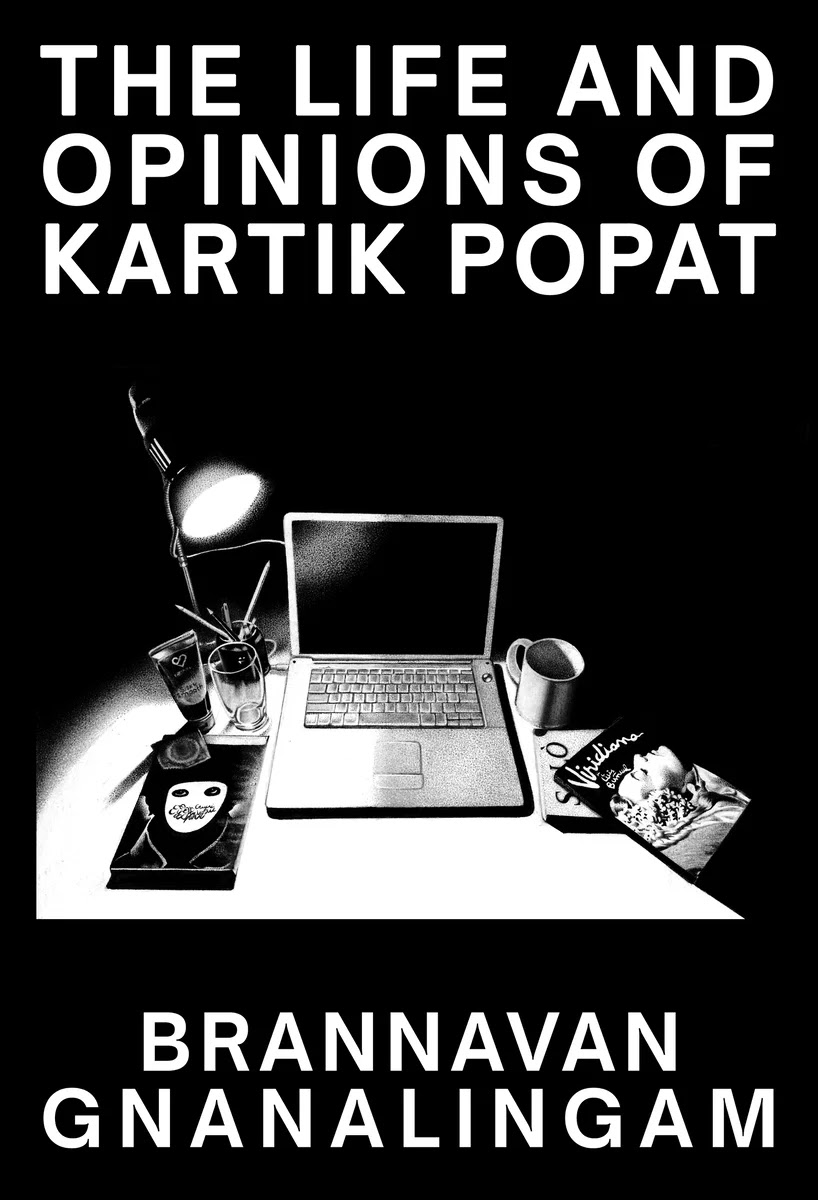
The Life and Opinions of Kartik Popat (2025)


Brannavan Gnanalingam. The Life and Opinions of Kartik Popat. ISBN 978-0473725976. Wellington: Lawrence & Gibson Publishing Collective, 2024. 297 pp. RRP: $30.00.


Brannavan Gnanalingam: The Life and Opinions of Kartik Popat (2024)


This is certainly a very timely book. At a moment when bizarre political twists and turns come so fast that we can hardly keep up with the craziness, a backwards look at the origin stories of certain such social-media-driven ideologies might well come in handy for all of us.

It’s a timely book, but it’s also a book about time. The first chapter is dated 1984, and the last 2024. The first is called “I’ve Been Writing” and the last “I’ve Been Thinking.” For older readers, at least, that triggers a little trip down memory lane to the titles of Richard Prebble’s infamous 1996 and 1999 ACT manifestos.

Brannavan Gnanalingam, too, has been writing. In the fourteen years since the publication of his first novel, called (appropriately) Getting Under Sail (2011) he’s completed another seven: an impressive total by any standards.

Like the protagonist of V. S. Naipaul’s debut novel The Mystic Masseur (1957) – the cautionary tale of a thwarted Trinidadian writer who exploits the gullibility of his celebrity clients to climb the social totem pole – Kartik Popat, Gnanalingam’s own anti-hero, also begins as a “creative” of sorts.

Popat’s thwarted ambitions as a film-maker, centred around his projected feature film And Jack, are gradually eroded away by the ever more effective prostitution of his talents by, first, the New Zealand political establishment; second, the anti-Vaxxer movement. (And, if we hadn’t already suspected the fact, Gnanalingam informs us in his bio-note that And Jack is the title of a real 2004 short film, “written and directed by Brannavan Gnanalingam, Jonny Thompson, and Steve Wakeem”).

This autobiographical note seems inextricable from his writing. Each of his first seven novels appears to have been based on a particular period in the author’s life: Getting Under Sail on a trip from Morocco to Ghana (which included being detained as a murder suspect); You Should Have Come Here When You Were Not Here (2013) on his time in Paris between 2012 and 2013; Credit in the Straight World (2015), the first of his books to be set in New Zealand, on the global financial crisis as seen from down under. And so on.

Again and again I felt these uncomfortable rhymes with experience as Gnanalingam/Popat forced me to relive Helen Clark’s painful last years in the Beehive; the rise of the “smiling assassin”, John Key; and the ghastly death throes of Jacinda Ardern’s coalition of kindness. You can’t take even the most tangential interest in New Zealand politics and not find your worst suspicions about our elected representatives thoroughly vindicated by Popat’s half-hearted Apologia pro Vita Sua.

However, it’s the pitiless grimness of Popat’s early years, bullied and despised at High School without the slightest prospect of reprieve from the dungeon of ethnicity, which really ring true. It was, admittedly, a long time ago. Change is possible. I’m sure there’s even more kneejerk racism on display now than during Popat’s miserable childhood.

Which brings us neatly to the question of what exactly Gnanalingam is seeking to achieve with this novel. He’s explained in some detail in a Spinoff article the moment of inspiration when he watched an Indian American podcast host (and former Republican presidential candidate) interviewing a notoriously racist influencer, a white woman, who began by praising him for being so “articulate”:
“I guess I can call you ‘articulate’ because you’re not an American black.”
After they had a good old yuck at the idea of such an obvious oxymoron, she threw in the kicker: “But I still would not have voted for you, because you’re an Indian.”

As Gnanalingam explains in his article:
you can grease up to racist folks by doing some of the heavy lifting for them, but they’ll still never view you as one of them. You’re just the hired help. And they’ll still view you as a loser. …

I wanted to capture this ugliness in my novel, grift off the grift, and imagine a New Zealand equivalent. Presumably mocking other minorities must be rewarding in its own way (putting aside the societal impacts) – power, money, royalties from tank-top sales, and kudos from the worst people who’d discard you the moment they don’t need you – and all you have to pay is your self-respect.
Perhaps the question Gnanalingam’s novel sets out to answer, then, is: How do you get from here to there? How do you start off as a proud child, shaped by community and family values, and turn into a grovelling toady for the modern day equivalent of slave-owners? It’s certainly a tricky one.

A straightforward first person life-and-times narrative must have seemed the obvious approach. But there are problems as well as advantages with that form. The Mystic Masseur, for instance, is not told in the first person. Its eponymous protagonist is observed from a discreet distance by a very judgmental contemporary (who sounds, strangely enough, a lot like Naipaul himself).

The apparent focus of Kartik’s tale is himself, his struggles, all the appalling people he’s met, virtually all of whom seem to have betrayed him in some way. The real focus is (I presume) supposed to be the morally bankrupt, self-serving nature of his story.

The ever more degrading compromises he makes in the desperate quest to be accepted by the complacent reactionary racist society around him – which lead him eventually to posting off packages of multi-vitamins as Covid remedies at the height of the Pandemic, and even renting an (admittedly unoccupied) tent in the anti-vax encampment in Wellington – are chronicled by Popat / Gnalalingam in grim detail.

“There need never, at the worst, be any difficulty about the things advantageously chuckable for art,” said Henry James. Gnalalingam has, understandably, chucked out little – certainly none of the rage and disgust he still feels at the self-satisfied complacency of Pākehā society. This is something (I would guess) that he experienced continuously as a child, and no doubt still experiences to this day.

It's not that this is bad material, by any means. On the contrary, the trouble is that it’s too interesting. My fascination with Popat’s early life and humiliations far outweighed any indignation I felt down the track at his anti-vaxxer shenanigans.

And given how little of the book is actually devoted to his final incarnation as an online stirrer and random conduit of contradictory misinformation, it’s not surprising that it’s the vomiting subhuman MPs he was forced to serve as a parliamentary staffer who remain the truly unforgettable parts of his story. Popat himself begins to fade to a mere reporter on their infamy.

Satire is a particularly demanding form in this respect. It’s not by accident that its most effective examples exhibit a kind of meme-like intensity: Jonathan Swift’s cartoonish Lilliputians and Brobdingnagians, for instance; or Evelyn Waugh’s battling war correspondents in Scoop. These are not subtle narratives, by any means, but they’re effective because of the burning indignation which compels each brutal line.

Swift, Waugh, Orwell had something vital to say, and they said it in the shortest, most telling way possible. Is the same true of Gnanalingam? His own political satire seems to me to lack the necessary counterbalance of a moral centre. Unlike Swift – or, for that matter, Laurence Sterne, whose Life and Opinions of Tristram Shandy presumably inspired his title – he leaves us with nothing to believe in.

So, in the absence of anything to hold to in the amoral vacuum that is the world of Kartik Popat (or, if you prefer, of contemporary New Zealand), we’re left only with the narrator himself. It’s not that it’s possible to love – let alone respect – Kartik Popat (or “Pooh-pat” or “Tikka”, as he’s variously nicknamed), but it’s easy enough to understand and even (at times) empathise with him.

His own analysis of his surroundings is, always, fatally flawed by the basic futility of his desire to fit in: “fit in” with a bunch of subhuman cretins, limned with all the bitterness of experience. But then that, too, is a profoundly human trait. Nor is his inconclusive ending – a new job as an insurance adjustor with instructions to deny as many storm-claims as possible – exactly calculated to enlighten us. It’s always someone else’s agenda he’s following.

Popat may well be a figure for our times – I fear that he is – but unfortunately that doesn’t make the novel he stars in as coherent as it could have been. For all its many undoubted merits, it’s too inclusive: too detailed in some places, too summary in others.

However, even if it’s not be quite the taut, targeted satire it set out to be, The Life and Opinions of Kartik Popat is still an invaluable chronicle of “the time of our time” (to borrow a phrase from that great Satan, Norman Mailer). There are some scenes here I doubt I’ll ever be able to scrub out of my memory no matter how hard I try.


(13-22/2/25)

Landfall Review Online (2025).
[Available at: https://landfallreview.com/fitting-in/]

[1506 wds]


Landfall 1 (1947)


Tuesday

Relics of John Perry (2025)


Emily Cumming Harris: In New Zealand and Australia

Catherine Field-Dodgson & Michele Leggott:
New Zealand Liliaceae, 1906


In January we received an intriguing email from archivist Katherine Pawley at the University of Auckland. ‘It just leapt out at me,’ she told us, indicating a link to a tall skinny painting by an unknown artist at Webb’s auction house in Auckland. As soon as we clicked on the link we knew what we were looking at. Katherine’s instincts were spot-on: this was another of Emily’s large 1906 oil paintings, and it hasn’t been seen in over twenty years.

Emily Cumming Harris, New Zealand Liliaceae, oil on board, 1170 x 410 mm.

We have been searching for this panel since first reading about it in a 1906 newspaper article. New Zealand Liliaceae featured prominently in the Nelson Evening Mail’s list of the paintings that Emily was sending to the International Exhibition in Christchurch that year:

By to-day’s steamer Miss Harris, of Nile-street, forwarded 12 oil paintings to the Christchurch Exhibition. The collection has been made at the request of the West Coast Executive, and will be displayed in the West Coast Court. The paintings reflect great credit on the artist, who is already widely known in connection with her productions of New Zealand flowers and birds. The collection includes three panels, — clematis indivisa, New Zealand mountain flowers, and New Zealand liliaceae — and also paintings of yellow kowhai and bell birds, Whau, entelea arborescens, gentians, kiekie, nikau, red neinei, turutu, senecios, pohutukawa, manuka, tainui, everlastings, honeysuckle flowers, rata (scarlet). Miss Harris will also have two panels of Antarctic flowers in the Nelson portion of the art gallery. (Nelson Evening Mail 9 Oct 1906: 2)

Then we found the panel mentioned in a contemporary auction record. New Zealand Liliaceae sold in 2002 for $358 at Dunbar Sloane in Wellington. Quite a story emerged when we realised that well-known art and ephemera collector John Perry must have purchased the painting in 2002, bundled it into his van and driven it back to ‘Global Village Antiques’, which he housed in the old Regent Theatre in Helensville. Perry died in 2021 and his vast collection – the equivalent of four tennis courts – is now being catalogued and slowly brought to auction by Webbs. Emily’s panel was being advertised for sale at Webb’s as part of Perry’s estate, alongside other fascinating artifacts that included road signs, shells and folk art cat sculptures.

...

When it was at Webbs in January, New Zealand Liliaceae had only John Perry’s business details and a catalogue number on the reverse, and the lower part of the frame appeared to be damaged.


We are delighted to report that Emily’s Liliaceae painting is now safely in the collection of a museum, where it will undergo some much-needed restoration work and we hope to visit it soon along with Harris descendants. Meanwhile we remain ever curious and watchful to see what other treasures might come to light from the John Perry estate.

Not for the first time we wish that a rediscovered work could tell us more about where it has been. In this instance, we are lucky to have insights from a range of art professionals and collectors who knew John Perry and wrote memorials after his death in 2021, commemorating an extraordinary passion for many different kinds of art and object.

Briar Williams:

If you’ve been anywhere in the art world in New Zealand in the past 50 years, you will have come across John F. Perry. New Zealand’s artistic and cultural landscape was greatly diminished, when John Perry the artist, obsessive collector, ex museum curator, arts writer for AASD and other publications but most importantly friend / mentor to many, passed away at home above his shop Global Village Antiques in the old Regent Cinema in Helensville, West Auckland on 6 June 2021.

Jack Ross:

It was a real shock to hear, earlier this week, that art historian, curator and antique dealer John Perry had died. It seems like forever that I’ve been driving up to Helensville periodically to check out his immense horde of vintage treasure: books, ceramics, furniture, pictures, prints, and everything in between.

In the early days, it was still possible to enter the body of the auditorium, and to get some sense of the sheer size of his collection. For many years now that part of the building has been closed off to the public, however, with only the front rooms accessible even to the most agile visitors.

The second-to-last time we saw him, he invited me upstairs into his apartment, and I got some sense of how he lived there, surrounded by pictures and curios, with his rooftop garden out the front, there on the outskirts of the ancient Kauri kingdom of Helensville.

Mind you, it didn’t seem too bad a place to live out your days – his apartment had a slightly Latin American air, as if he were one of those retired Colonels in a García Márquez novel, watching the rains come and go across the sinuous flatlands of the Kaipara.

Given John Perry’s extensive knowledge of colonial art, we can be certain he recognised Emily’s New Zealand Liliaceae when it came to auction in Wellington in 2002. Did he wonder about its size and medium in relation to Emily’s better-known watercolurs? Did he realise the panel was part of a larger exhibit from 1906? We don’t know. But we can be grateful for his custodianship of the panel in Helensville and imagine with Jack Ross the painting’s secluded life on the edge of the Kaipara Harbour.


(6-9/6/21)

'New Zealand Liliaceae, 1906.'
Ed. Catherine Field-Dodgson & Michele Leggott.
Emily Cumming Harris. [Available at: https://emilycummingharris.blogs.auckland.ac.nz/2025/03/24/new-zealand-liliaceae-1906/ (24/3/25)]

[202 wds]


Monday

Hard by the Cloud House (2024)


Landfall Review Online

The Whereabouts of Sinbad’s Isle


Peter Walker. Hard by the Cloud House. ISBN 978-1-99-101671-3. Auckland: Massey University Press, 2024. 288 pp. RRP: $39.95.


Peter Walker: Hard by the Cloud House (2024)

Travel writing is the least demanding of genres. You can write anything. You can write that there was nothing to write about. I could describe the croissants, of Parisian quality, on sale at the Uturoa bakery, or the Raiatean girls dancing on the backs of beflowered lorries on Bastille Day, or the strange sensation, crossing a glass-floored fale in the middle of the night and seeing coloured fish dart beneath your feet as in a diagram of the unconscious.
Depending on your temperament, you may find this description of travel writing - 'You can write anything' - reassuring or a little ominous. In any case, I suspect it was wise of Peter Walker to postpone it to the last of the three sections of his book. What is this book about, anyway? It begins with a richly detailed account of the discovery and various scientific controversies surrounding Te Hokioi, or 'Haast’s Eagle' (Hieraaetus moorei). This is popular science writing of the first order: as good as anything by Richard Dawkins or Stephen Jay Gould.

We learn here of the pronounced lack of interest in this raptor when researchers thought it must have been too ungainly to fly and thus condemned to hop about scavenging any small creatures too slow to outrun it. Now that this opinion has been overturned – by most experts, at least – its remains are again in high demand. So much for scientific objectivity.

The second section is dominated by history. What begins as a discussion of one possible locale for the depredations of this monstrous eagle – now also identified with the pouākai of Māori legend – morphs into a chilling account of the brutal and rapacious acquisition of the Canterbury Plains by a series of villains headed by Governor Grey himself. Again: riveting stuff: something I certainly should have known about, but have to confess that I didn’t, certainly not in such detail.

After that, in the third section, we stray into personal history or even allegory. The contention that Haast’s eagle may be the original of the 'Roc', or 'Rukh', or 'Rukhkh' of Islamic legend – writer and explorer Richard Burton gives all three of these as possible spellings in the notes to his exhaustive sixteen-volume 1885 translation of the Arabian Nights – is a bold one, to say the least. Walker, however, not content with this, suggests that it may also have inspired the Garuda bird of Indian and South East Asian folklore.

Indeed, as he morphs into a discussion of Te Hokioi’s possible associations with the Korotangi – a mysterious serpentine-stone bird carving discovered in the roots of a mānuka tree on the shores of the Aotea Harbour, near Kawhia, in 1878 – it gradually becomes apparent that this section is not meant to be read in quite the same way as first two parts of the book.

One could see this three-part structure simply as an attempt to impose order on an unruly collection of materials, gathered over decades, and now needing to be fixed in final form between two covers. I’d prefer, however, to follow the lead of Peter Walker’s definition of 'travel writing', quoted above, and to see it instead as an exceptionally entertaining – and informative – contribution to that genre.

Te Hokioi is clearly a protean signifier for Walker. There’s a certain risk in conflating such disparate material, mind you: let’s call it the curse of the Da Vinci Code. The single source for virtually all his Islamic and pre-Islamic learning, as Walker admits, is an essay entitled “The Rukhkh, Giant Eagle of the Southern Seas,” by A. D. H. Bivar, professor of Iranian Studies at London University, an essay included in a 2009 volume called Exegisti monumenta: Festschrift in Honour of Nicholas Sims-Williams. Bivar’s essay is only ten pages long, and 'it made no waves, as far as I knew ... And yet to state the whereabouts of Sinbad’s Isle, where so many had travelled in mind over the centuries … Perhaps there was some flaw in the argument which I couldn’t see.'

To summarise a long and (to my mind) somewhat fanciful yarn, Peter Walker claims Prof. Bivar’s reading of mediaeval Arab traveller “Ibn Battuta’s 42-day voyage in the late 1340s far out into the Pacific, where he thought he saw the Rukh [my emphasis], made a sighting of the New Zealand coast by earlier Arab mariners, and therefore an encounter with Harpagornis [Haast’s Eagle], seem feasible':
'It is my understanding that historians of New Zealand are generally sceptical of such visits,' Bivar writes, 'yet Arab accounts of the Rukhkh suggest that occasional visits of this kind did take place, since only there could a veritable giant eagle have been encountered'.
Bivar’s contention that virtually any Middle or Far-Eastern tradition of a 'great, winged raptor … the Griffin, the Anqa, the Rukh, the Simurgh of the Persians' seems likely to encode an encounter with Haast’s eagle, does sound – on the surface, at any rate – a little like Gavin Menzies’ claim, in his best-selling book 1421: The Year China Discovered the World (2002), that 'the fleets of Chinese Admiral Zheng He visited the Americas prior to European explorer Christopher Columbus in 1492, and that the same fleet circumnavigated the globe a century before the expedition of Ferdinand Magellan.' Bivar’s view is, after all, as Walker admits, based on a 'simple insight' as compelling as Menzies’ obsession with the great Ming treasure fleet: 'The Rukhkh always seems to have been located in the China Seas.'

He’s careful to elucidate that 'in Arab and Persian geography of the Middle Ages, "the China Seas" meant the part of the great encircling ocean which lies to the east of China: in other words the Pacific.' A pretty wide-reaching index of location, one would have to say. Consider Burton’s own comments on Sinbad the Sailor’s famous encounter with the giant Roc during his fifth voyage:
An excellent study of Marco Polo’s Rukh was made by my learned friend the late Prof. G. G. Bianconi of Bologna, 'Dell’Uccello Ruc,' Bologna, Gamberini, 1868. Prof. Bianconi predicted that other giant birds would be found in Madagascar on the East African Coast opposite; but he died before hearing of Hildebrand’s discovery.
This reference to 'Hildebrand’s discovery' is to a giant bird’s egg (subsequently classified as Aepyornis hildebrandti) excavated in Madagascar. Its close relation the Aepyornis maximus, or Elephant bird, is quite possibly the largest bird ever to have lived. And the closest living relative to the Elephant bird is the New Zealand kiwi. So, while the two islands are a mere 11,742 km apart, situating the 'Rukh' in New Zealand rather than Madagascar is only a matter of a few months’ navigation of the Southern Pacific … The point I’m trying to suggest here is that the old 'no smoke without fire' adage – when applied to a thousand or so years of fanciful tale-spinning – can be used to justify virtually any hypothesis: in this case, the possible point of origin of a giant mythical bird.

There may be a reason, then, why New Zealand historians 'are generally sceptical' of visits by medieval Islamic mariners. Bivar’s contention that 'Arab accounts of the Rukhkh suggest that occasional visits of this kind did take place, since only there could a veritable giant eagle have been encountered [my emphasis]' is as circular an argument as I’ve ever come across: as good as anything in Dan Brown or Gavin Menzies.

There’s no physical evidence of such visits to the South Island of New Zealand (Bivar is very careful to specify the location of these non-visits). However – says Bivar – they must have taken place, because where else would they have seen the Rukhkh? Well, as I’ve mentioned above, Madagascar was the favourite locale for such sightings in the late 19th century, the age of Burton. But one of the reasons we don’t take such observations very seriously anymore is because every ancient culture I’ve ever heard of has at least one story of a giant bird.

Was Haast’s eagle also the original of the Native American Thunderbird? The Eagle of Zeus? Veðrfölnir, the hawk that sits on an eagle on top of the world tree, Yggdrasil? Is it possible that these mythical beings might have evolved without actual sightings of Te Hokioi?

My doubts about Prof. Bivar’s (I hope) playfully speculative essay is certainly not meant as a critique of Peter Walker’s book. I’ve described his intentions above as an excursus into 'personal history – or even allegory', since that’s how I read them. This whole section, after all, doubles as an elegy for his lost friend, Polynesian artist Jim Vivieaere, and their fateful joint visit to the ancient marae of Taputapuatea on the island of Raiatea.

In travel writing, after all, as Walker informs us, 'you can write anything.' I’m just afraid that his subtle fusion of genres may have strayed over a little into the tempting domains of pseudo-history in this last of his three sections. As long as he doesn’t insist on our taking it literally, though – as I’m sure he does not – what harm can there be in imagining Sinbad and his friends staring up at the pristine Southern Alps, and seeing hovering over them this most wondrous – and terrifying – of raptors?


(14/6-9/7/24)

Landfall Review Online (2024).
[Available at: https://landfallreview.com/the-whereabouts-of-sinbads-isle/]

[1535 wds]


Landfall 1 (1947)


Saturday

Therese Lloyd: In Levin (2024)


NZ Poetry Shelf

Poetry Shelf on Poems:
Jack Ross on 'In Levin' by Therese Lloyd


Therese Lloyd: Other Animals (2013)


Therese Lloyd:

In Levin


Needlepoint rain
is static against the pines
running alongside
this endless beach
that stretches further to my left
and then to my right
With no way to turn
I must stand very still

There is detritus all around:
a motorbike’s green rusted petrol tank,
a bright pink single mattress
half buried in the sand
blue and white
ice-cream containers
scattered like impossible stepping stones

There is theme music too:
fantails’ song and the whoops and cries
of men playing cricket
A fallen pine gathers seaweed
and plastic bags in its rib-cage
A man riding a horse talks on a cell phone

The rate of teenage suicide
is at its highest ever
The local kids drag race
their souped-up Ford Escorts
leaving thick black stripes
that come to abrupt endings


[“In Levin” © Therese Lloyd, Other Animals (Wellington: VUP, 2013): 23 (reprinted by permission).]


It’s a strange experience to live with a poem for almost two decades. I must have read this one first in 2007 or so. It came in as a submission for an issue of Landfall I’d been asked to edit, and I could see at once that it had to go in.

Why? Because it stopped me dead in my tracks.
With no way to turn
I must stand very still
And why must this speaker stand so very still? Because they have nowhere to turn to, that’s why. There’s so much activity going on all around – cricket, cell phones, motorbikes – and yet they’re stopped still by something, something unnamed: just the sheer extent of the vista, perhaps; or by something else, off the edge of the screen.

A bit later on, I needed some poems for a class anthology I was editing. It was for Stage One Creative Writing students at Massey University, and I’d broken down the “poetry” section into a series of weekly themes. Therese Lloyd’s poem came in under “Figures of Speech.”

That may sound a bit reductionist, but I was very struck by the way she’d folded so many strategic metaphors and similes into this otherwise seemingly photo-realist description of a local scene:
  • “Needlepoint rain” – with the implication of embroidery (of course), but also of a certain stabbiness in the narrator.
  • “ice-cream containers / scattered like impossible stepping stones” – it’s that extra word “impossible” which (I feel) conveys the sense of futility, tragic waste which pervades the poem.
  • “A fallen pine gathers seaweed / and plastic bags in its rib-cage” – that’s a personification, rather than a metaphor, if you want to be pedantic (and I usually do). It projects the fallen pine as an animate being with a ribcage – which, after all, is what it is. The poem as a whole is full of a sense of animism: of things which seem at least as alive as people.

I don’t recall any Levin patriots protesting at the picture Lloyd painted of the place. I think it had just come top of some nationwide poll of youth suicide rates at the time, but it’s really the coast to the west of town which is the setting – a postcard-perfect Kiwi beach setting.

I called the picture it paints “photo-realist” above, but perhaps a better term would be “hyperreal.” It has the air of a place that you see with exceptional vividness because you’ve just had a terrible shock of some kind. I don’t know what that shock could be, but those last lines about the “souped-up Ford Escorts”
leaving thick black stripes
that come to abrupt endings
might give us some sort of clue.

This is a poem to read when you need to be reminded of the intensity, the momentousness of the things all around you. Fantails, logs, raindrops all live side by side with more human relics in Lloyd’s vision: the mattresses, ice-cream containers, petrol-tanks we leave behind us.

You can ride on by on your horse if you need to, wheeling and dealing on your phone, but if you’re prepared to invest in the world of “In Levin”, you have to stop, look around, and try and see all there is to see.


Jack Ross is the author of six poetry collections, four novels, and four books of short fiction. His latest book of short stories, Haunts, is due out from Lasavia Publishing later this year. He lives with his wife, crafter and art-writer Bronwyn Lloyd, on Auckland’s North Shore, and blogs at http://mairangibay.blogspot.com/.

Therese Lloyd lives in Wellington and grew up in Christchurch and Napier. She is the author of two collections of poetry, Other Animals (VUP 2013), and The Facts (VUP 2018) which was shortlisted for the Ockham Book Awards in 2019.


Matt Bialostocki: Therese Lloyd (Unity Books, 2013)


(28/4-13/5/24)

'Poetry Shelf on Poems: Jack Ross on ‘In Levin’ by Therese Lloyd.' Ed. Paula Green. NZ Poetry Shelf: a poetry page with reviews, interviews, and other things.
[Available at: https://nzpoetryshelf.com/2024/05/23/poetry-shelf-on-poems-jack-ross-on-in-levin-by-therese-lloyd/ (23/5/24)]

[539 wds]


Poetry Box: Paula Green


Thursday

Shadow Worlds (2024)


Landfall Review Online

Many In that Blue Room Believed, Heart and Soul


Andrew Paul Wood. Shadow Worlds: A History of the Occult and Esoteric in New Zealand. ISBN 978-1991016379. Auckland: Massey University Press, 2023. 426 pp. RRP $65.00.


Andrew Paul Wood: Shadow Worlds (2023)


The Blue Room: Being the Absorbing Story of the Development of Voice-to-Voice Communication in BROAD LIGHT with Souls who have Passed into THE GREAT BEYOND, by Clive Chapman (Auckland: Whitcombe and Tombs Ltd., 1927) … I first came across a reference to this curious book in D. Scott Rogo and Raymond Bayless’s almost equally intriguingly titled Phone Calls from the Dead (1979). Shortly afterwards I managed to acquire a copy of it myself, and was privileged to read its long, literally “ghost-written” – by a reporter identified only as G. A. W. – account of “Uncle Clive” and his careful fostering of the clairvoyant abilities of his young niece Pearl.

The story came to an abrupt end in 1927, with the publication of Chapman & G. A. W.’s book, so I was delighted to find some supplementary details about the case in the chapter entitled “Bumps in the Night” in Andrew Paul Wood’s newly published history of the occult and esoteric in New Zealand. He records, for instance, a reference in Harry Price’s Fifty Years of Psychical Research (1939) to an incident “around 1930”, where:
William Henry Gowland (1879-1965), professor of anatomy at the University of Otago’s medical school, witnessed heavy tables levitate and a locked piano play itself.
As an Otago Daily Times reporter invited to an earlier séance said of the phenomena he saw: “If it was trickery it was damnable trickery, for there were many in that Blue Room who believed, heart and soul.”

This is perhaps the most useful feature of Wood’s book: its inclusiveness, and the fact that he’s followed up on so many intriguing details of early New Zealand occultism – as far as that’s possible in so tantalisingly ill-defined a field. Nor does he scruple to record the many occasions where the trail has run cold, and the rumours of the continued existence of some exiled order or malign coven cannot be substantiated one way or the other.

It's true that much of this data is not, in itself, particularly interesting or stimulating except to enthusiasts (or other Academic researchers). The list of changing addresses for the Dunedin Theosophical Lodge between 1914 and 2015 – recorded in detail on pp. 61-62 of the chapter devoted to this “Not-so-secret Doctrine” – is fairly typical of this aspect of Shadow Worlds. If in doubt, include it, appears to be the guiding principle – after all, it might be of use to someone – which led me to wonder, at times, if simply compiling an Encyclopaedia of New Zealand Esotericism might not have suited his (and our) purposes better?

Wood’s book is, after all, already grouped in large, roughly chronological grab-bag chapters around his basic themes: Theosophy, The Golden Dawn, Anthroposophy, Spiritualism, Witchcraft, and various others. Would further segmentation into discrete entries really have compromised it much?

Part of the problem is the very large scale – both chronological and conceptual – of the study Wood has undertaken. It’s true that he specifies in his preface:
I do not pretend this to be a comprehensive or exhaustive history of the subject – an undertaking of that sort would take many years of research and extend to multiple volumes. … What I hope this book will do is give a taste of the parallel universe of the unexpected, the strange, and the high weird that exists just beneath the New Zealand story you thought you knew.
Exhaustive, no, but certainly at times a little exhausting. It’s awe-inspiring just how much material Wood does manage to cover, especially given the necessity of giving potted histories of at least some of the major luminaries – Madam Blavatsky, Aleister Crowley, Sir Arthur Conan Doyle, Rudolf Steiner – whose doctrines had such surprising offshoots here on the other side of the world.

The truth of the matter, I suppose, is that this book only really comes to life when it touches on something directly interesting to each individual reader. In my case, this was definitely his chapter on Spiritualism, “Bumps in the Night” – but devotees of Black Magic, Rosicrucianism, or Neopaganism are likely to be similarly engrossed by the sections on their pet topics.

In any case, it’s undoubtedly better to be grateful for what we have here than to carp about the various alternative ways in which it might have been arranged. Take, for example, the following 1870 letter from the northern gold fields, quoted from The Pleasant Creek News:
I saved a claim here at the Thames through a spirit communication. It had been neglected, and was liable to be jumped, when I was told by spirit writing that six men were coming at nine o’clock the next morning on the claim to jump the ground, with other particulars of their programme. It was there with the men that I got, just in the nick of time to save the claim. The jumpers came exactly at the time I was told they would do, and they saw at once that they were completely checkmated, and looked sheepishly disappointed and as white as ghosts when they saw we were too much and too strong to be bounced by them. You can see by this that I am a Spiritist.
There’s an individuality and expressiveness in this old news item which seems to open a door on a whole other world of experience – on, in fact, the “parallel universe of the unexpected, the strange, and the high weird that exists just beneath the New Zealand story you thought you knew” promised by Wood in his opening remarks.

Again and again, his book raises new questions about the precise nature of this secret history. What on earth was going on in Hawke’s Bay in the early to mid-twentieth century, for instance?

Wood starts off with an intriguing account of the “Havelock Work,” where, sometime around 1907-8, “a peculiar brew of Quakers, Theosophists, Anglicans and adherents of Radiant Living were developing a sympathetic climate” for esoteric enlightenment, with an organisation whose activities included:
Shakespeare and Dickens readings, carving, Morris dancing lessons and festivals, climaxing in the Old Village Fête of 1911 presided over by a pantomime King Arthur and his court.
Around 1912, Golden Dawn alumnus Robert Felkin brought his own peculiar blend of Freemasonry, Rosicrucianism and occultism to Havelock North, where he founded the grandly named Smaragdum Thalasses Temple of the Stella Matutina Order. (“Stella Matutina” is perhaps most famous for its connections with the poet W. B. Yeats, a member for over 20 years).

Some land was provided by local farmers for a temple building, completed in 1915, and known locally as “Whare Rā”. Felkin continued to run it till his death in 1926, when it was taken over by his widow Harriot. It would continue to act as a centre for local occult activities – including, latterly, black magic (or “Goetia”) – until the late 1970s.
Whare Rā was eventually sold to a Roman Catholic family, who thought they were merely getting a Chapman-Taylor-designed heritage house, unsealed the door to find the vault in their basement, and were so plagued by supernatural happenings that they had an exorcism performed.
If you find it surprising that such a mélange of magic, esoteric rituals and occultist teaching was permitted to flourish in so conservative an enclave, the explanation is not difficult to find: “most of the town’s leading personages were members of the Temple.”
Membership of Whare Rā is reputed to have included members of Parliament and two governors-general.
It’s hardly surprising, then, that “there was a weekend-long bonfire when the Temple was dissolved” in 1978. No doubt it included membership lists as well as the rest of their “documentation and paraphernalia.”

This is just one of the many fascinating stories recounted in Wood’s book. It’s true that I’m left with more questions than answers about Whare Rā’s influence on local culture in the Bay, but I don’t doubt his assiduity in hunting out data and clues from a notoriously cagy group of informants (and survivors).

“Occult” and “Esoteric” are, after all, both rough synonyms for “hidden” – and exposing such knowledge to the bright light of day can be surprisingly difficult at times. Despite the fact that the shelves of libraries and second-hand bookshops are groaning with esoteric literature, its authors have a tendency to content themselves with hints and whispers rather than committing themselves to facts.

To conclude, It’s hard to imagine that anyone interested in this field will be able to get anywhere in future without a well-thumbed copy of Andrew Paul Wood’s Shadow Worlds. For myself, I’d like to end with a quote from The Blue Room, the book that started this particular quest for me:
29/3/2*. – At tea time a message came through, strong but broken, F.R. (? FLOWING ROBES), then COUNCIL OF MARS. Next, in answer to the question as to who was the sender of this strange message, I AM ERIN; THEA. While this message was being spelled out I felt a sensation as of a strong electric current passing over my head at the end of each sentence. I had never felt this before, and it gives rise to the thought that possibly Mars could open up communication with this planet by means of electric or magnetic currents controlled by our spirit friends beyond.
Why not?
Why not, indeed?


(13-25/9/23)

Landfall Review Online (2024).
[Available at: https://landfallreview.com/many-in-that-blue-room-believed-heart-and-soul/]

[1570 wds]


Landfall 1 (1947)


Sunday

A Clearer View of the Hinterland (2023)


NZ Poetry Shelf

Poetry Shelf Favourite Poems:
A Clearer View of the Hinterland


Jack Ross: Leicester Kyle (2000)


A Clearer View of the Hinterland
Leicester at Millerton


Absence of rapids on Ngakawau stream.
Big Ditch and Little Ditch Creek – impious hand bisects the ‘D.’
Cobweb of raindrops in dragon sun.
“Down, down, down from the high Sierras ...”
Electrical storms: intensity of affect.
Fund-raising at the Fire Depot.
Grey & white kitten, black robin, and black fantail.
Huffing into an Atlas stove.
“If you can see the hills, it’s going to rain.”
Jack said: “A succession of inner landscapes.”
Kiwi peck through sphagnum moss.
Leicester said: “A community devoted to male play.”
Millerton speaks – A Cannabis Landslide.
Nature tips – gorse is choked by bush.
Other landrovers get one wave.
Proud grey donkey; manure in a sack.
Quarrelling over the Fire Service.
“Rain has a persistency of grades, much noted by the locals.”
Siren: “I’m always free on Wednesday nights.”
Twin side-logs set for smoke-alarms.
Utopia St, Calliope Rd.
Village hall stained with camouflage paint.
White-packaged videos, too frank a stare.
X of three rocks marks one rare tussock.
“You have to say: Great! Awesome! Choice!”
668 – Neighbour of the Beast.


[7-10/7/98]


As a kid, I spent a good deal of time poring over the works of Edward Lear. I did like the limericks, but it was his illustrated alphabet poems that really tickled my fancy. This was my first – and to date only – attempt to compose one myself.

It records a visit I made in 1998, some 25 years ago now, to my friend the Rev. Leicester Kyle, who was living at the time in Millerton, a small bush-clad town on the West Coast of the South Island. Millerton is quite a mysterious place (or it was then) – very much off the grid. It was, however, the rather deadpan commentary on its inhabitants and traditions delivered by Leicester as we navigated its narrow roads in his bright red Land Rover which was the real prize for me.

I found myself jotting down some of his more quotable comments and thoughts, along with a few of my own observations, and ended up grouping them in this way to reduce the information overload I felt overtaking me at times.

Leicester himself was a fascinating character. He started off as a botanist, was then ordained as an Anglican priest, only to convert in his late fifties to a new faith: poetry. After his death in 2006, my friend David Howard and I collaborated on an online edition of his collected works which can still be consulted here.

The poem first appeared in a small magazine called Spin [#36 (2000): 51], which I was co-editing at the time. It was described in a review of the issue as “languid and oddly themed,” a tag I’ve always relished. I’ve often thought it could stand as an epitaph for most of my work.

Some ten years ago I used it as the title poem for my collection A Clearer View of the Hinterland: Poems & Sequences 1981-2014 (Wellington: HeadworX, 2014). The publisher, Mark Pirie, was kind enough to include it on his website as an incitement to purchase the book.

I still have a soft spot for it, I must admit. It brings back many memories of those times: of Leicester himself, of the wild West Coast, and the kindness of the people I met there. It makes me feel like jumping in the car right now and heading straight down to Buller and Karamea to try to locate some of the overgrown industrial sites and hidden green havens my friend revealed to me then.

I fear that it might have to be a journey through time as well as space, though. Much of the Buller Plateau has been devastated since then by strip mining.


Jack Ross’s most recent book is The Oceanic Feeling (2021). Last year he retired from his job teaching creative writing at Massey University to pursue his own writing fulltime. He lives with his wife, crafter and art-writer Bronwyn Lloyd, in sunny Mairangi Bay, and blogs at http://mairangibay.blogspot.com/.

Favourite Poems is a series where a poet picks a poem from their own backlist and writes a short note to accompany it.


(13-14/4/23)

'Poetry Shelf Favourite Poems: Jack Ross’s "A Clearer View of the Hinterland".' Ed. Paula Green. NZ Poetry Shelf: a poetry page with reviews, interviews, and other things.
[Available at: https://nzpoetryshelf.com/2023/05/03/poetry-shelf-favourite-poems-jack-rosss-a-clearer-view-of-the-hinterland/ (3/5/23)]

[624 wds]


Poetry Box: Paula Green


Friday

The Frog Prince (2023)


Landfall Review Online

A Fool in Love


James Norcliffe. The Frog Prince. ISBN 978-0143775492. Vintage. Auckland: Penguin Random House New Zealand, 2022. 302 pp. RRP $36.00.


James Norcliffe: The Frog Prince (2022)


I suppose one reason I’m fascinated by Grimms’ Fairy Tales — or, rather, the Brothers Grimm’s Kinder- und Hausmärchen (Children’s and Household Tales), very few of which are actually about fairies — is because it’s the first book I ever read from cover to cover in German. At the time, I felt it was a good choice because I was already (I thought) familiar with the formulaic language of most of the stories (Es war einmal: Once upon a time). As it turned out, though, the experience taught me something about the nature of translation, which I’ve not been able to forget since.

Even to someone with German as rudimentary as mine, the first thing that struck me was that the stories had so obviously been composed by different people. Much is made of the wholesale alterations made to the original folktales by the moralising Wilhelm (and to a lesser extent Jakob) Grimm. ‘Mothers’ become ‘stepmothers’, pregnancies and murders are elided out. Far more striking, I found, were the obvious differences in sentence structures, word choices, and the overall approach between the various narrators. And I don’t just mean the few stories printed in dialect; ‘The Fisherman and his Wife’ being the most famous example. Even the standardised German of the other tales shows unequivocal signs of these diverse voices.

But virtually all of this, I realised with a shock, was invisible in translation. It didn’t matter whether you were reading Edgar Taylor, Margaret Hunt, Ralph Manheim or Jack Zipes. In English, the stories all sounded much the same: stock fairy tales from the collective myth-kitty. In German, by contrast, they provided a little anthology of diverse idioms and cultures all lumped together under that blanket term Deutsch.

‘The Frog Prince’ is one of the most perplexing stories in the whole collection. And, since it’s usually placed at the beginning, it’s the first one most readers will encounter. Everyone’s familiar with the idea of kissing a frog so that he’ll turn into a handsome prince. It may come as a bit of a shock, then, that the princess in the original tale never does actually kiss her frog. Instead, she hurls him violently against a wall when he tries to hold her to her promise to let him sleep in her bed.

Nor, for that matter, is he a prince. The original title is Der Froschkönig oder der eiserne Heinrich (‘The Frog-king, or Iron Henry’). So, he’s actually a king. And what’s all this about Iron Henry? What’s his part in the story?

No, he’s not the same person as Eisern Hans (‘Iron John’), the protagonist of another one of the Grimms’ tales, though there are certain common features — the golden ball, the deep well — between the two narratives. That story was used as the central plank of Robert Bly’s notorious masculinity self-help book Iron John: A Book About Men. Iron Henry is a type of faithful servant whose love for his lost master is such that he’s had to enclose his heart with three iron bands to prevent it from bursting with sorrow.

One of the many virtues of poet James Norcliffe’s first adult novel — he’s already written a number of others for children and young people — is the original solution he offers to the puzzles posed by this very enigmatic story.

Or, rather, one of the characters in his book, a young woman named Cara, has written a historical novella that suggests an answer: ‘The Frog Prince’ was, in fact, a fiction created by the Heller sisters, Mathilde and Helga, to attract the attention of the pale, scholarly Jakob Grimm, whom Mathilde, the elder of the two girls, had fallen for.

The Frog King story, as we have it, however, (according to Cara) was re-edited by Jakob’s overprotective younger brother Wilhelm to convert the compassionate princess of the original into the petulant brat of the version we now read. He also, for good measure, added faithful Heinrich to the mix to symbolise his own role as a benign presence in Jakob’s life.

But that’s just the beginning of the twists and turns in James Norcliffe’s book. The main level of the narrative records the abortive love affair of two young language teachers, David and Cara, at an international school in Northern France. The enigmatic Cara, author of the novella I mentioned above, chapters of which we encounter piecemeal as we move through the narrative, has been conducting an affair with young New Zealander, David. When he finally asks her to marry him — in a graveyard, appropriately enough — she abruptly disappears:
What he had always admired as Cara’s non-judgemental nature, her refusal to gossip, he now understood as secrecy, inexplicable privacy. Of course she had joked about politicians, celebrities, but they, not being in her orbit, were not really people, only names. The closer people were to her, the less willing was she to express an opinion. These things, along with her hopes and fears, he realised he had been forced to infer. Everything was always veiled. What misguided audacity had possessed him that he had actually asked her to marry him? He didn’t know her at all.
The precise relationship between these two stories, Cara’s and David’s, unfolding side by side, is the real riddle that drives Norcliffe’s story. It’s clear all along that David is a frog of the first order: he commits virtually every tactical error a man can in pursuit of an elusive Fata Morgana. He is, by turns, jealous, possessive, self-pitying, angry, importunate and futile. He is, in short (like most of us), a fool in love.

Cara, by contrast, has been trained by her upbringing to reveal nothing that might come back to bite her. Her defences are virtually impregnable. And the moment she drops them to allow David back in, his subsequent antics serve only to vindicate her stance.

It doesn’t help that an earlier fling with the amoral art teacher Angus has left her deeply suspicious of all male motives.

So how do the various layers of Norcliffe’s fiction co-inhere (to borrow a term from Charles Williams)? The princess in the Fräulein Hellers’ concocted ‘The Frog Prince’ earns the love of her handsome prince by showing him a hint of compassion. But the petulant princess in Wilhelm’s doctored text earns marriage to her Frog King without ever deserving it. David loses his princess by asserting property rights in her child (which he wrongly assumes to be his own). Cara is left with both child and independence, but in the final pages of the book, dreams of being sucked back down into the swamp as a female frog.

There seems no obvious — or at any rate simple — message to be deduced from all this. ‘Relationships are difficult’ perhaps, or the ever popular ‘a girl needs to kiss a lot of frogs before she finds a handsome prince’.

I prefer to see it as a test of our ability as readers. If you remove or dilute the regional peculiarities of the Grimms’ so-called fairy tales — as most translators are forced to do — you’re left with a kind of Disneyfied soup. If, however, you read with such fine-grained details in mind, you may end up marvelling at the particularity of each of them. These are, after all, the particularities that make our own love stories such an endless source of puzzlement to us, as well as, hopefully, most of the time, more delight than pain.

As far as this particular slice of life is concerned, David has failed, and Cara succeeded. Mathilde Heller fails to make an impression on Jakob Grimm, and Wilhelm succeeds in keeping property rights in his brother. Without knowing what will come next in each of their stories, it will never be possible to guess who will come out as the winner and end up holding the glittering prize.

JACK ROSS is the author of four novels, four books of short fiction, and six poetry collections, most recently The Oceanic Feeling (2021). He was managing editor of Poetry New Zealand from 2014–2019 and has edited numerous other books, anthologies, and literary journals.


(19-31/1/23)

Landfall Review Online (2023).
[Available at: https://landfallreview.com/a-fool-in-love/]

[1324 wds]


Landfall 1 (1947)


Wednesday

No ideas but in ... (2022)


[NZ Poetry Shelf]

Paula Green:
Poetry Shelf Paragraph Room 3: No ideas but in

No wars but in words

When I was at school, my friends and I used to have long philosophical arguments about whether or not it was possible to have a thought which wasn’t initially in words. I was a strong believer in the idea that a thought could precede the words which expressed it: that it often had to be translated – imperfectly – into words, after being conceived in musical or architectural or simply relational terms. Of course I couldn’t prove it, as our discussions were conducted entirely in words. We were also very concerned about the status of mathematics. Was it really a language? Did its axioms constitute words, or were they somehow superior to those slippery entities (as the budding scientists among us tended to argue)? Now that I’m older, my trust in words has not grown greater – but I think I love them more. In fact, “words are windows” was the first phrase that came to mind for this paragraph, until I realised it lacked a “no” and a “but”. Words are windows. They show us things. But they don’t do so clearly. And when you read – as I did in the online news today – that in Russia now you can “speculate freely and quite calmly on the prospects of nuclear war,” I’m again terrified at what treacherous little disease-laden free radicals words can be. I’d like to set against that the opening of Hemingway’s A Farewell to Arms: “I was always embarrassed by the words sacred, glorious, and sacrifice and the expression in vain … There were many words that you could not stand to hear and finally only the names of places had dignity.” That is to say, choose your words wisely, or they may blow up in your face.


(24-25/5/22)

'Poetry Shelf Paragraph Room 3: No ideas but in.' Ed. Paula Green.
NZ Poetry Shelf: a poetry page with reviews, interviews, and other things.
[Available at: https://nzpoetryshelf.com/2022/06/03/poetry-shelf-paragraph-room-3-no-ideas-but-in/ (3/6/22)]

[294 wds]


Poetry Box: Paula Green


Monday

Time in Poetry (2022)


[NZ Poetry Shelf]

Paula Green:
Poetry Shelf Paragraph Room 2

Time

I find it essential to be on time for everything (including the present assignment). If I’m invited anywhere, I count backwards to find the latest moment I can leave in order to be at my destination punctually. Occasionally I try to factor in a bit of fashionable lateness, but mostly in vain. Time in poetry, though, is a horse of a different colour. I wrote a poem while travelling in the Lake District with my family in 1981. The first two lines ran:
We built a man of slates, and after years,
revisited, the rock had grown a face.
I liked them, but I wasn’t really sure what they meant. Perhaps for that reason, what came next was less satisfactory – to me, and to others. The poem stayed with me, though, and fifteen or so years later I made a concerted attempt to complete it with some entirely new lines. And in that form it appeared in my first book, City of Strange Brunettes (1998), under the title “First Love.” But I didn’t entirely like that version either, so later on I had a go at changing the second stanza. Just now, in 2022, I had a look at the poem again and decided to change it back to the way it’d been in the book. Even as I read it, though, I can still hear the original 1981 version of the last four lines going round and round in my head. My point is not so much that the poem is still alive for me, after forty-odd years (though it is); rather, the thing that fascinates me is the number of different moments over those four decades that are somehow miraculously preserved in this one six-line poem. Writing a poem is the closest thing I’ve ever experienced to that Proustian idea of recovering lost time – not just as it was, but with the added patina of what has come in between then and now. It’s a snapshot of a buried past, but with the advantage that the people in the picture are still able to live and breathe. Going back to old poems to rewrite and reshape them is not so much about improving them as asserting their ongoing vitality – and, I suppose, my own.


(27-28/4/22)

'Poetry Shelf Paragraph Room 2.' Ed. Paula Green.
NZ Poetry Shelf: a poetry page with reviews, interviews, and other things.
[Available at: https://nzpoetryshelf.com/2022/05/06/poetry-shelf-paragraph-room-2/ (6/5/22)]

[376 wds]


Poetry Box: Paula Green