Showing posts with label 1998. Show all posts

Thursday

Poetry Live (1998)


Sunday Star-Times (18/10/98)

It’s Standing Room Only for the Rekindling of Live Lines:
Poetry Live at the Alleluya Café


Some scream; others mumble. Some recite from memory; others cling to their little bundles of scribbled or typewritten pages. There’s only one microphone – one reader, or singer, or musician at a time – but anyone is free to use it. At most of the tables there are heads bent over, testing words, chewing pens, writing down those elusive few lines which will somehow come across.

The audience is as mixed as the performers. Some, a few, are there every week; others just drifted in off the street for a coffee, or because they were attracted by the din. The Alleluya is, after all, usually just another Karangahape Road café. “Poetry Live is three hours on Wednesday nights,” says Peter Hawkesby, the owner. “I’m here seven days a week.”

His café boasts one of the best views in Auckland. During the day, the gentle green of Myers Park predominates; as night falls, the Chinese-blue sceptre of the Sky tower looms up behind the high glass windows. And St. Kevin’s arcade, though a little dilapidated, is an Art Deco gem. It was built in the 1920s, and still has its original ornamented shop-fronts and plaster ceilings. In the 1950s it played host to the Beats; now, in the 1990s, it’s home to the moveable feast called Poetry Live.

Founded in 1979 by the performance poet David Mitchell, Poetry Live has been migrating ever since from venue to venue – a kind of Cook’s tour of the older Auckland pubs: the Globe, the Gluepot, the Albion, the Shakespeare, the Empire. Most New Zealand poets have read there at one time or another, in one or other of these incarnations. Is this the end of its wanderings? Almost certainly not.

Probably only one person, Tim Bush, has been coming all that time, though even he admits to missing “a year or two. This’ll be my eighteenth or nineteenth. It’s not absolutely every week, though. We do finish a bit before Christmas, and then break till the end of January.”

It’s slightly staggering to think of that many poetry evenings, over that length of time: not a thousand and one, but more like 9,000 nights of guest poets, musicians, and MCs (different each week), as well as all those readers (and hecklers!) from the floor.

“David Mitchell was clear on the rules: ‘Read your own. Anyone can read, so long as they read their own.’”

Tim goes on to say, “I’m not always the oldest – I’m 63. It’s all ages, though it’s true they’re mostly young. Over the years it’s got more political, loud, and relevant. We get students, balladeers with pamphlets to sell, ‘poet laureates’ from the suburbs … all sorts, really.”

Judy McNeil, who has been administering Poetry Live since 1995 – as well as producing its magazine (started by Briony Jagger in 1992 as Auckland Live, and now called Tongue in Your Ear) – insists that “the whole idea is to provide an accepting kind of audience who don’t sit in judgement, who aren’t there to be critical.”

It hasn’t always been like that, though. Robert Sullivan, guest poet on one of the nights I was there, says he found the old Albion “gloomy and intricate,” with an audience to match. “People got pushed away from the mike, and the crowd would throw things if they didn’t like you.”

Briony Jagger, another guest poet, back after a long absence, agrees: “It was so smoky in the Albion that I had to go out every few minutes to breathe. The Shakespeare, on the other hand, had lounge chairs and sofas, and on a cold night there’d be a roaring fire to warm you up.” The audience at the Alleluya can get a bit thin in winter, but there’s generally someone at every table. “Some nights it’s standing room only,” puts in Judy.

“The other day we had a seventeen-year-old who came in for the first time, got inspired, and started to write on the spot. The next week he got up and read it,” this week’s MC, Annora Gollop, tells me. “It was good. Some of what we get is more therapy than poetry, admittedly, but people here are as tolerant of that as they are of a more literary style.”

Annora used to attend live poetry readings in Wellington. “There are the Poetry NZ readings for the really well-established poets, and then places like the Angus Inn in Upper Hutt which offer a mixture: pub poetry as well as the rest.” Other visitors from Christchurch, Dunedin, Nelson are anxious to tell me about the open mike venues in their own cities.

Even in Auckland, Poetry Live is not without competition. Over the years there have been numerous other places for live poetry, as well as workshop and performance groups. Just in the last month a rival has started up across the road: Friday nights at the Ron Riddell’s Live Poets’ Café. Most of the people I spoke to saw this as a healthy thing. They were happy to go to both.

“It can be a little forbidding at first, but there’s good will under the surface,” one young poet, Damian McGregor, confides to me. “I started coming at first because it didn’t cost me any money, but then I found I had a lot to learn from it.”

One thing is certain. As long as every table is full on Wednesday nights, as long as there’s a real need for a place that’s simply “creative: where people can just stand up and sing” – or recite – or shout – this long-running show is unlikely to close.

Poetry Live: 7.30-10.30, every Wednesday night, Alleluya Café, St. Kevin’s Arcade, Karangahape Road, Central Auckland.


(22/8-9/98)

Sunday Star-Times (October 18, 1998): F4.

[949 wds]


Sunday Star-Times (18/10/98)


•


Wednesday

Kathy Goes to Mexico (1998)


Pander 5 (Spring 1998)

Kathy Goes to Mexico:
In Memoriam Kathy Acker, d. 30/11/97.


Kathy Acker (1943-1997)


He who loves the white ones with red lips
must also kiss their feet
– Ahmad ibn Huseyn al-Muftī.

An American girl told me of a friend of hers who was writing a thesis on the English Civil War. One day some of his colleagues got into his files, and replaced the words Roundheads and Cavaliers with “shitheads” and “cocksuckers.” Next day he logged on to learn that “the cocksuckers were convinced of the divine right of kings,” and “the shitheads under Cromwell routed the cocksuckers at Naseby.” The damage was easy enough to reverse, but that momentary sense of shock, of dislocation must have been profound. That story has always reminded me, somehow, of Kathy Acker.

It was (I’m almost sure) November 1987, and I was snouting through the shelves of a little second-hand bookshop called Till’s, in Edinburgh. Seeing the title Blood and Guts in High School on the back of a big white Picador book, I took it down and began to leaf idly through. On page 30 there is a large, crude line-drawing of a cock, with the caption (in typed caps): TURN MY EYES INSANE. On page 46 the dream-maps begin, followed by Persian language-lessons, translations from Propertius and César Vallejo, ranting poems, Mallarméan prose texts … I was amazed, exhilarated – cagey. What was all this about? Was there anything of substance here, or just the thrill of unbridled experimentation? Page 110 read:
SUCK ME SUCK ME SUCK ME
sex is sweet

I wanted it to be true, I wanted this to be good – but I wasn’t convinced. One thing was certain: the possibility was worth two pounds.

You see (I hope), the connection with the cocksucker story. Was Kathy Acker simply scrawling obscenities over the spaces in other people’s texts (not that there’s anything wrong with that), or was there something more? Could she be that hoped-for visionary – that prophet of the scribbled palimpsest of our bodies we’d been waiting for so long? The one who could find words for the madness in our screwed-up heads?
The society in which I’m living is totally fucked-up. I don’t know what to do. I’m just one person and I’m not very good at anything. I don’t want to live in hell my whole life. If I knew how this society got so fucked-up, if we all knew, maybe we’d have a way of destroying hell. (Blood, 66)

I still don’t know the answer to these questions, but I have learned one thing. Kathy was a very serious writer. There was nothing frivolous or arbitrary in the excesses of her texts, “novels” or “essays” as might be. She was wild about not being free, and her indignation was her art.


•


When I speak of the aspiration towards the beautiful … I am not for a moment suggesting that art should shun the ‘dirt’ of the world. On the contrary! The artistic image is always a metonym, where one thing is substituted for another, the smaller for the greater. To tell of what is living, the artist uses something dead; to speak of the infinite, he shows the finite.
– Andrey Tarkovsky


I’m very staid compared with my students … No one ever told me you could walk around with a strap-on, having orgasms.
– Kathy Acker. (Sirius interview)

Who would have thought one could postulate a connection between Tarkovsky, cinematic sculptor in time, and Acker, wildest of the wild girls? Yet they seem very close to me. They’re both interested in joy, in the good life, in pleasure – they both express this through a preoccupation with pain. Kathy dedicated Empire of the Senseless to her tattooist; Tarkovsky’s masterpiece Andrey Rublyov contains scenes of torture and blinding so graphic they made its first audiences vomit and faint.

You know, everyone’s always talking about trauma and pain and how this society isn’t working, that we shouldn’t have racism and sexism, but we never talk in positive terms – like what joy would be, what it would be like to have a totally great existence. (Sirius interview)


•


RUS: I’m writing a piece … called “A User’s Guide to Trendy French Intellectuals” that thoroughly trashes all those people.
KA: You’re so dumb, man. They’re cool.
(Sirius interview)

In the kingdom of the blind, the one-eyed man is king. When one reads her interviews Kathy sounds like the sole literate person in a generation of dunces. Patiently, calmly she reminds her interlocutors of the existence of the French language, of Catullus, of the Black Mountain poets. They interrupt with a pitiful babble of computer jargon and self-advertisement. Dumb.

I think that’s one of the things I loved about her most. She was so literary. She was an egghead like the rest of us, and yet: “One of my students had a piercing through her labia. And she told me about how when you ride on a motorcycle, the little bead on the ring acts like a vibrator. Her story turned me on so I did it. I got two” (Sirius interview). She was cool. She was our Lawrence of Arabia – with one hand translating Latin, with the other masturbating endlessly, mindlessly, in the watches of the night.

The one thing I’m determined not to do is wax literary critical about her “method,” her theories of composition. One of the other Academic cocksuckers can do that. “I do what I do,” said Kathy. “I don’t think about strategies. … I think it’s best to be as open as possible, and just do what you do, and let people make of it what they want.” (X interview). There are ironies in that, but that’s not what I want to talk about. It’s her ends that interest me.

There are, however, three names which simply must be mentioned. It wouldn’t be fair not to: Georges Bataille, William Burroughs, Jean Genet. Genet – the “Janey” of Blood and Guts – helped define the masochistic sex-victims of her novels (perhaps, had she lived, she might have provided us with an analogue to his last book, the beautiful Prisoner of Love). Burroughs (along with the L=A=N=G=U=A=G=E poets), bequeathed her the cut-ups and extreme textual discontinuities. Bataille, in her own words, “looked for models for people to have totally great existences” (Sirius interview). They shared a Messianic vision of a less deformed world. Oh, and there’s one more name: Antonin Artaud. I scarcely dare say anything at all about that divine madman. Kathy ended her essay on le récit by asking:
Do you want more? Many roads lead out of these texts. (“Suggested Reading List,” 1994)

But those are roads you’ve got to travel alone.


•


The trip to Mexico was surreal. We rented a big van and hired a nurse … The first time Kathy wanted to pee Judith suggested she pee outside, on the ground ... K loved this (of course). After she peed she wanted to sit in the sun, where she was squatting with just her shirt pulled up over her waist. Then dream-like she said, “the sun feels so good on my cunt!” And the nurse, still rather midwestern and proper, smiled and said “oooo girl!”
– Matias Viegener.

I am a sentimentalist, I admit that. I’m easily swayed by the cheapest of devices in fiction or up on the big screen. But something in her lover’s long account of Kathy’s lonely death in that mad Mexican cancer clinic, her veins pumped full of carrot juice, seems to go beyond literature into what’s real. Why the fuck did she have to die? “The sun feels so good on my cunt.” It wasn’t her time to go. It meant a lot to know that she was there, somewhere, ranting away: “we left the pirate girls to do what pirate girls do.” Pussy, King of the Pirates, her last book. As Richard Kadrey put it in his obituary: “all the critics who hated it can kiss my ass.”
Somebody told me nobody reads anymore, but I think nobody is anymore. Time has and is being reduced because the plants must spring up. I can see them now, tremendous white and red roses, or my cunt, and I want to do more than just see.

There’s a lot that’s moving in Eurydice in the Underworld, the novel she was working on when she died. And that is what we’re left with now: twelve novels, two books of essays, innumerable reviews, texts, interviews:
I always think of role playing as being something you’re not. I don’t role play like that probably ‘cos … I basically have no sense of who I am.

I was never ever interested in shocking people. People got shocked, but that was their business.

Sex to me is like hunger, and I am damn hungry most of the time.

These are good things to say, but other people could have said them. The Rosie X. interview I’m quoting from ends with something really obscene and shocking, though:
RX: You must be making a lot of money.
KA: Fuck I am not! Why do you think I am working so hard!

It’s not just about art, and sex, and identity, it’s about money – and that is the bottom line.

Finally, though, I’ve got to come back to poetry, which is where I came in, to those sublime versions of Propertius in Blood and Guts. I know she said “If there are to be poets now, they cannot be romantics … Catharsis, that is poetry, takes place physically” (Eurydice), but they read as beautifully to me now as they did then, ten years ago, as they always will:
Just like Ariadne’s just dead on the empty shore
‘Cause Theseus has abandoned her,
Just like Andromeda who’s just gotten away from a horrible green sea-monster
Sleeps on the sharp spikes of rocks,
Just like from endless drinking, drugs, and sex
a Bacchante drops dead on soft sweet grass:
so I see lightly breathing
Slave Trader …

and outside the night, night becomes everything
.

Works Cited:
  • Acker, Kathy. Blood and Guts in High School. 1978. In Blood and Guts in High School, plus two. London: Picador, 1984. 5-165.
  • Acker, Kathy. Kathy Goes to Haiti. 1978. In Young Lust. London: Pandora, 1989. 5-170.
  • Acker, Kathy. Empire of the Senseless. London: Picador, 1988.
  • Acker, Kathy. “Suggested Reading List for le récit.” U of Idaho. Sep. 1994.
    [http://acker.thehub.com.au/read.html]
  • Acker, Kathy. Pussy, King of the Pirates. New York: Grove Press, 1996.
  • Acker, Kathy. Eurydice in the Underworld. London: Arcadia Books, 1997.
  • Ghanim, Mohammad ‘Abdah. “Yemeni Poetry from the Pre-Islamic Age to the Beginning of the Modern Era.” In Yemen: 3000 Years of Art and Civilisation in Arabia Felix, ed. Werner Daum. Innsbruch: Pinguin / Frankfurt: Umschau, 1987.
  • Kadrey, Richard. “Black Tarantula: The Intense Life and Uncompromising Death of Renegade Writer Kathy Acker.” Salon, 3 Dec. 1997.
    [http://www.salonmagazine.com/media/1997/12/03media.html]
  • Sirius, R. U. “Kathy Acker: Where Does She Get Off? An Interview.” Wired. c.1994. [http://www.altx.com/io/acker1.html]
  • Tarkovsky, Andrey. Sculpting in Time: Reflections on the Cinema. Trans. Kitty Hunter-Blair. 1986. London: Faber, 1989.
  • Viegener, Matias. “Matias Speaks.” 1997. [http://acker.thehub.com.au/matias.html]
  • X, Rosie. “Pussy and the Art of Motor Cycle Maintenance; or, How to be a Pirate on-line and channel your energies so as to remember your dreams … Kathy Acker interviewed.” Geekgirl. 1995. [http://206.251.6.116/geekgirl/002manga/acker.html]


(8/98)

Pander 5 (1998): 26-27.

[1939 wds]


Pander 5 (1998)


•


Tuesday

Hotere: Out the Black Window (1998)


Pander 5 (Spring 1998)


Hotere: Out the Black Window. Ralph Hotere’s Work with New Zealand Poets, Auckland Art Gallery Toi o Tāmaki – a City Gallery, Wellington Touring Exhibition (July 4th to September 6th, 1998).


Greogry O'Brien: Hotere: Out the Black Window (1998)


Rise up my love, my fair one, and come away.
For, lo, the winter is past,
The rain is over and gone;
The flowers appear on the earth;
The time of the singing of birds is come,
And the voice of the turtle is heard in our land

The Song of Songs, which is Solomon’s. This passage (chapter 2, verses 10-12) is one of the most beautiful aubades, dawn-songs, ever written – who knows when, or by whom? Ralph Hotere has included some of the words on a vast dark canvas in one of the far rooms of his travelling exhibition Out the Black Window. It seems as good a test case as any.

Test case for what? Well, at the poetry reading held at the Auckland Art Gallery on Saturday, August 1st, there seemed to be a consensus that we – audience and poets – liked the paintings, but didn’t have much to say beyond that bare fact. Ian Wedde read out his superb “Pathway to the Sea,” and talked about cooking feeds of mussels on the beach. Hotere has a dark sense of humour, he told us, and a way with silence.

Cilla McQueen, who was married to the painter for twelve years (until 1986), read a number of poems, including the text she compiled from Gulf War commentaries in Time and Newsweek for use in his Song of Solomon (1991):
sharpbreak revenge warpath gas bodybag bodybag loopgas blitz pin
cluster destroy tactical moth atomicflame mother of germbattles shift


the flowers appear on the earth

There are fourteen couplets, for the fourteen stations of the cross, each followed by a fragment from the original Song. What McQueen referred to as this “conscious un-language” of war was, she said, designed to contrast with its lyric beauty.

I wondered how much of the conception of the painting was hers, and how much his. The answer was almost entirely his – “cross-pollination, not collaboration.” She could not tell me where the Arabic text just visible at the bottom of the picture came from. (My Arabic teacher, Mr. Alan Dabaliz, tells me that it translates roughly as “Libyans Unite!” Copied, perhaps, from some news bulletin?)

Gregory O’Brien’s exhibition catalogue claims that the “oily black inks” of the painting “evoke the oil slicks” of burning Kuwait, the “trails of dots … become tracer fire in the night sky,” and the “horizontal panels of white and black denote the desert landscape.” Perhaps so.

My problem is with this easy sense of an equation. Song of Solomon = beauty; Time Magazine = warspeak. The black is the oil; the fourteen numbers Christ’s passion; the white is the desert. I have no objections to didacticism in itself, but I want to know if what I’m looking at is an anti-war poster, or a work of lasting complexity. It’s a question of genre. The Gulf War’s been over for seven years now. Is Hotere’s work, then, so time-bound?

The poets are little help here. They (naturally enough) trust Hotere to handle the visual side, while he trusts them to handle the verbal. Does the juxtaposition of these two media: an already-written poem by Bill Manhire, or Cilla McQueen, or Hone Tuwhare, or Ian Wedde, with the unpainterly surfaces of Hotere’s scraps of metal, or canvas, or paper, work as the catalyst for an artistic fusion reaction? Or are we being sentimental to think so?
Nigra sum, sed formosa, filiae Ierusalem
I am black, but comely, O ye daughters of Jerusalem …
Look not upon me, because I am black,
Because the sun hath looked upon me:

The original Song of Solomon is not really so simple a work as analyses of the painting would make it appear. It is, it’s true, a marriage song, conveyed through a series of voices: The “dark but comely” Shulamite, her Beloved, the Choruses of her brothers and the daughters of Jerusalem. It’s a love poem, but it’s also about pain and misunderstanding. The Shulamite wanders through the city at night till “The watchmen … found me, they smote me, they wounded me; the keepers of the walls took away my veil from me.”
I charge you, O ye daughters of Jerusalem,
If ye find my beloved, that ye tell him,
That I am sick of love …

The second time I visited the exhibition there were groups of sixth and seventh form girls seated in front of the paintings, scribbling industriously in their bursary notebooks – a frame, a few lines, some words of text: “O Africa,” “Rain,” “Wulf.”

What do the words mean to them? Anything? Or do they take them on trust, like the rest of our incomprehensible charades of endlessly-deferred meaning? I fear I may be looking for a sense of closure unattainable in art or life, but I find it hard to assent to smug readings of these paintings of Hotere’s as mere proof of his being on the “right” side in a series of recent controversies. Song of Solomon may have been inspired by the Gulf War, but it seems to me as much about the complexities of love between two people as the jagged confrontation of two cultures: “Jealousy is as cruel as the grave: the coals thereof are coals of fire, which hath a most vehement flame.”

The last part of this strangest, most modern of poems assures us that:
Many waters cannot quench love,
Neither can the floods drown it

But what does it mean by that bitter coda: “If a man would give all the substance of his house for love, it would utterly be contemned”? That there are limits even to love?

If the poem matches the painting in complexity of levels, does that justify both? Is the fact that both are about light and dark, love and betrayal some kind of criterion of merit? – Libyans Unite! – Perhaps so. Perhaps that’s as close as I’ll get to an answer. It is, as I say, a kind of test case.

I’m going to be taking a lot more things on trust from now on.


(7/98)

Pander 5 (1998): 32-33.

[1037 wds]


Pander 5 (1998)


•


Monday

Lars von Trier & Guy Maddin (1998)


Pander 5 (Spring 1998)


Guy Maddin: Waiting for Twilight, directed by Noam Gonick (Canada, 1997) / Tranceformer: A Portrait of Lars von Trier, directed by Stig Björkman (Sweden, 1997).


Stig Björkman, dir.: Tranceformer (1997)


In the Hans Andersen story “The Snow Queen,” the little boy Kay is hit in the eye with a shard of ice which deprives all he sees of truth, meaning, emotion. “I have a troll shard,” explains Lars von Trier, in Stig Björkman’s bio-pic about the man whom this year’s Film Festival programme proudly proclaims “the great Dane.”

Guy Maddin, the Canadian director of such offbeat efforts as Careful (1992), and this year’s Twilight of the Ice Nymphs, has a rare spinal affliction. This has the effect of making him feel ghostly hands touching him all over, continually but unpredictably. “I consult them on camera angles,” he confides to us halfway through Noam Gonick’s scratchy 16 mm. documentary. “Sometimes they press me on the chest as if to say ‘stop here.’”

Maddin’s story is eccentric, to match his personality. It is also (presumably) true. He could stop the feather-light touching with the right medication, but that would make him too sleepy to work, so he prefers to strike a modus vivendi with his ghost-collaborators.

Von Trier’s story, like his name, is a fiction (he was born plain Lars Trier). The troll-shard is – of course – no more than a metaphor. Interestingly, he appears to have an obsession with truth and lies. “Everything you’ve ever heard about me, everything that’s ever been written about me, is a lie,” is the first comment he makes on camera. Later he assures us: “I never lie.” “It’s true, he never lies,” confirms his long-time producer. “I tell 400 lies a day.” How do you live without telling lies? Well, it’s a little like Brecht’s Der gute Mensch von Sezuan – you hire somebody else to do the lying for you.

And my point is …? Well, Guy Maddin’s film Twilight of the Ice Nymphs is, unfortunately, well-intentioned but indubitable crap. Lars von Trier’s The Kingdom II, another instalment in his mad miniseries about a Copenhagen hospital, is very irritating, but just as indubitably good.

Can I be so categorical about it? Don’t I just mean that I like Lars von Trier and dislike Guy Maddin? Alas, not so. Guy Maddin and his Winnipeg buddies are just the kind of shiftless slackers who instinctively appeal to me. I love his camera style – the crazy over-the-top ‘twenties pastiche (close-ups of hysterical wide-eyed white faces, blatantly cardboard sets, screamingly artificial montage) of the German Expressionist Careful, Eisensteinian Archangel (1988), and, well … sui generis Tales from the Gimli Hospital (1986). They deserve to be masterpieces for sheer oddball craziness.

And yet, there’s something in them that doesn’t quite work. They’re terribly wordy. They look beautiful, but the characters talk on and on, boringly and pretentiously. What’s more, his films are basically pointless. The pastiche of silent film styles is used, for the most part, for clumsy sight-gags. Like its predecessors, Twilight of the Ice Nymphs is about unrequited love and jealousy. But it’s really about its French symbolist sets, soft-focus images and Romantic archetypes (the statue of Venus, the flooded bedchamber, the magic mirror). The actors stumble about aimlessly “acting” in whatever artificial style seems best to match the inane dialogue. Guy Maddin should be the cinematographer for some other director of genius, or design opera sets for Mozart’s Zauberflöte or Debussy’s Pelléas et Mélisande. He doesn’t have the first idea about narrative.

Lars von Trier is obviously a bastard. There are some very funny scenes in Björkman’s film where irritated collaborators tease or insult him (Emily Watson of Breaking the Waves pokes her tongue out at him). His barely suppressed fury at these failures to obey recalls the antics of the ghastly Swedish surgeon in The Kingdom (“Danske Scum!”). He has a bushel of phobias and tics. And do his films have any more in the way of an ostensible subject than Guy Maddin’s? Well, no, not on the face of it. Europa (distributed here as Zentropa, 1991) is about a young American who chooses to become a train conductor in Germany just after the Second World War; Breaking the Waves (1996) implies that boundless female self-sacrifice can achieve miraculous cures; The Kingdom (1994-97) is a mishmash of ghosts, demons, visions, and bureaucratic inefficiency. None of these scenarios (except perhaps the last) has much connection with reality …

And yet the raw intensity of these works is something impossible to convey in print. The literally “hypnotic” opening of Zentropa, as the voice of Max von Sydow counts us down into the German night, remains one of the most powerful cinematic experiences of my life. It compelled total belief. Breaking the Waves drove me almost mad with seasickness and sentiment. The Kingdom makes one, by turns, scream with laughter, gag with nausea, cry with frustration. It’s maddening, insane, endless. Something about it puts it up with those works (Hamlet, Gawain and the Green Knight) which should be failures by almost any reasonable standard – except for the unfortunate fact that they happen to be works of genius.

Tranceformer ends with the story of a UFO which the young Lars allegedly saw while riding along in the family SAAB (“It was like a skate. Do you know what a skate looks like? It’s a large, flat fish.”) The exasperated interviewer asks, finally, if anyone else in the car saw it. “No,” replies Lars triumphantly, “So it could be a complete lie!”

Learn to lie, Guy. Unfortunately, in this business (as in so many others), nice guys finish last.


Noam Gonick, dir.: Guy Maddin: Waiting for Twilight (1997)


(7/98)

Pander 5 (1998): 34-35.

[931 wds]


Pander 5 (1998)


•


Sunday

Talking about Kendrick Smithyman (1998)


Scott Hamilton & Hamish Dewe, ed.: Salt 6 (August 1998)

Talking about Kendrick Smithyman


Robert Cross: Kendrick Smithyman (1922-1995)


Dramatis Personae:
RT – Richard Taylor
JR – Jack Ross
SH – S Hamilton

RT – I found Gregory O’Brien’s essay on Smithyman, the one that won that prize in Landfall, pretty disappointing…

JR – It doesn’t help you at all. I mean, I really want someone to help me to read Atua Wera – it’s this huge poem and it’s very complex – and O’Brien doesn’t give me any help. He doesn’t actually say anything useful about Atua Wera. He spends most of the essay talking about himself. He doesn’t even seem to have read the book.

RT – The other writing on Smithy should be better known. No-one’s read enough about the old bugger. I haven’t read enough. Maybe Jack’s read enough. Maybe Jack’s read everything, Scott?

JR – There’s only a small body of criticism …

RT – More people need to read him, first. And they have to read him in interesting ways. He needs a proper fan club…

JR – The book I want to put together would juxtapose poems by Smithyman and photographs of Northland landscapes. I want to emphasise the regionalist aspect of his work, I guess. It’s not the only aspect I’m interested in, but it’s an aspect I identify with especially strongly.

SH – I don’t see it as being that useful. Smithyman was a pretty well read guy, he was a very self conscious poet, and the decisions he made regarding the style, the vocabulary, the content of his poems – these are very important. These are what interest me. Smithyman is constantly making formal and conceptual decisions. Everything he writes is, at least obliquely, about poetics, and about the role of poetry and poets.

JR – I’m not trying to say my reading of Smithyman is the only one. Many are valid.

SH – … it seems to me that too many people use that line as a way of dodging justifying the actual decisions that they make regarding the presentation of a readings. I mean, I agree with you, I believe in a plurality of reading, a number of perspectives etc. etc., but, because of the functional aspect of literary criticism or Art History or Music Theory or Sociology or whatever, you end up, inevitably, privileging some reading over other readings. If you go up to give a one hour lecture on Kendrick Smithyman to 300 first year English students, you don’t have the time or the resources to talk about, say, Smithyman as a crusty old regionalist, and Smithyman as a sophisticated satirist, and Smithyman as New Zealand’s foremost proto-postmodernist and Smithyman as a travel poet, and Smithyman as a Empsonian brainteaser, the composer of marvellous crossword puzzle clues, and so on. I mean all of these models of Smithyman have been presented, quite convincingly I think, in essays and reviews. So which Smithyman are you going to choose? Some readings are just not going to be practical. It’s not just a question of time: you can’t hope to explain Smithyman’s use of unusual rhyme schemes or metrical patterns to 18 year olds who don’t know what a sonnet is. You end up having to privilege one reading over another. I’m not criticising the making of these choices, I just think that they should be defensible.

RT – I like the way everyone disagrees. Someone should put together a book of essays on Smithyman; every writer could take a different tack. There’s plenty of room for everyone… You know his poetry’s very rich, richer than probably any other New Zealander’s poetry. He’s a cunning old bastard. He’s a fox. There are layers and layers …

JR – But you see I distrust the view of literary history you seem to hold. You seem to have this ‘golden arrow’ view of things – you seem to think that everything’s evolving towards perfection and that a poem, for instance, should be analysed in terms of the role it plays in this evolution.

SH – I don’t hold that view at all.

RT – I don’t agree with that either …

JR – I think that a poem should be seen on its own terms, not in terms of its place in some literary evolution. I don’t believe in literary evolution.

SH – You’re simplifying things …

JR – I think Smithyman is always talking about something. He is interested in things. I think one of his main themes is the isolation of New Zealand, and the strange status someone like himself has, living at the margins of Western culture …

RT – I’m not sure …

JR – … and I think he comes to terms with that fact, and he often uses landscape, the landscape of the northern part of the North Island, to get this theme across.

SH – Well, Curnow called New Zealand a “hard homeland for poets”. Poets don’t have the well-defined role that they have in other societies, and I don’t necessarily think that’s a bad thing. But I think these early guys – Curnow and R A K Mason and so on, and the second generation, Smithyman’s generation, felt very self-conscious about writing poetry. They needed some sort of justification. So Curnow embraced nationalism, became, in his early works, a sort of town crier. Mason and Baxter looked for a justification in political and religious life. To some extent, I think, they thought that the validity of their work rested on the validity of their beliefs. I think that Smithyman also felt the need to justify his poems, as well as a need to differentiate himself from people like Curnow and Baxter. I think that he fell back on a certain idea of poetry. I mean Smithyman created a persona for himself as an outsider, an erudite and detached observer, and a sort of crossword puzzler cum oracle cum public bar raconteur – and that’s where the notorious alleged obscurity of his work comes from. Oracles aren’t clear, you know? So I think that Smithyman’s obscurity is strategic – I mean he’s only obscure in a certain context. He’s obscure when he’s squeezed between Mason and Baxter in an anthology of New Zealand verse.

JR – I disagree. In fact, I couldn’t disagree with you more. I think Smithyman is obscure because of the complexity of his thinking. In fact, it’s better to call him a complex poet than an obscure poet.

RT – There is no obscurity …


(11/97)

Salt 6 (1998): 24-26.
[As “Poetics: Homages to Kendrick Smithyman (A Long Essay And A Short Talk).” Salt 6 online (9/99)]

[1040 wds]


Salt 6 (1998)


•


Saturday

Two Readings of Ti Point (1998)


Scott Hamilton & Hamish Dewe, ed.: Salt 6 (August 1998)

Two Readings of Ti Point


Jillian Taylor: Ti Point


At Ti Point

The Pacific as itself, a state of dream.
Provisional the islands in-shore, poised
upon some wish, some urgency, not disclosed
thus far, the dramas not resolved which stream
5 tides through an almost-sandchoked harbourmouth,
gentling bland airs moved on us from the south
or making plump such oystercatcher flocks
as stump the bared rich flats.
Among rocks
on a headland, like menhirs, we are disposed
to doze according to the Ocean’s need
to dream us idling here, who, God knows, agreed
hitherto how we should do worse and praised
the worse as virtue’s industry. Just down
the slope are middens, ovenstones in brown
loam, an industry of rejected shells
we puzzled over. Lie back. Seawind swells

nothing to importance meanwhile nor the cloud
mushrooms above our yet to be shattered
complacent city, dear, vulgar, desecrated
daily in other ways, where still a proud
flesh does not connote the smart pride of pain.
Afternoon soothes our part in guilt again
while elsewhere – Saigon, Hanoi – children scream
subscribed to dreams of power they do not dream.[1]

(14/5/68)

You may not realise it, but you’ve never seen the poem quite like this before. The text you are reading is not the one published in Earthquake Weather (1972), but the last one corrected by Kendrick Smithyman before his death in December 1995. Does it make any difference? You tell me:

  • l.2: “Provisional, the islands offshore,” has become “Provisional the islands in-shore”.
  • l.13: “hitherto that we should do worse” has become “hitherto how we should do …”
  • l..18: “nothing to consequence” has become “nothing to importance”.

These, it must be said, are fairly typical of the revisions made for that huge multi-volumed (alas, as yet unpublished) Collected Poems which occupied the poet after his retirement from Auckland University’s English Department in 1986. Like Yeats and Auden before him, he seized the opportunity to rewrite the past. We will come back to the effect they had on the poem in a moment.

Right now, I want you to observe the various methods of reading already adumbrated in these opening sentences. First of all, I have asserted the importance of textual correctness, which will sooner or later involve us in the science of textual criticism, with its paraphernalia of copy-texts, stemmas of descent, accidentals, substantives, and mechanisms of transmission. This is a background to any interpretation which we ignore at our peril.

“True, but uninteresting,” I hear my audience riposte at this point. The next method of reading which I have ushered in is perhaps more controversial: the biographical. Personal experience should tell us that it is very difficult to interpret the events of any life simply by adhering to plausible chronological sequence (he was in such-and-such a place at this time, so that probably gave him the idea of saying that). Such conjectures are often incorrect when it comes to points of detail, which should lead us to be extremely chary of this line of enquiry.

And yet, common sense tells us that this poem probably commemorates a visit by the poet to Ti Point, north of Leigh, on the coast above Auckland, in the year 1968. These deductions may go against the grain of New Critical close reading as practised in most of the English Departments in the Western World, but I don’t feel any particular awkwardness in making them. They may or may not prove useful to us.

Which brings us to our long-deferred close reading. Given the amount of ink that has been spilled on the subject of the complexities of Kendrick Smithyman’s syntax[2] (oh dear, my historicism is showing again – not only have I mentioned the history of the text and its author, but now I venture into the history of Smithyman criticism), we might expect to have to elucidate some difficulties there. Are there any?

Well, the first sentence has no verb, of course.
The Pacific as itself, a state of dream.

What precisely do you mean by that, Dr. Smithyman? Presumably, that the action in the sentence is an implied copula: a verb “to be,” an implicit equals sign. By being itself, the Pacific is a state of dream. We need not state this stasis: in fact, we are forbidden to do so.

The next sentence, too, appears to lack a main verb: the “islands in-shore” [are] provisional … poised upon some wish, some urgency not disclosed so far; the “dramas” [are] not resolved which – introducing a relative clause – “stream tides through an almost choked harbourmouth”. The question then arises: is it these dramas [or tides] which are “gentling” the bland airs and “making plump” the oystercatcher flocks, or is “gentling” to be taken here as an adjective qualifying the bland airs? Grammatically, the first reading makes most sense, as “making plump” must be read as a separate action in the sentence; but the natural tendency of the reader is, I think, to take “gentling” as an adjective first, and then reread it as a verb.

In my coarse, vulgar, essentialist way, I am tempted to say that the complex subordinations of the sentence – confusion of subjects and dependent clauses – are meant to denote the complexity of the scene before us: islands, harbourmouth, and flats, connected by tides, airs, and sand in as many diverse concatenations as possible. It works for me, anyway.

We now drop down a line, and enter the poem ourselves: “we are disposed” among the rocks, or rather, “we are disposed to doze” – does that mean that we want to, or that we are arranged in an appropriate fashion for doing so? – “according to the Ocean’s need to dream us, idling here”. Like the Red King’s dream in Through the Looking Glass, the Ocean (the capitalisation makes it seem rather Greek: the Ocean-stream, the Sea of Darkness) is dreaming us, and it is presumably this “us” who “agreed hitherto how [or “that”, the original reading] we should do worse” – a straightforward reversal of the conventional phrase “agreeing to do better.”

A tyrant asked a philosopher what he should do for the betterment of mankind. The philosopher replied: “Sleep longer, so that for that space of time mankind will not be plagued by you.” By the same token, the Ocean needs to dream us lying idle, we who have hitherto so abused our time by industriously serving and praising the worse.

Now comes the first plain, declarative sentence. Would any Smithyman poem be complete without midden-stones and shells? What’s more, as so memorably in “Tomarata” (written two years later about a fossil lake-bed a little inland from this same spot)[3], they must be puzzled over, probed for meaning. Hang on a second, though: Is this “industry of rejected shells” the same as “virtue’s industry” above? The one which we mispraised as being better when in fact it was worse? Is all our building – “Feed, propagate, be fed on; please someone; die”[4] – in vain, then? “Lie back,” we are told. It is a command, an imperative.

The reader is only implicitly included in this “we”, though. “We” are now defined as the people who puzzled over middens earlier, and you and I haven’t been doing that, except by analogy. Meanwhile, seawind is not swelling anything to importance [or “consequence”], nor is our city under a mushroom cloud, though it is “desecrated daily in other ways”. “We” are proud – we on the headland? we Aucklanders? we New Zealanders? we Westerners, even? – but that does not yet “connote the smart pride of pain” [a pun here on “smart”, of course].

And now for the moral:
Afternoon soothes our part in guilt again
while elsewhere – Saigon, Hanoi – children scream
subscribed to dreams of power they do not dream.

But hang on a bit, wasn’t it the Ocean which needed us to lie back, idle here? Was that all a pathetic fallacy from the beginning, then? It seems now that the Ocean doesn’t dream us; on the contrary, we dream it to justify our own actions. Right now those actions include newsreel shots of napalmed children running for cover on the devastated roads of Vietnam.

So now we understand the poem. Or do we? Well, no, of course not – we’ve hardly begun to understand it. What does “Pacific” mean, actually? Peaceful (Balboa got it wrong, it must be said). Still, that may be why the Ocean is urging us (in the poet’s imagination of its imagination) to “lie back” and “idle here”. The dramas on this particular stretch of coast are “not disclosed thus far”, and we are disposed to doze “like menhirs”. Asterix and Obelix haven’t done a great deal for the resonance of the word “menhir”, but of course we can recognise it as a stone – as at Carnac in Brittany – set up to honour the divine. Perhaps, also, a stone of sacrifice.

“God knows” that we’ve been listening, so far, not to the better angels of our nature but the worse. Our city may be “complacent … vulgar, desecrated” but it is also dear to us. It’s not yet suffered the fate of the Cities of the Plain. However, those cities’ descendants: Saigon, Hanoi, the warring capitals (perhaps also Hiroshima, Nagasaki, also on the Pacific rim), are now seeing their children sacrificed to “dreams of power.”

1968 was the moment for political statements, for making a stand. “Get clean for Gene,” chanted the American college kids supporting Eugene McCarthy’s doomed run on the Presidency. All that ended in the nightmare of the Democratic convention in Chicago, as much of a watershed in American letters as in political life, judging by the endless descriptions of the event by Norman Mailer, Jean Genet, Robert Lowell, Hunter Thompson, Arthur Miller, et al.

May 1968 in Paris saw the kids joining the workers for a brief revolutionary honeymoon – until de Gaulle put a stop to it. We know all about that; we’ve seen it on the movies. In Prague, the façade of Russian imperialism seemed ready to crumble for a moment before the tanks came rolling in. That, too, had everybody polishing up their ink-stones.

And in New Zealand … what? Oh, protest marches like everywhere else. Not so virulent as in Australia, of course, where the fact of conscription made the Vietnam war a more vivid reality. It seems no accident that this should be the Smithyman poem chosen for the Australian journal Meanjin Quarterly’s last issue of that pivotal year of ‘68. In retrospect, it is clear that this was our 1848: the same dawn of hope, the same bitter disappointments. “Saigon, Hanoi” – that was the mantra to invoke that year.

Don’t think that I’m unaware of the superficiality of this little thumbnail sketch of 1968 as I write it down. I hear the older members of my audience yawning or sniggering by turns as they hear the old, old story trotted out once more. It’s more frightening, though, to think that some of it may be news to some of my readers. News from nowhere. We live in such a chaos of competing information systems that it’s no longer safe to assume that anyone knows anything about anything.

So, do we need to think about 1968 in reading “At Ti Point”? Well, no, probably not – except insofar as the mention of Vietnam’s two warring cities invites us to consider the poem’s meditation on the merits of action or inaction in terms of contemporary history. I wonder, myself, if I am hearing some echoes of Auden’s Sonnets from China (1938) here:
Think in this year what pleased the dancers best:
When Austria fell and China was forsaken,
Shanghai in flames and Teruel re-taken,

France put her case before the world: ‘Partout
Il y a de la joie.’ America addressed
The earth: ‘Do you love me as I love you?’[5]

Thirty years on, it seems only too relevant. The names (half-forgotten, both of them, though the bombing of Shanghai was in its time as much of a cause célèbre as that of Hanoi a generation later; Teruel, part of the Republican defence of Madrid in the Spanish Civil War, is even more obscure) resound like the remnants of a dark age, reminders of places where “life is evil now: Nanking; Dachau.”[6] That last name at least needs no gloss, I hope.

And yet, Auden’s sonnet seems, paradoxically, more relevant here than Kendrick’s intricately patterned octets (complete with Shakespearean double couplets at the close of each stanza). In 1968, France was still asserting free love from the barricades; America was still uneasily aware that the global policeman inspires little affection in his constituents. In Kendrick’s poem, the names are simply far-off rumours, unreal beside the reality of the midden-strewn sandhills and the oystercatchers down on the flats.

As you will have gathered, I am no enemy to history as a constituent feature of poems, but I feel too much is left unsaid by this invocation in “At Ti Point”. Smithyman’s subtlety may have seemed a potent reproach to the stridency of Baxter’s Pig Island Letters (1966) and the other “engaged” works about the war, but I fear he is having his cake and eating it too. In succeeding in making the Vietnam and atomic bomb references seem like afterthoughts, rather than the culmination of this Ti Point reverie, I see him as too reluctant to be accused of crassness. I’d rather see him more crass than this if he’s going to bring up Vietnam at all, but of course he was never that sort of poet. He could never descend to the vulgarity of a Ginsberg, or even a Lowell or an Auden (at their worst). This is both their curse and their saving grace.

To sum up, then, I’ve talked about the poem’s text (though the changes proved not particularly significant in this case – the change from “offshore” to “in-shore” islands seems to denote merely that precision of evocation which we find in all of Smithyman’s mature work). I’ve also discussed, in passing, the poem’s form (rhyming pentameters, with a sonnet-like ABBA scheme at the beginning of each stanza perhaps simply to avoid the eighteenth-century associations of heroic couplets), and have found little to say about it. It’s a conveniently loose long line, giving him a chance to expand his ideas through enjambement, as well as providing an excuse for that one Audenesque omission of article: “Seawind” rather than the sea-wind. The half-disguised rhyme-scheme may be meant to give us the sense of another world intruding – an Elizabethan intricacy of politics and language intermingled: something we see in all the plays, the public poetry, of that era.

I’ve talked about syntax; I’ve talked about public events. I see no need to bring up any further biographical heavy artillery because most of the cultural and geographical points which could be thus made are fairly obvious to Aucklanders familiar with the coast north of the city. Come and visit if you want to find out more.

In conclusion, you will have gathered, I hope, that I yield to no-one in my admiration for Kendrick’s poetry, but that I have reservations about this particular example because of that perhaps-too-resonant coda. Which brings us to part two of this perhaps-too-protracted reading:


•


Puriri Trees at Ti Point

Tides below flex their habitual muscles.
At times immensely Ocean abrades
a boulder shore, the alternate dunes
across the estuary. Our lives comprehend
sea mist, sheen of salt and wit’s ruin
which aches at our boles. Compassion
we are not required to understand.

Beyond and above preternaturally graze
old stones among exotic grasses,
semblance of consolation in their crowd
upon the slope. They resist falling.
Falling is germane to our nature.

We also endure in company.
We are most plurally ourselves, strengthened
by a coarse conceit of root and branch.
Thus we remain, without need of prim
fantastics, wishes of virgins or matrons,
or a bravo’s masculine assertions
to fertilise the very ground. We bury
ambitious projects, skilled to make modest.

Our roots give order to middens.
We are not celebrated. Poets do not attend
at designated seasons in our grove.
We bulwark a spring, muddying its issue;
the gut of a venous stream we deplete.
Birds people us. Use us. We do not mind.[7]

(15/5/68)

The next day (if one can rely on the dating in the Collected Poems) Smithyman had another go. This time he chose the Puriri trees at the Point as the vehicle for his voice. As in the earlier poem, this “we” becomes ambiguous at times: “Falling is germane to our nature.” Well, yes, to ours too. We, too, are not rocks, which seem to “preternaturally graze” among the exotic grasses. “Semblance of consolation in their crowd” gives so much stronger a sense of the effect of these randomly grouped stones than the “menhirs” of the earlier poem. It’s nice to see them together, to feel that one can rely on them.

Everything here, in fact, seems “habitual.” “At times” Ocean (capitalised still – as firmly personified as the day before) abrades, wears down the shore, but it makes little difference. “Compassion we are not required to understand.” Unlike humans, who are required to (and yet who do not) understand compassion?

The trees seem at times intended as an example to us – all of us: “virgins”, “matrons”, or “bravoes” – in that they “bury ambitious projects, skilled to make modest”, but the poem does not insist on the identification. They are simply trees. This is what they do. “Use us. We do not mind.” They take. “The gut of a venous stream we deplete”. But they give in return. “Birds people us.” Not that it’s always that easy to tell: “We bulwark a spring, muddying its issue”. We guard the spring, and guarantee its banks, but its waters are muddied as a result. What did that anonymous American officer have to say? “We had to destroy the village in order to save it”?

But that reflection is intrusive here. I can make it, but I feel somehow rebuked by the poem’s reticence, by its own skill in “making modest”. The two “Ti Point” poems, putting it differently, make up a diptych, like Hieronymous Bosch’s two gardens. In the first, the times intrude over the horizon of the verbless Pacific. In the second, we are all verbs – active as dancers: Tides flex; Ocean abrades; stones graze; roots give order; even the abstract “wit’s ruin” aches at our boles. Yeats found words for these cycles of natural, right action in “Among School Children”:
Labour is blossoming or dancing where
The body is not bruised to pleasure soul,
Nor beauty born out of its own despair.[8]

These trees do not need to be “celebrated. Poets do not attend at designated seasons in our grove.” We come back, perhaps, to the Druidic ceremonies suggested by the earlier “menhirs”. 1968 was a hard row to hoe. Poets did a good deal of “attending at designated seasons” back then, and perhaps they had to. Who could now have the arrogance to criticise them for it? Lowell, in “Waking Early Sunday Morning” tries to pity the whole planet, “all joy gone / From this sweet, volcanic cone” – but even there the grand Marvellian gesture must be coupled with images of the truer, more private life: a President (LBJ) “sick / Of his ghost-written rhetoric.”[9]

“Think in this year what pleased the dancers best,” returning to Auden’s 1938. What pleases me best (in 1998) about Smithyman’s 1968 is “Puriri Trees at Ti Point.” It may not have got printed in Meanjin Quarterly, but it seems to me bone of my bone and flesh of my flesh. 1968 was a difficult time to make sense of, but years pass and people (and trees, and harbours, and even stones) remain. “Puriri Trees” can live with or without a gloss. “At Ti Point” is more contingent. It does credit to its author’s compassion and sense of occasion, but it seems to me flawed by a reluctance to submit to the inescapable arrogance associated with grand, historical gestures. “All the attitudes I struck in the 1930s did not save a single Jew,” as Auden remarked later on in life. Smithyman already inhabits this reticence.

Of course, it is also true that the second poem lacks a rhyme-scheme, thus allowing a more thorough celebration of the flexibilities of English of syntax than its predecessor. It seems less studied, less artful as a result. That probably makes it easier for a modern to like.

All I really want to do in this essay, though, is to try and point out the implications of any choice between these two poems. You may like both, or neither, or prefer the first to the second. It’s of little importance. What I want you to feel is the pivot of technical and ideological decision-making which balances these two readings of Ti Point, made by the poet Kendrick Smithyman on two successive days in May 1968.

A month later Kendrick returned to the subject of the Point in a poem called “Hail.” He said, then:
We call
this earthquake weather. We may not be wrong.[10]

1968 was earthquake weather with a vengeance.


Notes:

1. Text taken from Kendrick Smithyman, Collected Poems – henceforth CP IV: 1965-69 (14/5/68). The poem was first published in Meanjin Quarterly 27 (1968): 454; then in Earthquake Weather (Auckland: Auckland UP / Oxford UP, 1972) – henceforth EW, 23.

2. See, most notably, Reginald Berry’s “Hard Yakker: Kendrick Smithyman’s Colorless Green Ideas,” Landfall 168 (1988): 388-402. There is also relevant material in John Geraets’ “Kendrick Smithyman and Brasch’s Landfall,” Landfall 160 (1986): 443-57.

3. Kendrick Smithyman, “Tomarata,” The Seal in the Dolphin Pool (Auckland: Auckland UP / Oxford UP, 1974): 47-53. Included in Selected Poems (Auckland: Auckland UP, 1989): 94-99, the poem has recently been reprinted with an interesting “Afterword” by Peter Simpson (Auckland: Holloway Press, 1996).

4. Kendrick Smithyman, “Gathering the Toheroa,” Flying to Palmerston (Auckland: Oxford UP, 1968): 33; also Selected Poems, 48.

5. The English Auden: Poems, Essays and Dramatic Writings 1927-1939, ed. Edward Mendelson, 1977 (London: Faber, 1986): 260.

6. Auden, 257.

7. EW, 57. Also CP IV: 1965-69 (15/5/68).

8. Yeats’s Poems, ed. A. Norman Jeffares (London: Papermac, 1989): 325.

9. Robert Lowell, Near the Ocean (London: Faber, 1967): 16.

10. Kendrick Smithyman, “Hail,” EW, 37. Also CP IV: 1965-69 (30/6/68).


Works Cited:
  • Auden, W. H. The English Auden: Poems, Essays and Dramatic Writings 1927-1939. Ed. Edward Mendelson. 1977. London: Faber, 1986.
  • Baxter, James K. Pig Island Letters. Auckland: Oxford UP, 1966.
  • Berry, Reginald. “Hard Yakker: Kendrick Smithyman’s Colorless Green Ideas.” Landfall 168 (1988): 388-402.
  • Geraets, John. “Kendrick Smithyman and Brasch’s Landfall.” Landfall 160 (1986): 443-57.
  • Lowell, Robert. Near the Ocean. London: Faber, 1967.
  • Smithyman, Kendrick. Collected Poems IV: 1965-69. (Unpublished: 58 poems)
  • Smithyman, Kendrick. Flying to Palmerston. Christchurch: Auckland University & Oxford University Press, 1968.
  • Smithyman, Kendrick. Earthquake Weather. Auckland: Auckland University Press & Oxford University Press, 1972.
  • Smithyman, Kendrick. The Seal in the Dolphin Pool. Auckland: Auckland University Press & Oxford University Press, 1974.
  • Smithyman, Kendrick. Selected Poems. Edited by Peter Simpson. Auckland: Auckland University Press, 1989.
  • Smithyman, Kendrick. Tomarata. Afterword by Peter Simpson. Tamaki: Holloway Press, 1996.
  • Yeats, W. B. Yeats’s Poems. Ed. A. Norman Jeffares. London: Papermac, 1989.


(29-30/11/97)

Salt 6 (1998): 27-36.
[As “Poetics: Homages to Kendrick Smithyman (A Long Essay And A Short Talk).” Salt 6 online (9/99)]

[3687 wds]


Salt 6 (1998)


•


Friday

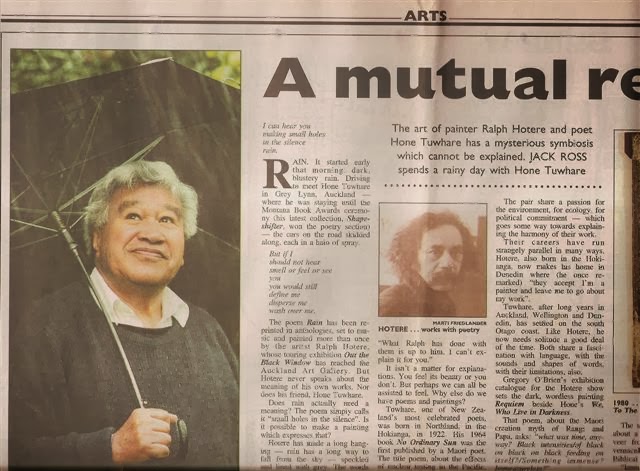
A Mutual Respect: Hotere and Tuwhare (1998)


Sunday Star-Times (2/8/98)

A Mutual Respect:
Ralph Hotere and Hone Tuwhare

Hotere: Out the Black Window. Ralph Hotere’s Work with New Zealand Poets. Auckland Art Gallery / Toi o Tāmaki, 4 July – 9 September.


I can hear you
making small holes
in the silence
rain.


Rain. It started early that morning: dark, blustery rain. As I drove to meet Hone Tuwhare in Grey Lynn, where he was staying until the Montana Book Awards ceremony (his latest collection, Shape-shifter, won the poetry section this year), I could barely see the other cars on the road. They skidded along, each in their own halo of spray.
But if I
should not hear
smell or feel or see
you

you would still
define me
disperse me
wash over me

The poem “Rain” has been reprinted in anthologies, set to music, and painted more than once by the artist Ralph Hotere, whose touring exhibition Out the Black Window is now on show in the Auckland Art Gallery. But Hotere never speaks about the meaning of his own works. Nor, I soon discovered, does his friend, Hone Tuwhare.

Does rain actually need a meaning? The poem simply calls it “small holes in the silence.” Is it possible to make a painting which expresses that? Ralph Hotere has made a long hanging – rain has a long way to fall from the sky – speckled and lined with grey. The words of the poem, at the bottom, are scrawled, stencilled, smudged in a series of different letterings.

“Every time he’s used something of mine the poems were written first,” Hone told me. “What Ralph has done with them is up to him. I can’t explain it for you.” I can’t explain it either. It isn’t really a matter for explanations. You feel its beauty or you don’t. But perhaps we can all be assisted to feel. Why else do we have poems and paintings?

Hone Tuwhare, one of New Zealand’s most celebrated poets, was born in Northland, in the Hokianga, in 1922. His 1964 book No Ordinary Sun was the first ever published by a Maori poet. The title-poem, about the effects of nuclear testing in the Pacific, is the subject of another memorable painting in Hotere’s exhibition.

“He’s one of our most political painters,” Hone said. “I’ve always respected him for that.” The two men share a passion for the environment, for ecology, for political commitment, which goes some way towards explaining the harmony of their work.

Their two careers have run strangely parallel in many ways. Hotere, also born in the Hokianga, now makes his home in Dunedin where (he once remarked) “they accept that I’m a painter and leave me to go about my work.” Hone, after long years in Auckland, Wellington, Dunedin, has settled on the South Otago coast. Like Hotere, he now needs solitude a good deal of the time. Both artists share a fascination with language, with the sounds and shapes of words – with their limitations, also.

Gregory O’Brien’s exhibition catalogue for the Hotere show sets the dark, wordless painting “Requiem” beside Hone’s “We, Who Live in Darkness.” That poem, about the Maori creation myth of Rangi and Papa, asks “what was time, anyway? Black intensities / of black on black on black feeding on itself? / Something immense? Immeasureless?”

As Hone read the poem aloud to me (his usual response to any question about them), he paused on the last word. “‘Immeasureless’ isn’t correct, they tell me – not good grammar.” The same thing has been said about a lot of his poems. They veer from pub language, Kiwi vernacular, to Shakespearean or Biblical rhetoric.

“Immeasureless” does stop us short, make us think about those “intensities of black on black” – the same blackness brooding in the heart of Hotere’s painting. In the poem “Hotere,” Hone said:
… when you score a superb orange
circle on a purple thought-base
I shake my head and say: hell, what
is this thing called aroha

Like, I’m euchred, man. I’m eclipsed?

The language is careful, precise – but local. That question mark at the end is not, Hone remarked to me, to show doubt, but because “Kiwi kids always go up at the end of a sentence.”

“I thought he’d hate the poem. But when he saw it he really liked it; he wanted to use it in his exhibition.”

We live in a dark world: “a visual kind of starvation,” as Hone puts it. South Africa, the Springbok tour, the French nuclear tests, the Aramoana smelter, these are some of the issues which Hone and Hotere have dealt with together. Hotere paints on old bits of corrugated iron and canvas which have been discarded as rubbish; Hone writes, at times, in a kind of disposable street language. Perhaps what they finally have in common is that they are trying to salvage something for us. And not all the paintings are black.

As I ended my long conversation with Hone Tuwhare he pressed a bottle of wine on me as a parting gift. “Are you sure?” I asked, uncertain. “It’s a koha,” he said, “for aroha.” Read his poems; look at Ralph’s pictures. What is this thing called aroha?


(16/7/98)

Sunday Star-Times (August 2, 1998): F7.

[857 wds]


Sunday Star-Times (2/8/98)


•


Thursday

Titanic (1998)


Pander 4 (Winter 1998)


Titanic, directed and written by James Cameron – with Leonardo di Caprio, Kate Winslett, Billy Zane, Kathy Bates – (USA, 1997).


James Cameron, dir.: Titanic (1997)


Third thoughts on Titanic … No, I haven’t been to see it three times – I leave that to moony girls in Language Schools. Twice, though, that seems not excessive. After all, it has ceased to be a film and become a cultural phenomenon.

I went to see it first in the middle of December last year, and this is what I find written in my diary under that date:
“So is it a colossal, floating turkey? It’s tempting simply to reply ‘yes’ and leave it at that, but it’s perhaps too facile a response. The love-triangle is mawkish and silly, with Billy Zane posturing like any Dion Boucicault Sir Jasper (“So, my proud beauty!”), and the principals doing a strange reprise of Cruise and Kidman in Home and Away. Yet there are moments of undoubted awe and grandeur in it – not so much the special effects as the little scenes like the father putting his child in a boat: “There’ll be another boat for daddies later on,” which have a kind of grave sentimental majesty about them. And then there’s poor Jack freezing in the water – for a moment his pale face and blackened lips take us back to the days of the silent screen: Way Down East – that scene with the ice-floes and the waterfall. When it’s good, it’s in that silent movie way. But those who are describing James Cameron as Cecil B. DeMille redivivus have a point. There’s more of DeMille than of D. W. Griffiths in it, unfortunately. Nor does it really end there. The Titanic was an unlucky ship. It remains to be seen if this is an unlucky film, but the sheer scale of the production certainly echoes the hubris of those shipbuilders of long ago. As Hardy put it at the time:

What does this vaingloriousness down here?”

Well, don’t I have egg on my face! As the film slowly bumbled its way from box-office phenomenon to critical acclaim, from Golden Globes to Oscars, I began to think that maybe I wasn’t such hot shit as a prophet after all. So I went back to see it again.

Undeniably, it has charm. Nobody does any acting to speak of, but then they don’t really have to. In a sense, the less you expect of it, the more it delivers. Unless he’s forgotten how recently, diCaprio can act (Gilbert Grape, This Boy’s Life), and Kate Winslet is of course a genius, but here they’re basically used as props (I do love that scene with her sloshing through the corridor with axe held high – she looks so intrepid and absurd at the same time).

Of course, we’ve seen these big films before: Dances with Wolves, The Last Emperor. They clean up, then they go away. It was Billy Wilder who reminded us that nobody ever said: “Hey, let’s go and see that movie. I hear it came in under budget!”

Is there any more to it than that? More to it than that mawkish moment at the Oscars when Cameron claimed a milli-second’s silence for the victims of the catastrophe? For a moment it grasps at dignity – it gestures towards Orphans of the Storm. It contents itself, finally, with The Ten Commandments, but maybe that’s not altogether a bad thing.


(4/98)

Pander 4 (1998): 10.

[564 wds]


Pander 4 (1998)


•


Wednesday

Fairy Tale: A True Story (1998)


Pander 4 (Winter 1998)


Fairy Tale: A True Story, directed by Charles Sturridge, screenplay by Ernie Cantreras, music by Zbigniew Preisner – with Florence Hoath, Elizabeth Avon, Phoebe Nicholls, Paul McGann, Peter O’Toole – (UK, 1997).


Charles Sturridge, ed.: Fairy Tale: A True Story (1997)


The ghastliness of the trailer has to be seen to be believed – gossamer-winged fairies flying in all directions, buffoons falling in streams, Yankish voices braying vile calumnies. It’s enough to put off anyone except desperate parents in the middle of the school holidays. What happens if you actually go and see the film?

About half an hour in, my companion leant across to me and whispered “This is really good!” Later still, “I’m enjoying this.” The smoky sepia-tones of the photography, the sure grasp of narrative line, the delicacy of the storytelling – territory where one foot wrong can never be recovered – seemed to be adding up to something truly extraordinary. Then, as the last vista faded out, all was explained. The single phrase “Charles Sturridge” came up on the screen.

No, you may not remember the name, but the man who directed “Brideshead Revisited” is no slouch with the camera. More to the point, I was privileged to attend the première of his film A Handful of Dust (remembered best, I suppose, for launching the career of Kristin Scott Thomas) in 1987. The man himself was there, and in the discussion afterwards, showed impressive good humour and intelligence (unlike David Hare, whose Paris by Night I had gone to the week before – when a hearty Glaswegian in the audience suggested retitling it “Naked Tory,” he could only gasp and splutter in reply). Someone tried to put Charles similarly on the spot by asking him why English filmmakers were stuck in a rut of Evelyn Waugh and E. M. Forster adaptations. “Well, that’s because American studios will pay us to make them,” he replied. “If they’d pay for more contemporary films, I’d make those instead.” He went on to explain the facts of life very kindly and simply.

Nor were these hollow words. Any of you who had the misfortune to see the film Aria, which consisted of a series of short segments by famous directors inspired by operatic arias (most of which seemed to show naked blondes killing themselves), will remember one masterly sequence in black and white showing a group of children stealing a car for a joyride. Charles Sturridge again. The man can do anything.

Retelling the story of the Cottingley fairies puts his abilities to the test, though. It is, on the face of it, not promising material for a screenplay. In most accounts Sir Arthur Conan Doyle shows up as (at best) a credulous buffoon, (at worst) a crass vulgarian; the girls as designing little minxes; and the rest of the world as fools. Ernie Cantreras, author of the screenplay, chooses first of all to emphasise the context.

We are deep in the First World War, and spiritualism is flourishing as never before – it is a world of Theosophists, Mons angels, and grieving parents. On one side we have the master illusionist, Harry Houdini (played with his usual protean efficiency by Harvey Keitel), intent on exposing fakes. On the other we have Conan Doyle (Peter O’Toole), deep in mourning for his own son, dead on the Somme, who has put his immense reputation as the creator of Sherlock Holmes into the cause of anti-materialism.

The first of many electrifying moments occurs when Phoebe Nicholls, mother of twelve-year-old Iris and aunt of eight-year-old Frances comes home in tears from a futile meeting to find the first of the famous photographs lying on the kitchen table. The girls flee in terror, her husband (Paul McGann), convinced that the pictures must be fakes, tries to head her off. How will she react? We expect rage, hysteria, indignation. Instead, her face lights up with joy. We see at once the need she has to believe in the possibility of seeing her dead son once again.

The subtlety of this (and of the film as a whole) requires some analysis to be understood, little to be felt. On the one hand, it justifies the girls’ deceit – they did it for her. Nor are the photos really fakes, as they are both convinced that they do see fairies down by the beck (so do we). Nor is she is not stereotypically credulous. Only after various experts have denounced the possibility of photographic trickery does she finally admit full belief.

The way in which the film explains how the photographs were taken is also a masterpiece of cinematic rhetoric. Three scenes are intercut: the father’s chess game against an allegedly “mute” opponent; Houdini’s escape from the tank of water he is suspended in; and the wicked reporter Ferret’s burglarising the family house. Game, escape, and come-uppance are achieved simultaneously in such a way as to tell us both how the fake was done, and why the news did not come out till fifty years later. It must be seen to be believed.

My sole criticism of this film which (for me) moves immediately to the status of children’s classic, alongside Baron Munchausen and Tiger Bay, consists of asking what audience it is really intended for. It is a great film about children (like A High Wind in Jamaica), but is not really for them. The inclusion of fairies is almost the only concession to viewers who cannot appreciate the social history of the epoch, and that probably rules out many of the rest of us as well. I loved it. I fear it will not make Charles Sturridge a household name. Please, someone, let him keep on making films like this one.


(4/98)

Pander 4 (1998): 10.

[939 wds]


Pander 4 (1998)


•