Showing posts with label Landfall Review Online. Show all posts

Sunday

Pastoral Care (2026)


Landfall Review Online

But Baby, I Love You


John Prins. Pastoral Care. ISBN 978-1-99134810-4. Landfall Tauraka short story series. Dunedin: Otago University Press, 2025. 246 pp. RRP: $35.00.


John Prins: Pastoral Care (2025)


Leon Edel once claimed that in Henry James’s first (seldom-reprinted) novel Watch and Ward (1871):
His fault was that of most first-novelists: he tried to cram all his future performances into the single work; and he achieved a fiction rich in thematic material and overstuffed in performance.
And yet, as Edel concedes: ‘it shows us the artist, working within a literary tradition, grasping his form, and in possession of a verbal ear that will give him a transcendent style.’

John Prins’ first book Pastoral Care is not a novel, but a collection of short stories. The eponymous novella which takes up more than half of its length might justify the comparison, however.

Not that there’s anything particularly Jamesian in Prins’ approach to fiction. There’s quite a range of styles on exhibition here, from the epigrammatic precision of ‘Lake Pukaki’ to the gentler ironies of ‘Rapture.’

Certainly I have my favourites among them. ‘Lake Pukaki,’ for me, is just a bit too polished. The situation it records is both absurd and tragicomic, but it leaves me wanting to clap more than sniff away a tear or suppress a guffaw. Maybe it needs to relax a bit, to insinuate itself into the audience’s consciousness without quite so much epigrammatic wit. But others may well disagree.

‘Rapture,’ though (perhaps for personal reasons) seems triumphantly successful to me. Perhaps you have to be brought up religious to see the humour in a protagonist who’s constantly having to balance her strange attraction to her friend Lucy and the incessant demands of God:
Mara felt Lucy was created in God’s image, and that a shared magnetic consciousness existed between them. Next time they passed too close to one another, there would be a collision.
The ending, too, is exquisitely apt. I don’t want to include too many plot-spoilers in here, but the combination here of earthly emergency and possible divine agency is both funny and poignant: one of the things that Prins does best.

The press release for his book accuses him of setting out to reinvigorate the ‘tradition of social realism in New Zealand short fiction.’ There’s something in that, I suppose. Certainly there are no metafictional attempts to break the fourth wall – nor do any angels (or demons) pay a visit. I think he’s set out to record the world as he sees it, with imagination and vigour, and further attempts to supply a typology at this point in his artistic trajectory would probably be premature.

Who, after all, could have intuited The Portrait of a Lady – or, more to the point, What Maisie Knew – from the more conventional plot mechanics of Watch and Ward? And yet, as Edel reminds us, we can find there the kernels of much of his later imagery: an old lady with a ‘green shade over her eyes’, for instance, who will reappear to much greater purpose in The Aspern Papers.

What’s most fascinating to me about Prins’ book is to see, in its other eight stories, so many tropes and ideas which reappear in the novella ‘Pastoral Care’.

Take, for instance, his fictional poet Bernard Jane, author of the collection But Baby, I Love You. In the story of that title, an unscrupulous publisher has persuaded Jane to recast a set of poems inspired by his overwhelming love for his newborn son so as if they were ‘addressing a romantic lover.’
Bernard was curious, then disturbed. The publisher calculated sales projections and it was a no-brainer. Domesticity, childcare, and the awe inspired by fatherhood were not profitable in 1983. They would sell three times as many books filled with machismo and sexual innuendo.
There’s a certain willing suspension of disbelief required to entertain the notion that any New Zealand poet could make enough from the sales of their latest poetry collection to provide for their family, ‘and feed them, and keep them warm,’ but the conceit of the story is that Jane is a kind of James K. Baxter / Sam Hunt / Glenn Colquhoun combo whose every word is treasured by his contemporaries – even those in the ‘literary scene’ he so despises:
You mean all those writers whose every story ends at the beach, or in the water, and who’re unable to write a metaphor that isn’t a bird, or a tree, or a river, and whose self-deprecation is nothing more than thinly veiled self-loathing. That literary scene?
It’s an odd story. It seems to hinge on the idea that lying about the nature of your poems is okay if it makes you some cash, and yet that it’s all those other dully nationalist writers who should be denigrated as sold-out hacks. It doesn’t quite compute. As Jane himself is honest enough to admit at the opening of the story, ‘There was so much to be ashamed of.’

Reading ‘Pastoral Care,’ however, the connections with ‘But Baby, I Love You’ really start to bear fruit.

Paul Whelan, its protagonist, has a lot in common with Bernard Jane. They’re both reluctant, put-upon fathers, and long descriptions of domestic lack-of-bliss dominate the opening sections of both narratives. Paul, however, is an English teacher rather than a writer, and his principal literary idol appears to be – Bernard Jane.

There’s a long, agonising description of one of Paul’s lessons, where he attempts to get his class to pay attention to the minutiae of a Jane poem entitled – you guessed it! – ‘But Baby, I Love You.’ I have to say that I’m with the kids in the class on this one. Even after I’d looked up the word ‘Domp’ [Delayed Onset Muscle Pain] it was rather difficult to fathom.

It didn’t help that Paul was trying to get them to read it as a poem about romantic love, while reserving till Monday the ‘bombshell’ that it was ‘actually a poem about Bernard Jane’s newborn son.’

Paul’s lesson is a disaster. It isn’t helped by an old black-and-white clip of Bernard Jane himself pontificating about the dreadful responsibility of having been declared ‘the Father of the Nation’ by a Landfall-lookalike called Framework magazine.

But then, that’s presumably the point of the passage: to puncture Paul’s conceit, his conviction that he’s controlling the class and their reactions to him, when in fact they’re barely tolerating him. Bernard Jane is a particularly bad role model for him, because his example encourages the kind of top-lofty nonsense which gets Paul into so much appalling trouble during the story.

The first, most important criterion of any story must be: Does it keep you reading? ‘Pastoral Care’ kept me reading – with a vengeance. I couldn’t put it down. That was not really the case with the earlier stories in the collection. I enjoyed them all: some very much, but they didn’t exactly compel me (with the possible exception of ‘Rapture’).

Waiting for the hideous denouement looming for Paul at the end of his catalogue of disasters felt a little like watching David Brent crash and burn in The Office. No warnings, no words-to-the-wise can turn Paul aside from getting drunk with his favourite actor (a sort of Sam Neill clone called Owen Durham); then provoking an absurd affray with some of his stroppier students at an afterparty, which ends with him soaked and humiliated in their swimming pool, having drowned the wrong phone: not the one belonging to the student who played him their mocking videos of him, but (alas) his own.

I galloped through Prins’ pages as if on steroids, longing for some kind of an end to these terrible blows to poor Paul’s self-esteem. Maybe you have to have been, at some point, a teacher to empathise with him fully, but I’m not sure. I suspect any reader would be drawn in by this slow-motion car crash.

But then he goes soft on us at the end!
Paul asked if Anne [his head teacher] knew anything about what had happened at the Vlassitches’. She did, she told him, and it was all a big nothing.
All a big nothing! Actually she’s asked in the big hung-over buffoon to see if he’d be willing to act as head of English for them next year.

I, you, every reader that ever lived, was surely expecting Paul’s little racket to be rumbled: all the dreadful, embarrassing mistakes he’d committed during this day from hell to be rained on with fire and brimstone from on high. But John Prins decided otherwise. He let his hero off with a warning. Now isn’t that a whole lot better than ending your story ‘at the beach, or in the water’, or else with a metaphorical ‘bird, or a tree, or a river’?

The novella seems to me a great length for Prins. It allows him the scope to develop his characters, and yet forbids too many tangents. It’s not that he isn’t good at short stories: he is – very good. But ‘Pastoral Care’ is an accomplished, fully-formed, completely focussed piece of work. I liked it a lot. It leaves me eager to read more by this writer.


Time Out, Mt Eden: Pastoral Care booklaunch (29/8/25)
l-to-r: Sue Wootton, John Prins, Isabel Haarhaus


(30/12/25-3/1/26)

Landfall Review Online (2026).
[Available at: https://landfallreview.com/but-baby-i-love-you/]

[1504 wds]


Landfall 1 (1947)


Thursday

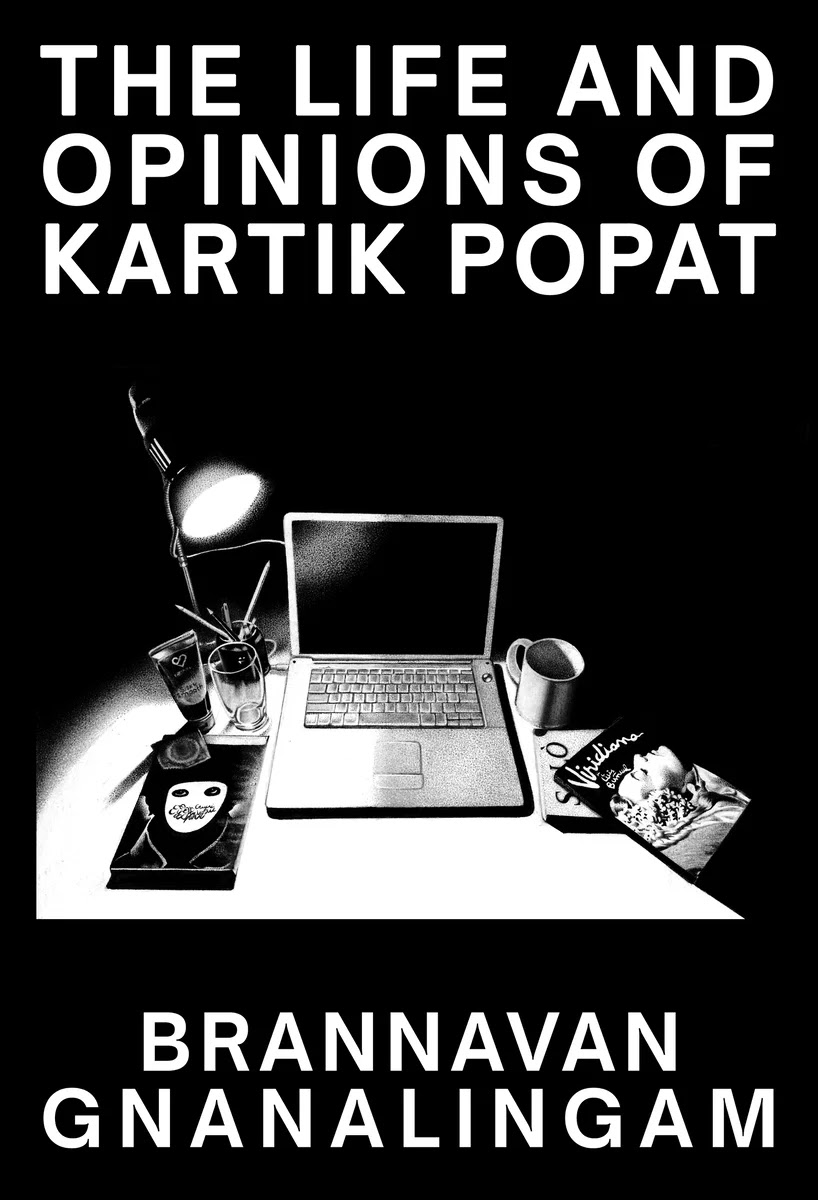
The Life and Opinions of Kartik Popat (2025)


Brannavan Gnanalingam. The Life and Opinions of Kartik Popat. ISBN 978-0473725976. Wellington: Lawrence & Gibson Publishing Collective, 2024. 297 pp. RRP: $30.00.


Brannavan Gnanalingam: The Life and Opinions of Kartik Popat (2024)


This is certainly a very timely book. At a moment when bizarre political twists and turns come so fast that we can hardly keep up with the craziness, a backwards look at the origin stories of certain such social-media-driven ideologies might well come in handy for all of us.

It’s a timely book, but it’s also a book about time. The first chapter is dated 1984, and the last 2024. The first is called “I’ve Been Writing” and the last “I’ve Been Thinking.” For older readers, at least, that triggers a little trip down memory lane to the titles of Richard Prebble’s infamous 1996 and 1999 ACT manifestos.

Brannavan Gnanalingam, too, has been writing. In the fourteen years since the publication of his first novel, called (appropriately) Getting Under Sail (2011) he’s completed another seven: an impressive total by any standards.

Like the protagonist of V. S. Naipaul’s debut novel The Mystic Masseur (1957) – the cautionary tale of a thwarted Trinidadian writer who exploits the gullibility of his celebrity clients to climb the social totem pole – Kartik Popat, Gnanalingam’s own anti-hero, also begins as a “creative” of sorts.

Popat’s thwarted ambitions as a film-maker, centred around his projected feature film And Jack, are gradually eroded away by the ever more effective prostitution of his talents by, first, the New Zealand political establishment; second, the anti-Vaxxer movement. (And, if we hadn’t already suspected the fact, Gnanalingam informs us in his bio-note that And Jack is the title of a real 2004 short film, “written and directed by Brannavan Gnanalingam, Jonny Thompson, and Steve Wakeem”).

This autobiographical note seems inextricable from his writing. Each of his first seven novels appears to have been based on a particular period in the author’s life: Getting Under Sail on a trip from Morocco to Ghana (which included being detained as a murder suspect); You Should Have Come Here When You Were Not Here (2013) on his time in Paris between 2012 and 2013; Credit in the Straight World (2015), the first of his books to be set in New Zealand, on the global financial crisis as seen from down under. And so on.

Again and again I felt these uncomfortable rhymes with experience as Gnanalingam/Popat forced me to relive Helen Clark’s painful last years in the Beehive; the rise of the “smiling assassin”, John Key; and the ghastly death throes of Jacinda Ardern’s coalition of kindness. You can’t take even the most tangential interest in New Zealand politics and not find your worst suspicions about our elected representatives thoroughly vindicated by Popat’s half-hearted Apologia pro Vita Sua.

However, it’s the pitiless grimness of Popat’s early years, bullied and despised at High School without the slightest prospect of reprieve from the dungeon of ethnicity, which really ring true. It was, admittedly, a long time ago. Change is possible. I’m sure there’s even more kneejerk racism on display now than during Popat’s miserable childhood.

Which brings us neatly to the question of what exactly Gnanalingam is seeking to achieve with this novel. He’s explained in some detail in a Spinoff article the moment of inspiration when he watched an Indian American podcast host (and former Republican presidential candidate) interviewing a notoriously racist influencer, a white woman, who began by praising him for being so “articulate”:
“I guess I can call you ‘articulate’ because you’re not an American black.”
After they had a good old yuck at the idea of such an obvious oxymoron, she threw in the kicker: “But I still would not have voted for you, because you’re an Indian.”

As Gnanalingam explains in his article:
you can grease up to racist folks by doing some of the heavy lifting for them, but they’ll still never view you as one of them. You’re just the hired help. And they’ll still view you as a loser. …

I wanted to capture this ugliness in my novel, grift off the grift, and imagine a New Zealand equivalent. Presumably mocking other minorities must be rewarding in its own way (putting aside the societal impacts) – power, money, royalties from tank-top sales, and kudos from the worst people who’d discard you the moment they don’t need you – and all you have to pay is your self-respect.
Perhaps the question Gnanalingam’s novel sets out to answer, then, is: How do you get from here to there? How do you start off as a proud child, shaped by community and family values, and turn into a grovelling toady for the modern day equivalent of slave-owners? It’s certainly a tricky one.

A straightforward first person life-and-times narrative must have seemed the obvious approach. But there are problems as well as advantages with that form. The Mystic Masseur, for instance, is not told in the first person. Its eponymous protagonist is observed from a discreet distance by a very judgmental contemporary (who sounds, strangely enough, a lot like Naipaul himself).

The apparent focus of Kartik’s tale is himself, his struggles, all the appalling people he’s met, virtually all of whom seem to have betrayed him in some way. The real focus is (I presume) supposed to be the morally bankrupt, self-serving nature of his story.

The ever more degrading compromises he makes in the desperate quest to be accepted by the complacent reactionary racist society around him – which lead him eventually to posting off packages of multi-vitamins as Covid remedies at the height of the Pandemic, and even renting an (admittedly unoccupied) tent in the anti-vax encampment in Wellington – are chronicled by Popat / Gnalalingam in grim detail.

“There need never, at the worst, be any difficulty about the things advantageously chuckable for art,” said Henry James. Gnalalingam has, understandably, chucked out little – certainly none of the rage and disgust he still feels at the self-satisfied complacency of Pākehā society. This is something (I would guess) that he experienced continuously as a child, and no doubt still experiences to this day.

It's not that this is bad material, by any means. On the contrary, the trouble is that it’s too interesting. My fascination with Popat’s early life and humiliations far outweighed any indignation I felt down the track at his anti-vaxxer shenanigans.

And given how little of the book is actually devoted to his final incarnation as an online stirrer and random conduit of contradictory misinformation, it’s not surprising that it’s the vomiting subhuman MPs he was forced to serve as a parliamentary staffer who remain the truly unforgettable parts of his story. Popat himself begins to fade to a mere reporter on their infamy.

Satire is a particularly demanding form in this respect. It’s not by accident that its most effective examples exhibit a kind of meme-like intensity: Jonathan Swift’s cartoonish Lilliputians and Brobdingnagians, for instance; or Evelyn Waugh’s battling war correspondents in Scoop. These are not subtle narratives, by any means, but they’re effective because of the burning indignation which compels each brutal line.

Swift, Waugh, Orwell had something vital to say, and they said it in the shortest, most telling way possible. Is the same true of Gnanalingam? His own political satire seems to me to lack the necessary counterbalance of a moral centre. Unlike Swift – or, for that matter, Laurence Sterne, whose Life and Opinions of Tristram Shandy presumably inspired his title – he leaves us with nothing to believe in.

So, in the absence of anything to hold to in the amoral vacuum that is the world of Kartik Popat (or, if you prefer, of contemporary New Zealand), we’re left only with the narrator himself. It’s not that it’s possible to love – let alone respect – Kartik Popat (or “Pooh-pat” or “Tikka”, as he’s variously nicknamed), but it’s easy enough to understand and even (at times) empathise with him.

His own analysis of his surroundings is, always, fatally flawed by the basic futility of his desire to fit in: “fit in” with a bunch of subhuman cretins, limned with all the bitterness of experience. But then that, too, is a profoundly human trait. Nor is his inconclusive ending – a new job as an insurance adjustor with instructions to deny as many storm-claims as possible – exactly calculated to enlighten us. It’s always someone else’s agenda he’s following.

Popat may well be a figure for our times – I fear that he is – but unfortunately that doesn’t make the novel he stars in as coherent as it could have been. For all its many undoubted merits, it’s too inclusive: too detailed in some places, too summary in others.

However, even if it’s not be quite the taut, targeted satire it set out to be, The Life and Opinions of Kartik Popat is still an invaluable chronicle of “the time of our time” (to borrow a phrase from that great Satan, Norman Mailer). There are some scenes here I doubt I’ll ever be able to scrub out of my memory no matter how hard I try.


(13-22/2/25)

Landfall Review Online (2025).
[Available at: https://landfallreview.com/fitting-in/]

[1506 wds]


Landfall 1 (1947)


Monday

Hard by the Cloud House (2024)


Landfall Review Online

The Whereabouts of Sinbad’s Isle


Peter Walker. Hard by the Cloud House. ISBN 978-1-99-101671-3. Auckland: Massey University Press, 2024. 288 pp. RRP: $39.95.


Peter Walker: Hard by the Cloud House (2024)

Travel writing is the least demanding of genres. You can write anything. You can write that there was nothing to write about. I could describe the croissants, of Parisian quality, on sale at the Uturoa bakery, or the Raiatean girls dancing on the backs of beflowered lorries on Bastille Day, or the strange sensation, crossing a glass-floored fale in the middle of the night and seeing coloured fish dart beneath your feet as in a diagram of the unconscious.
Depending on your temperament, you may find this description of travel writing - 'You can write anything' - reassuring or a little ominous. In any case, I suspect it was wise of Peter Walker to postpone it to the last of the three sections of his book. What is this book about, anyway? It begins with a richly detailed account of the discovery and various scientific controversies surrounding Te Hokioi, or 'Haast’s Eagle' (Hieraaetus moorei). This is popular science writing of the first order: as good as anything by Richard Dawkins or Stephen Jay Gould.

We learn here of the pronounced lack of interest in this raptor when researchers thought it must have been too ungainly to fly and thus condemned to hop about scavenging any small creatures too slow to outrun it. Now that this opinion has been overturned – by most experts, at least – its remains are again in high demand. So much for scientific objectivity.

The second section is dominated by history. What begins as a discussion of one possible locale for the depredations of this monstrous eagle – now also identified with the pouākai of Māori legend – morphs into a chilling account of the brutal and rapacious acquisition of the Canterbury Plains by a series of villains headed by Governor Grey himself. Again: riveting stuff: something I certainly should have known about, but have to confess that I didn’t, certainly not in such detail.

After that, in the third section, we stray into personal history or even allegory. The contention that Haast’s eagle may be the original of the 'Roc', or 'Rukh', or 'Rukhkh' of Islamic legend – writer and explorer Richard Burton gives all three of these as possible spellings in the notes to his exhaustive sixteen-volume 1885 translation of the Arabian Nights – is a bold one, to say the least. Walker, however, not content with this, suggests that it may also have inspired the Garuda bird of Indian and South East Asian folklore.

Indeed, as he morphs into a discussion of Te Hokioi’s possible associations with the Korotangi – a mysterious serpentine-stone bird carving discovered in the roots of a mānuka tree on the shores of the Aotea Harbour, near Kawhia, in 1878 – it gradually becomes apparent that this section is not meant to be read in quite the same way as first two parts of the book.

One could see this three-part structure simply as an attempt to impose order on an unruly collection of materials, gathered over decades, and now needing to be fixed in final form between two covers. I’d prefer, however, to follow the lead of Peter Walker’s definition of 'travel writing', quoted above, and to see it instead as an exceptionally entertaining – and informative – contribution to that genre.

Te Hokioi is clearly a protean signifier for Walker. There’s a certain risk in conflating such disparate material, mind you: let’s call it the curse of the Da Vinci Code. The single source for virtually all his Islamic and pre-Islamic learning, as Walker admits, is an essay entitled “The Rukhkh, Giant Eagle of the Southern Seas,” by A. D. H. Bivar, professor of Iranian Studies at London University, an essay included in a 2009 volume called Exegisti monumenta: Festschrift in Honour of Nicholas Sims-Williams. Bivar’s essay is only ten pages long, and 'it made no waves, as far as I knew ... And yet to state the whereabouts of Sinbad’s Isle, where so many had travelled in mind over the centuries … Perhaps there was some flaw in the argument which I couldn’t see.'

To summarise a long and (to my mind) somewhat fanciful yarn, Peter Walker claims Prof. Bivar’s reading of mediaeval Arab traveller “Ibn Battuta’s 42-day voyage in the late 1340s far out into the Pacific, where he thought he saw the Rukh [my emphasis], made a sighting of the New Zealand coast by earlier Arab mariners, and therefore an encounter with Harpagornis [Haast’s Eagle], seem feasible':
'It is my understanding that historians of New Zealand are generally sceptical of such visits,' Bivar writes, 'yet Arab accounts of the Rukhkh suggest that occasional visits of this kind did take place, since only there could a veritable giant eagle have been encountered'.
Bivar’s contention that virtually any Middle or Far-Eastern tradition of a 'great, winged raptor … the Griffin, the Anqa, the Rukh, the Simurgh of the Persians' seems likely to encode an encounter with Haast’s eagle, does sound – on the surface, at any rate – a little like Gavin Menzies’ claim, in his best-selling book 1421: The Year China Discovered the World (2002), that 'the fleets of Chinese Admiral Zheng He visited the Americas prior to European explorer Christopher Columbus in 1492, and that the same fleet circumnavigated the globe a century before the expedition of Ferdinand Magellan.' Bivar’s view is, after all, as Walker admits, based on a 'simple insight' as compelling as Menzies’ obsession with the great Ming treasure fleet: 'The Rukhkh always seems to have been located in the China Seas.'

He’s careful to elucidate that 'in Arab and Persian geography of the Middle Ages, "the China Seas" meant the part of the great encircling ocean which lies to the east of China: in other words the Pacific.' A pretty wide-reaching index of location, one would have to say. Consider Burton’s own comments on Sinbad the Sailor’s famous encounter with the giant Roc during his fifth voyage:
An excellent study of Marco Polo’s Rukh was made by my learned friend the late Prof. G. G. Bianconi of Bologna, 'Dell’Uccello Ruc,' Bologna, Gamberini, 1868. Prof. Bianconi predicted that other giant birds would be found in Madagascar on the East African Coast opposite; but he died before hearing of Hildebrand’s discovery.
This reference to 'Hildebrand’s discovery' is to a giant bird’s egg (subsequently classified as Aepyornis hildebrandti) excavated in Madagascar. Its close relation the Aepyornis maximus, or Elephant bird, is quite possibly the largest bird ever to have lived. And the closest living relative to the Elephant bird is the New Zealand kiwi. So, while the two islands are a mere 11,742 km apart, situating the 'Rukh' in New Zealand rather than Madagascar is only a matter of a few months’ navigation of the Southern Pacific … The point I’m trying to suggest here is that the old 'no smoke without fire' adage – when applied to a thousand or so years of fanciful tale-spinning – can be used to justify virtually any hypothesis: in this case, the possible point of origin of a giant mythical bird.

There may be a reason, then, why New Zealand historians 'are generally sceptical' of visits by medieval Islamic mariners. Bivar’s contention that 'Arab accounts of the Rukhkh suggest that occasional visits of this kind did take place, since only there could a veritable giant eagle have been encountered [my emphasis]' is as circular an argument as I’ve ever come across: as good as anything in Dan Brown or Gavin Menzies.

There’s no physical evidence of such visits to the South Island of New Zealand (Bivar is very careful to specify the location of these non-visits). However – says Bivar – they must have taken place, because where else would they have seen the Rukhkh? Well, as I’ve mentioned above, Madagascar was the favourite locale for such sightings in the late 19th century, the age of Burton. But one of the reasons we don’t take such observations very seriously anymore is because every ancient culture I’ve ever heard of has at least one story of a giant bird.

Was Haast’s eagle also the original of the Native American Thunderbird? The Eagle of Zeus? Veðrfölnir, the hawk that sits on an eagle on top of the world tree, Yggdrasil? Is it possible that these mythical beings might have evolved without actual sightings of Te Hokioi?

My doubts about Prof. Bivar’s (I hope) playfully speculative essay is certainly not meant as a critique of Peter Walker’s book. I’ve described his intentions above as an excursus into 'personal history – or even allegory', since that’s how I read them. This whole section, after all, doubles as an elegy for his lost friend, Polynesian artist Jim Vivieaere, and their fateful joint visit to the ancient marae of Taputapuatea on the island of Raiatea.

In travel writing, after all, as Walker informs us, 'you can write anything.' I’m just afraid that his subtle fusion of genres may have strayed over a little into the tempting domains of pseudo-history in this last of his three sections. As long as he doesn’t insist on our taking it literally, though – as I’m sure he does not – what harm can there be in imagining Sinbad and his friends staring up at the pristine Southern Alps, and seeing hovering over them this most wondrous – and terrifying – of raptors?


(14/6-9/7/24)

Landfall Review Online (2024).
[Available at: https://landfallreview.com/the-whereabouts-of-sinbads-isle/]

[1535 wds]


Landfall 1 (1947)


Thursday

Shadow Worlds (2024)


Landfall Review Online

Many In that Blue Room Believed, Heart and Soul


Andrew Paul Wood. Shadow Worlds: A History of the Occult and Esoteric in New Zealand. ISBN 978-1991016379. Auckland: Massey University Press, 2023. 426 pp. RRP $65.00.


Andrew Paul Wood: Shadow Worlds (2023)


The Blue Room: Being the Absorbing Story of the Development of Voice-to-Voice Communication in BROAD LIGHT with Souls who have Passed into THE GREAT BEYOND, by Clive Chapman (Auckland: Whitcombe and Tombs Ltd., 1927) … I first came across a reference to this curious book in D. Scott Rogo and Raymond Bayless’s almost equally intriguingly titled Phone Calls from the Dead (1979). Shortly afterwards I managed to acquire a copy of it myself, and was privileged to read its long, literally “ghost-written” – by a reporter identified only as G. A. W. – account of “Uncle Clive” and his careful fostering of the clairvoyant abilities of his young niece Pearl.

The story came to an abrupt end in 1927, with the publication of Chapman & G. A. W.’s book, so I was delighted to find some supplementary details about the case in the chapter entitled “Bumps in the Night” in Andrew Paul Wood’s newly published history of the occult and esoteric in New Zealand. He records, for instance, a reference in Harry Price’s Fifty Years of Psychical Research (1939) to an incident “around 1930”, where:
William Henry Gowland (1879-1965), professor of anatomy at the University of Otago’s medical school, witnessed heavy tables levitate and a locked piano play itself.
As an Otago Daily Times reporter invited to an earlier séance said of the phenomena he saw: “If it was trickery it was damnable trickery, for there were many in that Blue Room who believed, heart and soul.”

This is perhaps the most useful feature of Wood’s book: its inclusiveness, and the fact that he’s followed up on so many intriguing details of early New Zealand occultism – as far as that’s possible in so tantalisingly ill-defined a field. Nor does he scruple to record the many occasions where the trail has run cold, and the rumours of the continued existence of some exiled order or malign coven cannot be substantiated one way or the other.

It's true that much of this data is not, in itself, particularly interesting or stimulating except to enthusiasts (or other Academic researchers). The list of changing addresses for the Dunedin Theosophical Lodge between 1914 and 2015 – recorded in detail on pp. 61-62 of the chapter devoted to this “Not-so-secret Doctrine” – is fairly typical of this aspect of Shadow Worlds. If in doubt, include it, appears to be the guiding principle – after all, it might be of use to someone – which led me to wonder, at times, if simply compiling an Encyclopaedia of New Zealand Esotericism might not have suited his (and our) purposes better?

Wood’s book is, after all, already grouped in large, roughly chronological grab-bag chapters around his basic themes: Theosophy, The Golden Dawn, Anthroposophy, Spiritualism, Witchcraft, and various others. Would further segmentation into discrete entries really have compromised it much?

Part of the problem is the very large scale – both chronological and conceptual – of the study Wood has undertaken. It’s true that he specifies in his preface:
I do not pretend this to be a comprehensive or exhaustive history of the subject – an undertaking of that sort would take many years of research and extend to multiple volumes. … What I hope this book will do is give a taste of the parallel universe of the unexpected, the strange, and the high weird that exists just beneath the New Zealand story you thought you knew.
Exhaustive, no, but certainly at times a little exhausting. It’s awe-inspiring just how much material Wood does manage to cover, especially given the necessity of giving potted histories of at least some of the major luminaries – Madam Blavatsky, Aleister Crowley, Sir Arthur Conan Doyle, Rudolf Steiner – whose doctrines had such surprising offshoots here on the other side of the world.

The truth of the matter, I suppose, is that this book only really comes to life when it touches on something directly interesting to each individual reader. In my case, this was definitely his chapter on Spiritualism, “Bumps in the Night” – but devotees of Black Magic, Rosicrucianism, or Neopaganism are likely to be similarly engrossed by the sections on their pet topics.

In any case, it’s undoubtedly better to be grateful for what we have here than to carp about the various alternative ways in which it might have been arranged. Take, for example, the following 1870 letter from the northern gold fields, quoted from The Pleasant Creek News:
I saved a claim here at the Thames through a spirit communication. It had been neglected, and was liable to be jumped, when I was told by spirit writing that six men were coming at nine o’clock the next morning on the claim to jump the ground, with other particulars of their programme. It was there with the men that I got, just in the nick of time to save the claim. The jumpers came exactly at the time I was told they would do, and they saw at once that they were completely checkmated, and looked sheepishly disappointed and as white as ghosts when they saw we were too much and too strong to be bounced by them. You can see by this that I am a Spiritist.
There’s an individuality and expressiveness in this old news item which seems to open a door on a whole other world of experience – on, in fact, the “parallel universe of the unexpected, the strange, and the high weird that exists just beneath the New Zealand story you thought you knew” promised by Wood in his opening remarks.

Again and again, his book raises new questions about the precise nature of this secret history. What on earth was going on in Hawke’s Bay in the early to mid-twentieth century, for instance?

Wood starts off with an intriguing account of the “Havelock Work,” where, sometime around 1907-8, “a peculiar brew of Quakers, Theosophists, Anglicans and adherents of Radiant Living were developing a sympathetic climate” for esoteric enlightenment, with an organisation whose activities included:
Shakespeare and Dickens readings, carving, Morris dancing lessons and festivals, climaxing in the Old Village Fête of 1911 presided over by a pantomime King Arthur and his court.
Around 1912, Golden Dawn alumnus Robert Felkin brought his own peculiar blend of Freemasonry, Rosicrucianism and occultism to Havelock North, where he founded the grandly named Smaragdum Thalasses Temple of the Stella Matutina Order. (“Stella Matutina” is perhaps most famous for its connections with the poet W. B. Yeats, a member for over 20 years).

Some land was provided by local farmers for a temple building, completed in 1915, and known locally as “Whare Rā”. Felkin continued to run it till his death in 1926, when it was taken over by his widow Harriot. It would continue to act as a centre for local occult activities – including, latterly, black magic (or “Goetia”) – until the late 1970s.
Whare Rā was eventually sold to a Roman Catholic family, who thought they were merely getting a Chapman-Taylor-designed heritage house, unsealed the door to find the vault in their basement, and were so plagued by supernatural happenings that they had an exorcism performed.
If you find it surprising that such a mélange of magic, esoteric rituals and occultist teaching was permitted to flourish in so conservative an enclave, the explanation is not difficult to find: “most of the town’s leading personages were members of the Temple.”
Membership of Whare Rā is reputed to have included members of Parliament and two governors-general.
It’s hardly surprising, then, that “there was a weekend-long bonfire when the Temple was dissolved” in 1978. No doubt it included membership lists as well as the rest of their “documentation and paraphernalia.”

This is just one of the many fascinating stories recounted in Wood’s book. It’s true that I’m left with more questions than answers about Whare Rā’s influence on local culture in the Bay, but I don’t doubt his assiduity in hunting out data and clues from a notoriously cagy group of informants (and survivors).

“Occult” and “Esoteric” are, after all, both rough synonyms for “hidden” – and exposing such knowledge to the bright light of day can be surprisingly difficult at times. Despite the fact that the shelves of libraries and second-hand bookshops are groaning with esoteric literature, its authors have a tendency to content themselves with hints and whispers rather than committing themselves to facts.

To conclude, It’s hard to imagine that anyone interested in this field will be able to get anywhere in future without a well-thumbed copy of Andrew Paul Wood’s Shadow Worlds. For myself, I’d like to end with a quote from The Blue Room, the book that started this particular quest for me:
29/3/2*. – At tea time a message came through, strong but broken, F.R. (? FLOWING ROBES), then COUNCIL OF MARS. Next, in answer to the question as to who was the sender of this strange message, I AM ERIN; THEA. While this message was being spelled out I felt a sensation as of a strong electric current passing over my head at the end of each sentence. I had never felt this before, and it gives rise to the thought that possibly Mars could open up communication with this planet by means of electric or magnetic currents controlled by our spirit friends beyond.
Why not?
Why not, indeed?


(13-25/9/23)

Landfall Review Online (2024).
[Available at: https://landfallreview.com/many-in-that-blue-room-believed-heart-and-soul/]

[1570 wds]


Landfall 1 (1947)


Friday

The Frog Prince (2023)


Landfall Review Online

A Fool in Love


James Norcliffe. The Frog Prince. ISBN 978-0143775492. Vintage. Auckland: Penguin Random House New Zealand, 2022. 302 pp. RRP $36.00.


James Norcliffe: The Frog Prince (2022)


I suppose one reason I’m fascinated by Grimms’ Fairy Tales — or, rather, the Brothers Grimm’s Kinder- und Hausmärchen (Children’s and Household Tales), very few of which are actually about fairies — is because it’s the first book I ever read from cover to cover in German. At the time, I felt it was a good choice because I was already (I thought) familiar with the formulaic language of most of the stories (Es war einmal: Once upon a time). As it turned out, though, the experience taught me something about the nature of translation, which I’ve not been able to forget since.

Even to someone with German as rudimentary as mine, the first thing that struck me was that the stories had so obviously been composed by different people. Much is made of the wholesale alterations made to the original folktales by the moralising Wilhelm (and to a lesser extent Jakob) Grimm. ‘Mothers’ become ‘stepmothers’, pregnancies and murders are elided out. Far more striking, I found, were the obvious differences in sentence structures, word choices, and the overall approach between the various narrators. And I don’t just mean the few stories printed in dialect; ‘The Fisherman and his Wife’ being the most famous example. Even the standardised German of the other tales shows unequivocal signs of these diverse voices.

But virtually all of this, I realised with a shock, was invisible in translation. It didn’t matter whether you were reading Edgar Taylor, Margaret Hunt, Ralph Manheim or Jack Zipes. In English, the stories all sounded much the same: stock fairy tales from the collective myth-kitty. In German, by contrast, they provided a little anthology of diverse idioms and cultures all lumped together under that blanket term Deutsch.

‘The Frog Prince’ is one of the most perplexing stories in the whole collection. And, since it’s usually placed at the beginning, it’s the first one most readers will encounter. Everyone’s familiar with the idea of kissing a frog so that he’ll turn into a handsome prince. It may come as a bit of a shock, then, that the princess in the original tale never does actually kiss her frog. Instead, she hurls him violently against a wall when he tries to hold her to her promise to let him sleep in her bed.

Nor, for that matter, is he a prince. The original title is Der Froschkönig oder der eiserne Heinrich (‘The Frog-king, or Iron Henry’). So, he’s actually a king. And what’s all this about Iron Henry? What’s his part in the story?

No, he’s not the same person as Eisern Hans (‘Iron John’), the protagonist of another one of the Grimms’ tales, though there are certain common features — the golden ball, the deep well — between the two narratives. That story was used as the central plank of Robert Bly’s notorious masculinity self-help book Iron John: A Book About Men. Iron Henry is a type of faithful servant whose love for his lost master is such that he’s had to enclose his heart with three iron bands to prevent it from bursting with sorrow.

One of the many virtues of poet James Norcliffe’s first adult novel — he’s already written a number of others for children and young people — is the original solution he offers to the puzzles posed by this very enigmatic story.

Or, rather, one of the characters in his book, a young woman named Cara, has written a historical novella that suggests an answer: ‘The Frog Prince’ was, in fact, a fiction created by the Heller sisters, Mathilde and Helga, to attract the attention of the pale, scholarly Jakob Grimm, whom Mathilde, the elder of the two girls, had fallen for.

The Frog King story, as we have it, however, (according to Cara) was re-edited by Jakob’s overprotective younger brother Wilhelm to convert the compassionate princess of the original into the petulant brat of the version we now read. He also, for good measure, added faithful Heinrich to the mix to symbolise his own role as a benign presence in Jakob’s life.

But that’s just the beginning of the twists and turns in James Norcliffe’s book. The main level of the narrative records the abortive love affair of two young language teachers, David and Cara, at an international school in Northern France. The enigmatic Cara, author of the novella I mentioned above, chapters of which we encounter piecemeal as we move through the narrative, has been conducting an affair with young New Zealander, David. When he finally asks her to marry him — in a graveyard, appropriately enough — she abruptly disappears:
What he had always admired as Cara’s non-judgemental nature, her refusal to gossip, he now understood as secrecy, inexplicable privacy. Of course she had joked about politicians, celebrities, but they, not being in her orbit, were not really people, only names. The closer people were to her, the less willing was she to express an opinion. These things, along with her hopes and fears, he realised he had been forced to infer. Everything was always veiled. What misguided audacity had possessed him that he had actually asked her to marry him? He didn’t know her at all.
The precise relationship between these two stories, Cara’s and David’s, unfolding side by side, is the real riddle that drives Norcliffe’s story. It’s clear all along that David is a frog of the first order: he commits virtually every tactical error a man can in pursuit of an elusive Fata Morgana. He is, by turns, jealous, possessive, self-pitying, angry, importunate and futile. He is, in short (like most of us), a fool in love.

Cara, by contrast, has been trained by her upbringing to reveal nothing that might come back to bite her. Her defences are virtually impregnable. And the moment she drops them to allow David back in, his subsequent antics serve only to vindicate her stance.

It doesn’t help that an earlier fling with the amoral art teacher Angus has left her deeply suspicious of all male motives.

So how do the various layers of Norcliffe’s fiction co-inhere (to borrow a term from Charles Williams)? The princess in the Fräulein Hellers’ concocted ‘The Frog Prince’ earns the love of her handsome prince by showing him a hint of compassion. But the petulant princess in Wilhelm’s doctored text earns marriage to her Frog King without ever deserving it. David loses his princess by asserting property rights in her child (which he wrongly assumes to be his own). Cara is left with both child and independence, but in the final pages of the book, dreams of being sucked back down into the swamp as a female frog.

There seems no obvious — or at any rate simple — message to be deduced from all this. ‘Relationships are difficult’ perhaps, or the ever popular ‘a girl needs to kiss a lot of frogs before she finds a handsome prince’.

I prefer to see it as a test of our ability as readers. If you remove or dilute the regional peculiarities of the Grimms’ so-called fairy tales — as most translators are forced to do — you’re left with a kind of Disneyfied soup. If, however, you read with such fine-grained details in mind, you may end up marvelling at the particularity of each of them. These are, after all, the particularities that make our own love stories such an endless source of puzzlement to us, as well as, hopefully, most of the time, more delight than pain.

As far as this particular slice of life is concerned, David has failed, and Cara succeeded. Mathilde Heller fails to make an impression on Jakob Grimm, and Wilhelm succeeds in keeping property rights in his brother. Without knowing what will come next in each of their stories, it will never be possible to guess who will come out as the winner and end up holding the glittering prize.

JACK ROSS is the author of four novels, four books of short fiction, and six poetry collections, most recently The Oceanic Feeling (2021). He was managing editor of Poetry New Zealand from 2014–2019 and has edited numerous other books, anthologies, and literary journals.


(19-31/1/23)

Landfall Review Online (2023).
[Available at: https://landfallreview.com/a-fool-in-love/]

[1324 wds]


Landfall 1 (1947)


Tuesday

Milk Island (2017)


Landfall Review Online

The Poetics of Planned Obsolescence


Rhydian Thomas. Milk Island. ISBN 978-0-473-39794-4. Wellington: Lawrence & Gibson Publishing Collective, 2017. 256 pp. RRP $30.00.


Rhydian Thomas: Milk Island (2017)


This is a very strange book. I like it. I like it very much. It’s fair to say that this was not always the case. When I first picked it up I found it quite difficult to force myself through the opening pages. It’s a particularly repellent set of scenes that Rhydian Thomas paints, and he does so in a kind of sub-argot of political knowingness: a distillate of hard-bitten journo and Evelyn Waugh. If it hadn’t been for a faint curiosity about the real reasons behind his protagonist Nina’s presence in ‘the funfair of Kiwiana … the core of Kaikōura’s rebuilt civic centre’, I might not even have persevered with it. That would have been a mistake.

The year is 2023. Milk Island is the new name for the South Island, rebuilt by private corporate interests after the disastrous earthquakes of 2018. ‘We were in the shit last year for referring to Milk Island as a “correctional facility”,’ remarks one broadcaster early in the book. ‘I usually call it: a suite of public-private correctional, agricultural and tourist initiatives,’ replies another.

The opening section of the novel, ‘Witness’, climaxes in a terrifying account of a New Right theme park, full of bizarre references to minor political events of the past couple of decades (a ‘too-fast limo ride’ in reference to Helen Clark’s not-particularly infamous faux pas; a ‘man dressed as Stalin who suddenly appeared at the end of the hall, mumbling to himself: “Five New Taxes … Nanny State … more communist ISIS death-camps”’, and so on).

What struck me most about this first of the four stories that make up Thomas’s novel, was the element of planned obsolescence in all this. Setting your eco-catastrophe one year from your narrative’s publication practically guarantees it will go out of date almost immediately (even Orwell allowed himself 35 years for his ‘prophecies’ about 1984 to be fulfilled). Also, it’s hard to imagine anyone not from New Zealand – what’s more, anyone not obsessed with virtually every detail of local pop-culture, politics and day-to-day trivia – even being able to follow some of the more intricately knowing riffs indulged in by Thomas’s characters.

This must be deliberate. How would anyone not from around here, for instance, be able to make any sense – to take one obvious example – of the endless references to ‘Sir’ Richie McCaw (the Mock-McCaw-spunk milkshakes on sale at the Kiwiana funpark, the constant speculations about the effect of security camera footage of supermarket flirtations on his love life)?

So what is the point of this book? Is it anything more than a spewed paroxysm of rage at the ignorant imbecility of Kiwi Kulture in general? So expert a ventriloquist is Thomas that it would be possible for someone who had read only Part One of his book to see him as just one more left-leaning political satirist, a few steps above the media hacks he satirises but essentially of their column-writing genus. Which is where the true brilliance of his book kicks in.

The second section is narrated in the voice of a prisoner locked up in the vast private-enterprise penitentiary that now appears to occupy much of what once was Christchurch. Not since Jean Genet’s early poem ‘Le condamné à mort’ (‘The Man on Death Row’) has there been anything quite like this strange half-poem/half-rave. And, while Genet had the advantage of writing from inside the belly of the beast, at least his prisoner had the consolation of not being comforted in his despair by a virtual simulacrum of Billy T. James.

Horror and pain without dignity: that is the dominant note in the book up to this point, and certainly an impatient reader (or, for that matter, an unsympathetic reviewer) might remark that little of the pleasure principle has leaked through its pages so far.

The third section, depicting the woes of one of the pettier capitalist entrepreneurs leasing space at this prison, is similarly lacking in the milk of human kindness, though it does contain a fascinating set of instructions on how to smear the reputation of a political opponent with a few cunning keystrokes in the digital age.

But if the book has been gradually moving from a jazzed-up version of Waugh’s Scoop to similarly syncopated updates of Genet and American Psycho, we break through, finally, in ‘@HUTRUNNER’, the last section, to something closer to the prophetic books of Blake. The sheer outrage and horror at the environmental devastation perpetrated on our country by the giant collective pig farms reaches almost apocalyptic levels here.

Nina is back, her mask has slipped off, and she ranges the land like a latter-day Kwai Chang Caine, tweeting images and film-clips of the brutishness she sees, until the narrative’s final consummation: the meeting of the eco-terror-journalist with the nation’s literal sacred cow, Milky Moo herself.

The blurb for Milk Island describes it as ‘absurd and unhelpful’ and ‘100% pure fiction’. Both claims are untrue. Anyone courageous enough to persevere through its merciless pages will find a lot more than a Green Party election manifesto here. There’s no doubt that Rhydian Thomas has ‘a dark turn of mind’ (to quote from the HBO series Deadwood), but his book is not pointless, nor (unfortunately) can I even persuade myself that his concerns are particularly time-bound.

He’s an angry man, so much is obvious, but he has a lot to be angry about – and, what’s more, he has the literary skill to force anyone prepared to commit to his pages both to understand and to participate in this rage.

So, while it’s true that future readers might require a few footnotes (who is this … Dave Dobbyn? Why do we keep on hearing duh duh duh da da echoing out from every sound system?), the same might be said of Swift or Orwell.

Like theirs, Thomas’s message is harsh; and like them, however ‘distant’ or ‘futuristic’ what he writes may be, it always turns out to be about the realities of here and now. Just as Orwell’s 1984 is far more about 1948, when it was written, than the year it’s ostensibly set in, so the 2018 earthquakes Thomas begins with have already happened – and anyone who’s tuned in lately to watch the ‘progress’ of the Christchurch ‘rebuild’ will not find it difficult to identify the source of his inspiration.

There are no real heroes in Thomas’s vision, and the few fumbling attempts at human contact – between Nina and Jack Paheke, for instance – are so perfunctory as to lack all conviction. Only the travails of the unfortunate Milky Moo, as she stumbles from disaster to disaster like a bovine version of Sade’s Justine, might move us to accept even the possibility of feeling in a world so devoid of warmth and beauty.

I wish with all my heart that Rhydian Thomas wasn’t describing Aotearoa New Zealand circa now, but it’s increasingly hard to persuade myself that he isn’t.

JACK ROSS is the editor of Poetry New Zealand. His latest work of fiction, The Annotated Tree Worship, is due out in late 2017 from Paper Table Novellas. He works as a Senior Lecturer in Creative Writing at Massey University’s Auckland Campus, and blogs at http://mairangibay.blogspot.com/.


(23/7-13/8/17)

Landfall Review Online (2017).
[Available at: https://www.landfallreview.com/the-poetics-of-planned-obsolescence/]

[1176 wds]


Landfall 1 (1947)


MiStory (2015)


Landfall Review Online

Is MiStory YourStory?


Philip Temple, MiStory. ISBN 978-0-9922578-0-4. Dunedin: Font Publishing, 2014. 271 pp. RRP $NZ34.99.


Philip Temple: MiStory (2014)


Political dystopias – extrapolations of worrying contemporary social trends into the near future (or the far distance) – have a distinguished history in English. Swift’s Gulliver’s Travels (published in 1726) might be seen as the prototype, but Orwell’s 1984 (1949) is probably the most famous example of the genre.

What’s generally required in these narratives is some kind of Everyman protagonist against whom all these monstrous exaggerations of the present can be measured. Thus Swift’s Lemuel Gulliver (a portmanteau version of ‘gullible traveller’) seldom seems aware of the full implications of what he is describing.

Orwell’s hero Winston Smith is a rather more complex case. He is, on the one hand, intensely ordinary (hence the name ‘Smith’), but there’s far less ironic distance between him and his creator than between Swift and Gulliver.

Smith’s strange, wistful yearnings – against a backdrop of malodorous boarding-houses, barking drill-masters and petty discomforts – seem as relevant to 1948, when Orwell wrote it, as 1984, when it was set. In fact, it’s been alleged that 1948 was his original choice for a title.

Fast forward 20 years or so, and New Zealand got its own version: C.K. Stead’s Smith’s Dream (1971) – memorably filmed by Roger Donaldson as Sleeping Dogs (1977). I don’t think it’s any coincidence that Stead’s main character is also called Smith. And, like Orwell’s, Stead’s Smith is a romantic, an unwilling rebel forced into the Resistance more or less against his will, and (eventually) a hapless victim of its casual brutality. Even as played by a vulpine young Sam Neill, Smith is far more of a pawn than a puppet master.

Philip Temple’s choice of a protagonist for his own dystopic vision of the future, MiStory, is therefore one of the most crucial decisions in his whole book. He could, on the one hand, have chosen to satirise him gently (like Swift): to write in his voice, while winking all the time over his shoulder at the reader.

On the other hand – like Orwell (and, to some extent, Stead) – Temple could have written him as a complete (or partial) alter ego: a boiled-down version of the self, whose views he essentially endorses throughout. In which case it would be essential for the success of the story that we too should find him comprehensible and sympathetic.

The narrative problem here is that the more complex and nuanced his protagonist’s character becomes, the more Temple risks diverting attention from what seems to be the central focus of his book: the possible consequences of increasingly intrusive cyber-security, combined with an ever more paranoid atmosphere of real (or feigned) terrorist threat.

What, then, is the reader’s experience of John Maitland, the average Kiwi bloke whose somewhat disjointed diary MiStory is, (there are also a few sections written by his sister Sophie, as well as various transcripts of recorded conversations)? No doubt there will be different answers for different readers, but perhaps some common points can be agreed on.

Well, to begin with, John (to put it mildly) is no stylist. He writes in a kind of deadpan, cursive telegraphese. Nor does he really particularise the events and people he describes. Of course, that could be seen as a way of signalling the cultural degradation, which is a major part of Temple’s theme. It does, however, make it difficult to feel we’re ever getting to know John really intimately.

This, too, could be seen as a deliberate strategy, forcing the reader to ‘construct’ him as a person from a few hints and scraps of data. New Zealand males are, after all, notoriously unforthcoming in conversation. It would certainly account for his comment about a Scottish refugee he’s been interrogating: ‘I think he’s a good man, you could go pighunting with a man like that.’

There are other, less positive sides to John’s character, though. Let’s take the scene early on where he’s having an intimate dinner with his new girlfriend Jenni:
Jenni wanted to talk about where we go from here and I said, Thats a bit sudden, weve only known each other 5 minutes and she said, It feels a lot longer to me and I thought you couldn’t get enough of me. I felt a real wave of resistance when she said that and I didn’t say it but I thought, What a cheek, what an insult it was to you, as if youd never existed, dead scarcely 2 months. But then I thought isn’t it me who is doing the insulting?

Since Temple’s – and, by extension, John’s – book actually begins with him collecting his (allegedly) much-loved wife’s ashes from the ‘cremate section down Cumberland Street’, one might feel inclined to second that last sentence.

When we learn that he’s never troubled to read the book on contemporary politics which his wife, a prominent academic and dissident, spent so much time working on before her death, he does – once again – risk coming off as a completely unsympathetic character. Admittedly, when he does get round to reading her work, it opens him up to the idea of writing down events as they happen, which results in the diary we’re reading.

The fact, though, that he’s started a sexual relationship with Jenni so soon after his wife’s death seems a little more than surprising. And when his first reaction to her question about where they might be going is to see Jenni as being ‘insulting’, he sounds positively hypocritical. Hypocritical and self-serving, and thus – by extension – potentially alienating to most readers.

At this point one begins to wonder how consciously Temple is setting out to question his hero’s motives: his right to be regarded as the ‘moral centre’ of his own narrative? The (so-called) ‘alienation effect’ – beloved of Bertolt Brecht – is of course a tried-and-true response to the fact that audiences tend to identify with any charismatic protagonist. Brecht’s plays deliberately set out to introduce jarring, distancing moments which (allegedly) allow us to judge rather than simply empathise with the characters we’re watching.

Is this Temple’s intention for John? His complete lack of interest – until and for some time after the beginning of his diary – in his wife’s (and his sister’s) intense political and intellectual engagement with the erosion of freedom in their society does not really tend to endear him to us either. Why didn’t he read her book? It’s not as if he’s described as having anything better to do, and it might have prepared him better for her judicial murder.

There’s no doubt that Temple sees this potential unlikableness of his hero as a problem, because he’s careful to preface the reprinted set of notebooks that constitute John’s testament with some parenthetical remarks by his sister Sophie on how wonderful he was and (therefore) how important this piece of writing is:
But MiStory is not just about my brother and me. It is also YourStory, all our story, and fit to be kept in a safe place until everyone can read it.

John’s apparent lack of curiosity about the forces behind the sinister police state he lives in is dealt with more obliquely, further on in the story:
it took [Sophie] long enough to tell me that she and Annie had kept me in the dark for my own good, but also as a good cover. Glad I was of use.

That little sarcastic aside in the final sentence sounds typical of the man we’re gradually getting to know: those women deliberately chose to keep me in the dark as a cover. It’s actually quite noble of me to forgive them for encouraging my lack of engagement with anyone but myself …

Can the novel survive this failure to win us over to the point of view of the somewhat callous and self-serving John Maitland, or must this be seen as its Achilles heel? The decision to write it as a diary, deliberately restricting us to John’s point of view (albeit with occasional supplementary sections by Sophie, complete with frequent rave reviews of her brother) does mean that there’s very little chance to escape from him.

The choice, too, to write it as almost a full year’s worth of diary entries – it begins in early January and ends in late November – removes much of the element of suspense from the plot. Clearly it was designed to build slowly, presumably to match the growth of John’s political consciousness, but the result is a certain lack of conciseness in the author’s otherwise very telling exposition of this future surveillance state.

It’s important to emphasise here the unrelenting bleakness of Temple’s vision: most of the rest of the world seems to be a glowing radioactive cinder, while even in New Zealand the North Island has been lost to ‘armed refugee groups that … have been kept going by eastasian arms drops and by forming an alliance with Ngapuhi who are using the situation to try and get independence’.

The Resistance fighter who is filling John in about the present state of affairs in Godzone is quick to add magnanimously that he doesn’t see that last development as necessarily ‘a bad thing’. John, as usual, puts it more succinctly: ‘Again? They never give up do they? You have to hand it to them.’

MiStory, then, far from being ‘our story’, as his sister Sophie claims, is clearly John Maitland’s story – and, by extension, Philip Temple’s. Like Orwell and Stead before him, he’s taken all the things that most irk him in modern society and projected them into a brutal and off-putting future.

His book may lack some of the charm and rapier wit of its predecessors in the genre (due mainly to the complicated nature of our feelings about his narrator), but it’s hard to deny its timeliness when it comes to the probable consequences of our present narcissistic, web-based self-scrutiny, combined with the growth of casual violence for nebulous political ends.

Perhaps, then, it’s true that each age gets the heroes it deserves. While I continue to maintain a sneaking preference for Orwell’s and Stead’s twin Smiths over Temple’s John Maitland, I can’t deny that so uncompromising a view of what’s coming to get us may fit more closely with the realities we face.

So, while I can’t say I’m eager to go pig hunting with Maitland anytime soon, I do see Temple’s point in not cushioning his ugly points with a pretty prose style and a more noble and sympathetic set of characters.

JACK ROSS works as a senior lecturer in creative writing at Massey University’s Auckland campus. His latest book A Clearer View of the Hinterland: Poems and Sequences 1981–2014 appeared last year from HeadworX in Wellington. He also edits Poetry NZ.


(13/1-7/2/15)

Landfall Review Online (2015).
[Available at: http://www.landfallreview.com/fiction/is-mistory-yourstory/]

[1797 wds]


Landfall 1 (1947)


Monday

The Wind City (2014)


Landfall Review Online

Carnage in Cuba Street


Summer Wigmore, The Wind City. ISBN 978-0-9922578-0-4. Wellington: Steam Press, 2013. 319 pp. RRP $NZ30.


Summer Wigmore: The Wind City (2013)


“Want to go get that drink now? Steff said. “We can watch old episodes of Buffy or Doctor Who or something.”

“You are so immensely geeky,” Saint said, “you’re, like, Geeky McGeekface, sole resident of Geekville, Silicon Valley. But,” he added, magnanimously, “I suppose so. As a favour.”

Steff rolled his eyes. “You love those shows as much as I do or more, come on.”

“Blasphemy! I am entirely too excellent to like lame-person shows.” Saint paused. “Is Firefly on the table?”

This is the climax to Summer Wigmore’s urban fantasy novel The Wind City, set – appropriately – in Wellington, with Māori gods and monsters as its principal characters. (I should insert a warning at this point: Spoiler Alert! I don’t really see any way of discussing the novel without revealing essential details of the plot, so please do consider that before reading on ...)

The extract should give you some idea of Wigmore’s prose style. There’s a lot of dialogue, mostly in this sort of retro hipsterish vein, and to say that most of her characters are preoccupied with image is the equivalent of saying that they breathe air. There’s scarcely a moment when they’re not posing or planning future cool gestures (if they happen to be on their own for a moment).

Put that way, it all sounds rather tiresome (though I should acknowledge that the press release does specify the age range it’s aimed at as between 18 and 35, which puts me firmly out of the running). The fact that the author is nineteen and that this is her first book might also give one pause. Should one have enough talent to write a novel at such a tender age? To say nothing of knowledge of the world?

To put things more in context, Saint, above (by far the most irritating member of her cast of characters), has been massacring large numbers of the atua and other spirits who inhabit Wellington at the instigation of a phantom called Noah (whom we have gradually come to realise is actually that old trickster Māui up to his fun again). A kind of fire-making apparatus has been imbedded in Saint’s hand, and he’s cut quite a swathe with it, including burning down the Hikurangi, an otherworldly café which inhabits roughly the same space as the Wellington Public Library, with most of its patrons left to die horribly inside.

Saint was, however (at least at first) under the impression that he was doing good by purging the urban neighbourhood of these supernatural visitors, and – given it’s not really possible for anyone to tell him anything – he persevered in the killing long after any other more reasonable person would have stopped.

When he did discover the truth – that these spirits are, more or less, “people” (what C. S. Lewis would call “hnau”: sentient, non-human beings) – he countered his first impulse to commit suicide with the rather less predictable one of just keeping going. If you’re already a murderer, why not murder a lot more people just to boost your tally?

His “geeky” friend Steff, who manifests such odd habits as reading books and working on university assignments, has finally managed to talk him down and persuade him not to go out in a blaze of glory in the scene quoted above.

I suppose that I disliked Saint from the moment I met him; just as I had a more-or-less equal and opposite positive reaction to Tony, the major female protagonist, who finds out that she’s a taniwha – the guardian taniwha of Wellington, in fact – fairly early in the piece. It wasn’t till the very end that I realised that this was integral to the author’s intentions.

The name “Saint” should probably have alerted me in advance. He did rather remind me of that repellent albino priest character in Dan Brown’s Da Vinci Code who goes around flagellating himself for his sins and murdering as many people as possible at pretty much the same time. And yet, so expert is Wigmore in reproducing the mindset and vocabulary of so vapid a narcissist as Saint, that I saw her as endorsing his absurd and self-serving views until quite late in the story.

There’s a crucial moment in J. R. R. Tolkien’s classic essay “On Fairy Stories” where he quotes G. K. Chesterton’s justification of the stark black-and-white judgements of the traditional fairy tale: “For children,” he says, “are innocent and love justice; while most of us are wicked and naturally prefer mercy.”
Andrew Lang was confused on this point. He was at pains to defend the slaying of the Yellow Dwarf by Prince Ricardo in one of his own fairy-stories. ”I hate cruelty,” he said, “ . . but that was in fair fight, sword in hand, and the dwarf, peace to his ashes! died in harness.” Yet it is not clear that “fair fight” is less cruel than “fair judgement”; or that piercing a dwarf with a sword is more just than the execution of wicked kings and evil stepmothers – which Lang abjures: he sends the criminals (as he boasts) to retirement on ample pensions. That is mercy untempered by justice.

That was my initial feeling when I read the scene where Saint schleps off home with his buddy to watch Firefly instead of getting his just deserts: “Mercy untempered by justice,” I thought. “This author is simply too young to understand the irrevocable, unforgiveable nature of murder – she lets off her villain simply because he has a cute butt and a bit of a way with him ...” But then:
They used an uhi, for a knife was not fit for this kind of work. Positioned it carefully so the chisel blade rested on the joint between his thumb and his hand, then lifted the club, then brought it down up on the uhi hard, driving the pounamu tip into his flesh. It wasn’t neat: it took several hits before the thing was severed and at first Saint didn’t make a sound, grinding his teeth to keep quite. He gave up when they started on his index finger, though.

Now that’s a bit more like it. There’s no nonsense here about retiring the criminals on ample pensions. It’s not that this strictly functional form of rehabilitation is likely to prove much more effective. As Hinewai, the glamorous white-haired patupaiarehe, puts it: “You’re poison, you’re a cancer that will spread if you’re not cut out.” So why, then, doesn’t Tony the Taniwha do precisely that? It would be easy enough – his memory could be wiped, even if the rest of his physical body was spared.

At this point the morality of the book becomes quite complex. There were a number of murders by atua in the early part of the book – enough to attract the attention of Saint’s friend Steff, a student of statistical anomalies. So if you stick to the simple concept of revenge, who actually committed the first offense?

Also, Saint did genuinely believe himself to be a hero while he was torching those first groups of otherworldly beings. It was only afterwards, when his mentor Māui realised that the city was beginning to generate its own guardian spirits – radio-headed Cuba from Cuba St., for instance – that he tried to call a halt to the massacre. By then Saint had gone too far to back out so easily.

Nor is the almost exaggeratedly fair-minded Tony entirely dismissive of the idea of vendetta:
Secretly, in her heart of hearts, she occasionally thought this was kinda fair, really. Saint had killed so many atua that it seemed only reasonable for a few humans to be killed in turn – nooo no not good, that wasn’t fair at all! It was the dark ancient taniwha-heart of her that thought it, mainly, the part that thought revenge was a totally good idea and murder was justifiable.

I like very much that word “mainly” – it was mainly the taniwha-heart that thought in terms of an eye for an eye. Mainly – but not exclusively.

As Tony weighs up these dilemmas of the ethical responsibility, her resemblance to another supernaturally gifted guardian, Buffy Summers, the heroine of Joss Whedon’s long-running TV series Buffy the Vampire Slayer, comes ever more clearly into focus. Saint, too, assumes his proper place as a kind of avatar of Spike, her conflicted, English-accented, vampire boyfriend. Are Wigmore’s characters mere echoes of Whedon’s – or is it just that the former have watched and read so much fantasy fiction that they have no other way to react to things? That certain stereotypical patterns of teen angst has been programmed into them by simple repetition of the same memes? The latter explanation seems a better fit with the intense self-consciousness of Wigmore’s Tony (named by her comics-fan mother after Marvel’s Iron Man, Tony Stark) and Saint (actually Santiago – or, if you prefer, Saint Iago) ...

I don’t want to claim that this is – yet – a faultless work of fiction. It’s an intensely lively one, though – with a complex and well-thought-out plot which continues to deliver surprises right up till the end. Perfection is pretty boring, anyway. If you accomplish everything you can accomplish at the age of 19, then there’s not really much left to do afterwards besides running off to Africa like the young Rimbaud. Better instead to cultivate your craft, and concentrate on writing more novels as entertaining and intriguing as this one!

JACK ROSS is a poet, fiction writer, anthologist and editor, who teaches at the Albany Campus of Massey University in Auckland.


(16-17/10/13)

Landfall Review Online (2014).
[Available at: http://www.landfallreview.com/fiction/carnage-in-cuba-street/]

[1585 wds]


Landfall 1 (1947)