Thursday

How Many Miles to Babylon? (2017)


Olivia Macassey, ed.: brief 55 (2017)

How Many Miles to Babylon?
Three Faces of Mike Johnson’s Lear


Mike Johnson: Lear (1986)


What a huge stage! Spread in all directions and lost in an infinity of indigo and steel. The sky. The sky? What whirling things are these? Are stars a myth? We look backwards into time, don’t we Mainchance, when we look at the stars? … We ride, bare-back, the photon wave; it’s for gamblers, the law of probability. Blind chance.
– Mike Johnson, Lear (1986): 164-65.


The mantric moan of the dying

The locally created book is a measure of
the culture of the country that produced it.

– Mervyn Cull 5/7/86 [Blurb for Lear]

I remember hearing a story on the six o’clock news about a young Russian couple who built themselves a not-very-seaworthy yacht to sail across the Pacific. Their long strange odyssey culminated in a night-time wreck on a rocky shoreline in New Zealand.

As soon as the locals saw something was wrong, they were down there with ropes and blankets and cups of hot cocoa. Little could be done for the boat, which was smashed to pieces, but the couple were soon tucked up warm and safe in bed in one of the neighbouring houses.

That is, until a knock came on the door.

You see, while one group of neighbours was down playing good Samaritan – fighting the waves and saving the lives of the hapless daredevils – someone in one of the other houses was placing a call to the Immigration Services.

Who were these boat-people, after all?

Illegal immigrants, that’s who!

The two young Russians finished off their night in a jail cell.


I’ve always felt that story says something fundamental about the New Zealand character.

On the one hand, there’s the desire to help your fellow man: to be friendly and helpful and go the extra mile for people you don’t know and whom you’ll probably never see again.

On the other hand, there’s a miserable substratum of suspicion and meanness: a genuine wish to make other people as miserable as you are yourself: perhaps with an anonymous phone call, or a poison-pen letter, or just a late night visit to spray-paint their door.

I guess one of the many reasons I so admire Mike Johnson’s marvellous, mythic first novel Lear is the deadpan honesty with which he examines this dichotomy within us.

What is Mike’s book about? Many things, certainly: the innate dependence of a settler culture on pre-set patterns from abroad, cultural blueprints made elsewhere for quite a different purpose, now bent to service in an alien environment; the shifting and unstable identities that result from such mismatched patterns; the role of language in shaping (and inhibiting) individual perception …

Most of all, perhaps, it’s about the need to find a way of talking about a new land on a deep level without resorting to the mere parroting of indigenous names, or slavery to outmoded genres from elsewhere.

The two main influences on the novel are:
  1. Shakespeare (of course): the one-stop shop for any writer composing in English.
  2. Apocalyptic Sci-Fi: in particular the works of Philip K. Dick and (possibly) J. G. Ballard, but really any of the creators of all those end-of-the-world narratives which so dominated the imaginative life of the 1950s and 60s, when Johnson was growing up: The Day of the Triffids, Earth Abides, The Death of Grass, The Drowned World.

There’s something of Joseph Conrad there, too: the upriver journey in Heart of Darkness:
In and out of rivers, streams of death in life, whose banks were rotting into mud, whose waters, thickened with slime, invaded the contorted mangroves, that seemed to writhe at us in the extremity of an impotent despair. (1988, 17)

Compare that to the first sight of the settlement of Babylon beside the similarly unnamed river in Lear:
A huddle of streets by the river. A filthy main street that leads to nowhere. Shacks that lean in on themselves. Low hills covered by a spiny forest overhung by a perpetual raft of dark cloud. A few urchin faces peering from doorways, the blotchy white of the sickness on their limbs. And, low over the river, the mantric moan of the dying. (3)


By the waters of Babylon

Minds come in different degrees of sophistication … Perhaps one could read mentality into a rumbling car engine in somewhat the same way that people read extra meanings into the structures of the Great Pyramid or Stonehenge, the music of Bach, Shakespeare’s plays, and so on – namely, by fabricating far-fetched numerological mapping schemes that can be moulded and flexed whenever needed to fit the desires of the interpreter.
– Douglas R. Hofstadter, The Mind’s I (1981): 382.

“Not our Babylon” is the first sentence of the paragraph I quoted above. This sets up the clear contrast Johnson needs between the visionary oasis of Lear’s imagination and the actual collection of miserable, radioactive shacks his boat has just reached at the beginning of the novel:
Babylon! Not the city of gleaming spires Lear wraps in silk: a black book falling open at endless markets, winding streets, curving arcades with silver and ormolu roofs sailing eternally against blue. A blue so intense it makes the eye shiver. (1)

This ideal / real dichotomy is basic to the story he is telling: the letter of Shakespeare’s play against the garbled parody of it Johnson’s characters are enacting; the actor-manager “Lear” against his original incarnation as the longshoreman-gambler Mainchance; the mock violence of playacting against the horror of the character Edmund’s actual rapes and murders.
Edmund is insane; that’s why he’s such a bad actor. He only plays himself but he’s not as smart as the Edmund in the play. (14)

But is there some deeper reality behind it? Is it from here?

The first time I read Lear, I felt a shadowy intimation of the mighty Whanganui river as the backdrop for his Kiwi version of Apocalypse Now – perhaps because Hiruharama (Jerusalem) is there, and that reminded me of his “Babylon.” Rereading it more recently, though, I was a little shocked to discover no unequivocal local references at all.

As far as settings go, Mike Johnson could be said to have hedged his bets quite cleverly. His river could as easily be the Thames as the Whanganui or the Wairoa. Why, after all, would an aging new world wharfrat sail off in a boat with a troupe of players?

Which set me wondering about Babylon itself.

There’s no doubt that the name has been chosen deliberately for its cultural resonance: on p.29 we are treated to a long quote from Lear’s “large black book” (presumably the Bible) about “BABYLON THE GREAT, THE MOTHER OF HARLOTS AND THE ABOMINATIONS OF THE EARTH” [Revelation 17: 5].

Nor was the name unknown to Shakespeare: “There dwelt a man in Babylon” sings Sir Toby Belch in Twelfth Night [Act II, sc. 3], and Mistress Quickly excuses the dying Falstaff from the crime of “handling women” with the observation that “but then he was rheumatic, and talked of the whore of Babylon” [Henry V, Act II, sc. 3].

My own discovery, though, is that there actually is a New Zealand Babylon.


How many miles to Babylon?

How many miles to Babylon?
Three score miles and ten.
Can I get there by candlelight?
Yes, and back again.
If your heels are nimble and light
You may get there by candlelight
.
– Iona & Peter Opie, ed. The Oxford Dictionary of Nursery Rhymes (1979): 73.

It’s not that it was that difficult to find. Having searched for it online, I quickly discovered three places of that name in the Czech Republic, two in America, and one in New Zealand (setting aside the original ancient city in Iraq, reconstructed for his own glory by Saddam Hussein in the 1980s).

Further details proved somewhat harder to find. I started off by looking for general information, then switched to a search for images. But the pictures that came up showed nothing but empty farmland. They did give me an approximate location, however: just north of Dargaville, on the Kaipara Coast.

This put it approximately 2 and a half hours (or 184 kilometres) from my front door in Auckland. Which sounded like too good an opportunity to miss.

So I set off one morning to check it out for myself.


I’d already asked a few friends if they knew anything of such a place. Stu Bagby, a fellow-poet born in Te Kopuru, just down the coast from Dargaville, said he’d never actually heard of it, but knew from experience that there were a number of settlements in this old gum-digging region which had simply disappeared both from the map and local memory. His uncle might know more, he thought.

Stu himself grew up in a place called Tangowahine, between Dargaville and Whangarei, which has now shrunk to virtually nothing, although it once had a post office and general store of its own. Perhaps Babylon could be one of these old New Zealand ghost towns?

We both knew, of course, that the best person to have asked would have been Kendrick Smithyman, born – like Stu – in Te Kopuru (albeit 25 years earlier). As well as being one of our greatest poets, Kendrick was a mine of historic lore about Northland: it was, after all, his principal stock in trade.

Sadly, Kendrick died in 1995, and – while there are no fewer than four references to Babylon in his online Collected Poems, edited by Peter Simpson and his widow Margaret Edgcumbe, three of them can be eliminated right away. The first, “Appointment in Samara” (c.1944), is set in a kind of renaissance anywhere, as evidenced in the line “So many miles from Zoom to Babylon.” The second, “Serenade” (3/5/53), references “Buda” as its principal place-name, placing it firmly in Eastern Europe. The third, “Holy Trinity, Goodramgate” [York] (15/5/69), refers to the “waters of Babylon” as one of the places where “we all fall down” – “we” being, in context, understood to be the British: in foreign wars “in France, in Flanders, … on the Peninsula.”

In fact, only the early poem “Northern Story” (6/9/51) makes clear reference to a New Zealand Babylon:
Uncouth, nibbling waters limp to spill their valley channels culling gumlands’ brown chips to serve a river’s appetites where shrill blasts push wire and rush. Air freezes any face each early morning puckered at the shed. Bandied, scarred factory iron at Babylon gusts from its studs. Wind and water sail flailing into perdition. (Smithyman, 2004)

Stu’s other suggestion was equally sound. He mentioned how helpful the people at the Dargaville Museum had been to him on earlier research trips up north. So I decided to call in there first.

Before that, though, I stopped for a piece of greasy bacon and egg pie in the main street of Dargaville. Inside the café, there was a spirited conversation going on concerning the recent revelations about the treatment of young boys in Borstals in Australia’s Northern Territory. There’d been graphic footage of some of them being stripped naked and beaten on the news the night before.

There might have been a racial element involved, opined one of the older men. “I’m sure it has something to do with them being Aborigines.”

“I couldn’t do that to anyone,” said the young Asian woman minding the café. “Not even to an animal. Not beating with iron bars.”

It seemed just a little too uncomfortably reminiscent of the world of Lear.

Suitably sobered, I drove up the hill, past the two salvaged masts of the Rainbow Warrior, to the museum itself. Mid-week, in winter, things were a little quiet. I took the precaution of touring through their collection first, hoping to see some pictures or artefacts from Babylon itself. So far as I could see there was nothing.

So I asked the lady on the desk if she’d heard of a place called Babylon. “Yes, I have,” she replied (somewhat unexpectedly). “It’s on the road going north out of town, route 12.”

“You should have just asked,” she added. “You didn’t have to pay to see the collection.”

“Oh no, it was very interesting,” I lied. My father used to drag us through every pioneer museum he could find on our endless summer camping trips around the two islands. There can hardly be a small town whose photos and artefacts I haven’t had to pore over at one time or another. It has, I fear, left me with a certain allergy for the genus.

The Dargaville Museum is, though, to do it justice, an exemplary and very well-arranged collection: geared more for the international than the local tourist trade, with all glitz that that implies.

The Museum Assistant proved very helpful indeed. She drew me a map, told me just where to go to find the Babylon Coast Road (the only relic left of what must once have been a town, but was now, she thought, just a rather ill-defined coastal region), and an estimate of relative distances.

So off I went. And, yes, there it was, on the left, just after Scotty’s Camp Road, a dirt track stretching off into the hinterland.

I’m not especially fond of unsealed roads, after an incident involving a flat tire and a lot of hassle on a not dissimilar quest to Tomarata (setting for the eponymous Smithyman poem) some ten years before. It seemed a bit absurd to come all this way and not even explore the place properly, though, so down it I dutifully drove.

Only to find nothing. Or nothing in particular. There were beautiful pine woods; some crystalline tarns; green, fenced-off fields; even one or two SUVs disputing the way with me from time to time.

It goes on like that for 20-odd kilometres, until it reaches the holiday hamlet of Omamari, from where one can turn down to Baylys Beach. As an alternative to that, though, one can also connect up with the tar-sealed road to Kai-iwi lakes, and thus get back onto the main road.

And so I did. Without incident. After which I turned round and drove back to Auckland.

So, yes, while it is a bit more than three score miles and ten there and back, it’s certainly a round trip which can be accomplished by candlelight – i.e., in less than one day – should one so desire.

Why bother, though? There’s nothing much to see.


Two texts of King Lear

In all but one of Shakespeare’s plays the revisions are local – changes in the wording of individual phrases and lines – or else they are effected by additions and cuts. Essentially, then, the story line is not affected. But in King Lear the differences between the two texts are more radical … the sum total of these differences amounts, in this play, to a substantial shift in the presentation and interpretation of the underlying action.
– Stanley Wells and Gary Taylor, “General Introduction.” William Shakespeare: The Complete Works (1986): xxxv.

I well remember the excitement when Stanley Wells and Gary Taylor published their Oxford Shakespeare in 1986. There were a number of innovative features in it: their decision to present a performance rather than a printers’ version of the plays, for a start; the attempt to present the plays in chronological order, rather than in the more familiar categories of Comedies, Histories and Tragedies; the description of many of them as collaborations rather than sole-authored works; the revisions in so many names: “Falstaff” with its (conjectured) original, “Sir John Oldcastle,” for instance; and – last but not least – the inclusion of two separate versions of “King Lear,” one based on the Quarto text of 1608, and the other on the First Folio version of 1623.

Wells and Taylor contended that the first of these versions, which they entitle “The History of King Lear,” was based on Shakespeare’s original manuscript, or “foul papers,” of the play as he “first conceived it, probably before it was performed” (1025). They believe that the many differences between it and the Folio text, which they call “The Tragedy of King Lear,” are due to a substantive revision undertaken by the author for his theatre company’s promptbook “probably two or three years after the first version had been written and performed” (1063). In other words, that rather than simply conflating the 300 or so lines present in the Quarto but not in the Folio with the 100-odd lines in the Folio but not in the Quarto, future directors (and readers) should see the two of them as significantly different imaginings of the play. A follow-up volume on the subject, The Division of the Kingdoms: Shakespeare’s Two Versions of King Lear (1987), co-edited by Gary Taylor, included the essay “Fluctuating Variation: Author, Annotator, or Actor?” by New Zealander MacDonald P. Jackson.


I was taught by Mac Jackson at Auckland University. I don’t remember whether this particular point of the two versions of King Lear came up in his lectures (though it probably did), but I certainly recall the mystique and intensity surrounding Shakespearean studies in the English Department there.

No doubt it was a manifestation of my own unreconstructed cultural cringe to place so much stock in this endorsement of the scholarship of my own little country by the heavyweights at Oxford University when I first started reading the new Shakespeare in the late 1980s. I was, after all, recently arrived in Britain, on a Commonwealth Scholarship, and everything I thought I’d learned up till then seemed suddenly in question.

As time went by, I learned to pay less attention to where people were from, and more to what they were actually saying, but it was still nice to feel that at least some part had been played in this great discovery (if it was a discovery, that is: some would call it a wild conjecture) by our grammarians back home.

What a coincidence, though, that Mike Johnson’s Lear should have come out in Auckland at the very same time – hand-set by Warwick Jordan on his own printing press, which accounts for many of the misprints but also much of the strange beauty of the first edition (if it’s been reprinted since then, I have to say that I’m not aware of it)!

But was it a coincidence? There was something very particular, almost palpable, about that fascination with Shakespeare at Auckland University in the 1980s.

We’d all studied Shakespeare at school, of course: even read King Lear – but I can still call to mind the weird intensity of Professor Ken Larsen as he stood there lecturing on the arcane significance of the Fool in Lear, his status as a prelapsarian being in a play which can be seen to re-enact almost literally the Fall of Man. It was as if these men – Jackson, Larsen, Michael Neill – had a secret, and much of that secret was bound up with Lear.

Did any of that atmosphere rub off on Mike Johnson, as he sat in his shack on Waiheke, letting himself go for the first time as a writer (as he once told me), rejecting all the models of what he should write, and instead letting the deep speak unto his deep?

Who can say? I wasn’t there. It might all be in my head. Certainly the details of my encounters with Shakespeare, and with the mysteries of his text, are my own, and unlikely to be precisely paralleled by others.

What I mean to say is that however particular these Shakespearean, Lear-related associations of mine may be, something like them must have been re-enacted in literally hundreds of small towns, provincial capitals of ex-British colonies, settlements in Australia, Canada, New Zealand, Rhodesia, South Africa – or, for that matter, other parts of Africa: Kenya, Nigeria; not to mention Guyana, Jamaica and the myriad islands of the British West Indies.

Plays such as The Tempest arch over many of the great writers who’ve grown up in these places: over Wilson Harris’s Guyana Quartet, over Derek Walcott’s’ “The Schooner Flight.” What we’ve learned to recognise as a Shakespearean exuberance of language rings out in many of these post-colonial (I’m tempted to add post-canonical) sites.

The originality of Mike Johnson is, however, his determination to go directly to the source: to the very text itself, rather than its reverberations and influences (unlike, say, Jane Smiley in A Thousand Acres, her clever re-situating of the play in the American mid-west).

The point of King Lear for Mike Johnson is that it is – on the one hand – a text as ubiquitous and immediately recognisable as the Bible or Homer; on the other, that it can be used to encode a secret, more personal, but no less valid, set of signs.

The “far-fetched numerological mapping schemes that can be moulded and flexed whenever needed to fit the desires of the interpreter,” mentioned in my earlier quote from Hofstadter’s anthology The Mind’s I, can be used not simply to read scriptural history into the measurements of the Great Pyramid, or (for that matter) anagrams of the name of the “true” author of the works of “Shakespeare” into the texts of his plays, but also (it would appear) to deconstruct the underlying texts of an entire culture.

This, at any rate, is the scope of ambition behind Mike Johnson’s first novel.


Ghost Towns of New Zealand

Cordelia organises it all with an authoritative calm; out of heaped boxes of clothing a wardrobe and make-up space appear, two tents arise; out of lumps of timber and cloth the stage takes form; the lanterns are carefully hefted into place; Edgar is despatched to the forest for some branches. Order and purpose spring into being and things gravitate as if by magnetic force to their rightful place.
– Mike Johnson, Lear: 37.

Having made a first attempt to track down New Zealand’s “Babylon” – with a couple of trips back up that way to take photos and confirm certain details – I found references to it beginning to pop up wherever I looked.

For instance, my friend Scott Hamilton’s blog Reading the Maps supplied one in an interview with the daughter of photographer Gordon Ell, author of what Scott refers to a “psychogeographic study” of New Zealand ghost towns:
In between asking me questions about South Auckland and the Waikato, Sarah remembered childhood expeditions down Babylon Coast Road and other routes into the ruins of the gum and goldfields of Northland and the Coromandel.

Further examination of Ell’s 1988 book New Zealand Ghost Towns and Glimpses of the Past reveals no direct references to Babylon, though he does remark that each of the ephemeral gum-digging camps on the Northern Wairoa (inhabited mostly by “Yugoslav refugees from the dying Austro-Hungarian empire”) had its own name:
Those on North Kaipara head near Dargaville included Scotty’s (200 men), Jerusalem and Welcome, the latter both on the same farm. (26)

Journalist and local historian David McGill’s Ghost Towns of New Zealand (1980) supplies some more concrete details:
The most intensive [Kauri gum] digging was around the Wairoa River. … There were settlements of diggers at Tucker’s Flat near Matakohe and at the Ru Point area close to Raupo, while the short distance from Dargaville to Bayly’s Beach included Scotty’s, Jerusalem, Kennedy’s and Welcome. … poor Babylon above Dargaville is [now] down to eight people officially, despite having once yielded three tonnes of the stuff from one hole, dug out by Dick Matutinovich and Andy Botica. [173]

He also includes, on p.174, a map which “indicates that Flaxmill and Babylon had their own [railway] stations, despite the fact that Flaxmill was eventually absorbed into Babylon.”


What is one to make of all these overlapping fragments of information? Was there some kind of mill or factory at Babylon? Certainly that would seem to match best with those early lines of Smithyman’s: “Bandied, scarred factory iron at Babylon / gusts from its studs.”

If there ever was, it isn’t there now. The Wairoa and its numerous tributaries continue to criss-cross the landscape between Dargaville and Whangarei, however, in a manner distinctly inviting to river-boats such as that belonging to Johnson’s itinerant company of thespians.


Three Faces of Lear

Eve Black: Don't you want to get me one?
Ralph White: Well, I've never seen you take a drink before.
Eve Black: Honey, there are a lot of things you've never seen me do before. That's no sign I don't do 'em.
The Three Faces of Eve, dir. Nunnally Johnson (USA, 1957)

One might object, of course, that going in search of an imaginary town from a Science Fiction novel – with only the most tenuous reasons for suspecting that its author might ever have heard of this presumed “original” – sounds like a rather tenuous research methodology.

Did Mike Johnson know that there had once been a “Babylon” on the Kaipara when he chose that name for his imaginary village? I don’t know. I haven’t asked him.

Even if he had, would it make much difference to the nature of the novel he dreamt up: that strange mixture of courtly erudition and intense, provincial ignorance? Not directly, no. His larger point would, I’m sure, remain valid in either case.

Why bother to go and look for it, then?

I suppose, if I were to be honest, that the impetus for this quest – and the larger study of “Speculative Fictional” landscapes within New Zealand which it forms a part of – is largely supplied by its paradoxical nature. The “reality” of the tiny village called Babylon in Mike Johnson’s novel (what one might call the First Face of Lear), is opposed quite clearly, in context, to the dream-like imaginings of “Lear” himself (Second Face):
“Listen, Mainchance …”
“Don’t call me that.”
“But I …”
“I am not that.”
“But Mainchance, I …”
“Gloucester, I am Lear; petulant, aging monarch to some nameless kingdom.” (111)

But the larger purpose of the novel itself, I would argue, is to present us with a simulacrum of the complex ways in which our imaginations insist on writing us into language (Third Face). Lear is all about levels. As its eponymous hero complains:
“Even at the best of times a player’s existence is a precarious one. The play is our only vehicle; it has been like this back to the time of the Bard himself. The play is our source and sustenance; if you pollute it, Edmund, what will the rest of us eat?” (57)

King Lear has become far more than just another Renaissance play for us far-flung children of Empire. It underlies the paradox of our existence: the deracinated flotsam and jetsam of colonial expansion rubbing shoulders with those we’ve worked so hard to displace. As Edgar puts it, wandering through the nightmarish forest surrounding their temporary stage:
I wonder if the para-beings can hear me. Hear me think. The creatures that take human shape and prefer warm, living flesh to corpses … here in the forest with its shadows falling across his shoulders and the human world receding, it occurs to him that the forest and its creatures are part of a reality lying alongside, but not exactly continuous with, his human reality. Another dimension that interpenetrates the universe he walks and breathes in. (46)

The “automobile wheels” of my Holden Barina, as they compile their psychogeographic map of the barren spaces of Babylon Coast Road, are surely as good a way as any of interrogating the underlying patterns of this strange existence of ours?

But why King Lear? Why that one play in particular? It is, I suppose, about the usurpation of authority, the trampling down of innocence. Those are, to be sure, universal themes – but just as The Tempest seems to speak more directly to Caribbean writers such as Walcott and Naipaul more than the other plays, so the unjust confiscation of authority (for which read sovereignty, or – more simply – land), and the pitiless disregard for such hapless victims as the Fool, or Cordelia (paralleled strangely throughout the play), have a particular meaning for us, I fear. We live in the superficial sunshine of Goneril and Regan’s kingdom: our callousness disguised as order, our ruthlessness as common sense.

Mike Johnson’s Lear sets out to dramatize this wound, this fundamental instability within us, not least in the shifting personal pronouns employed by his narrator / character Curan as she hides from horrors she’d like to blame on Edmund, rather than the rest of the (complicit) cast:
Curan burrows deeper in to the floor of the forest. I am a burrowing creature, a being of fern and moss, a creature of twigs and leaves. Look at me and I vanish before your eyes. I am one with the dirt, and my home is here among the blind burrowing creatures. I can breathe with the trees, send my roots down deep into the warm places of the earth, exhale the mineral breath of rock. (175).


Works cited:

Conrad, Joseph. (1988). Heart of Darkness: An Authoritative Text; Backgrounds and Sources; Essays in Criticism. 1899. Ed. Robert Kimbrough. 1963. Third Edition. A Norton Critical Edition. New York & London: W. W. Norton & Company.

Ell, Gordon. (1988). New Zealand Ghost Towns and Glimpses of the Past. Auckland: The Bush Press.

Hamilton, Scott. (7/5/16). “The City of Words.” Reading the Maps. [Available at: http://readingthemaps.blogspot.co.nz/2016/05/the-city-of-words.html]

Hofstadter, Douglas R., & Daniel C. Dennett, ed. (1982). The Mind’s I: Fantasies and Reflections on Self and Soul. 1981. Harmondsworth: Penguin.

Johnson, Mike. (1986). Lear: the Shakespeare Company Plays Lear at Babylon. Auckland: Hard Echo Press.

McGill, David. (1983). Ghost Towns of New Zealand. 1980. Wellington: A. H. & A. W. Reed Ltd.

Opie, Iona & Peter, ed. (1997). The Oxford Dictionary of Nursery Rhymes. 1951. Rev. ed. Oxford: Oxford University Press.

Shakespeare, William. (1986). The Complete Works. Ed. Stanley Wells & Gary Taylor. Oxford: Clarendon Press.

Smithyman, Kendrick. (2004). “Northern Story.” Smithyman Online: Collected Poems 1943-1995. Ed. Margaret Edgcumbe & Peter Simpson. Auckland: Mudflat Webworks. [Available at: http://www.smithymanonline.auckland.ac.nz/document.php?wid=304]


(27/7-11/10/16)

brief 55 (Summer 2016-17): 113-31.

[4986 wds]


brief: The other New Zealand literary journal

Issue 55 Supplement: How Many Miles To Babylon:

How Many Miles to Babylon?
Three Faces of Mike Johnson’s Lear


"Did Mike Johnson know that there had once been a “Babylon” on the Kaipara when he chose that name for his imaginary village? I don’t know. I haven’t asked him.

Even if he had, would it make much difference to the nature of the novel he dreamt up: that strange mixture of courtly erudition and intense, provincial ignorance? Not directly, no. His larger point would, I’m sure, remain valid in either case.

Why bother to go and look for it, then?

I suppose, if I were to be honest, that the impetus for this quest – and the larger study of “Speculative Fictional” landscapes within New Zealand which it forms a part of – is largely supplied by its paradoxical nature …

– Jack Ross

The following is a colour supplement for Jack Ross‘ essay, How Many Miles to Babylon? which appears in brief issue 55. All photographs: Bronwyn Lloyd (5/8/16).


Mike Johnson: Lear (1986)


Mike Johnson's dystopian SF novel is set on a waterway described only as "the river," in a tiny settlement called "Babylon."


Tangiteroria


Scaffolding at Tangiteroria, on SH14 between Whangarei and Dargaville.


Northern Wairoa River


Northern Wairoa River


The upper reaches of "the river" - at Tangiteroria.


The view


The view from Tangiteroria, looking towards the West Coast.


Tangowahine


A prototype for Babylon? The tiny settlement of Tangowahine, on the way towards the coast.


Wairoa River (Dargaville)


Funnily enough, the Wairoa River was always referred to simply as “the river” by the inhabitants of the Kapipara. Here it is at its widest, looking over towards Te Kopuru.


Babylon Coast Road


The sign is on SH 12, 6 kms north of Dargaville.


Babylon Coast Road


Stop!


Babylon Coast Road


Storm clouds coming over the hills from Babylon: the former gum-digging settlement down near Baylys Beach.

The full text of How Many Miles to Babylon? Three Faces of Mike Johnson’s Lear by Jack Ross appears in brief issue 55.


(2-25/12/16)

The brief blog: [available at: http://www.briefthejournal.nz/issue-55-babylon/].

[157 wds]


Sunday

The Time of Achamoth (2017)


John Geraets, ed.: JNZL 34.2: New Writing 1975-2000 (2016)

The Time of Achamoth:
M. K. Joseph and the Rise of New Zealand Speculative Fiction


M. K. Joseph: The Time of Achamoth (1977)


The Hole in the Zero

It’s an old country. One day out in the back of beyond you come across a small town, run-down because many of its young people have headed for the city. In an unpretentious building you discover a local art gallery-cum-museum. A solitary caretaker puffing a pipe turns on the lights and you are startled by the paintings on the walls... Here are old images of heaven and hell that now have a surreal air. You’d like to understand this odd iconography but the caretaker has a curiously literal approach – he tells local stories about the paintings as though he were pointing things out to you through a window.
(Roger Horrocks, ‘The Invention of New Zealand’, And/1 (1983)

Horrocks’ caretaker’s ‘curiously literal approach’ has prevailed for a long time in our discussions of – in particular – New Zealand fiction. The ‘surreal air’, certainly detectable in such mid-twentieth-century texts as Janet Frame’s Owls Do Cry (1957) or David Ballantye’s Sydney Bridge Upside Down (1968), could still be assimilated critically, albeit with a certain strain, into the essentially unmediated realism of the Settler Fiction tradition.[1] It wasn’t really until the 1970s that the first genuinely unassimilable fictional texts started to appear here. The straight Science Fiction of Pat Booth’s Long Night Among the Stars (1961) or M. K. Joseph’s The Hole in the Zero (1967) was succeeded by politically prescient thrillers such as C. K. Stead’s Smith’s Dream (1971 – memorably filmed as Sleeping Dogs) and Craig Harrison’s Broken October: New Zealand 1985 (1976 – based on his play Tomorrow Will Be a Lovely Day). Both were set in the very near future, and made little secret of their polemical intentions: in the case of Stead’s novel, to alert us to the dangers of a quasi-fascist dictatorship in New Zealand (provoked by the suppression of dissent during the Vietnam war); and, with Broken October, an outsider’s view – Harrison emigrated to New Zealand in 1966, in his mid-twenties – of the ongoing scandal of the dominant culture’s repression of Māori independent identity.

Both Stead’s and Harrison’s novels were interesting and thought-provoking, but neither was particularly inventive in formal terms. They didn’t suggest any larger dissatisfaction with realism as a dominant literary mode. The emergence of speculative fiction as a viable alternative genre in New Zealand over the last quarter of the twentieth century therefore requires a certain amount of explanation. How did we move from Stead’s and Harrison’s books to such complex and multi-layered texts as Mike Johnson’s Lear (1986) and Phillip Mann’s Pioneers (1988) – not to mention Harrison’s own later works The Quiet Earth (1981) and Days of Starlight (1988)?

A recent re-reading of M. K. Joseph’s 1977 novel The Time of Achamoth suggests at least a partial answer to the question. The attention of speculative fiction critics such as John Clute (in his magisterial Encyclopedia of Science Fiction) has tended, to date, to focus on Joseph’s more technically experimental text The Hole in the Zero (1967), largely overlooking Achamoth. Could the reason for that be as simple as the latter’s contemporary New Zealand setting? The Hole in the Zero, after all, takes place in the affectless reaches of Outer Space. Whatever the reason for this critical neglect, one might as easily argue that Achamoth’s sense of fusion between realism and speculative intent was a conceptual advance for Joseph, than a retreat from the repetitively symbolic patterning of The Hole in the Zero.

Certainly The Time of Achamoth, as a narrative, seems designed to challenge the need for unreflective realism in New Zealand fiction. I shall therefore be arguing here that taking a closer look at both the book and its author may help us to discern some general principles to apply in reading the later speculative fiction works of Harrison, Johnson, Mann, and their various successors. It might also help us to suggest reasons for this change in the fictional weather in the late 1970s and 1980s.


M. K. Joseph (1914-1981)


‘Many future tracers of trends and categories will have to start at or near M. K. Joseph’, commented Dennis McEldowney in his Listener obituary (Robinson & Wattie: 276).[2] That still seems a just assessment. He may have dropped from sight to some degree, but there’s much to be gleaned from the very varied body of work he left behind.

Born in Essex shortly before the outbreak of World War One, Michael Kennedy Joseph emigrated to New Zealand with his family in 1924. He completed his schooling at Tauranga Boys High and Auckland University College, where he completed an MA in English in 1934. He then returned to England to study at Merton College, Oxford, in 1936, graduating just in time to join the Artillery at the outbreak of World War Two. He returned to Auckland as a lecturer in English in 1946. His first major success as a writer came with the Second World War novel I’ll Soldier No More (1958), followed by a satire on Academic life (A Pound of Saffron, 1961), and another war story, A Soldier’s Tale (1976). The latter was brutally parodied by Allen Curnow in his poem ‘Dichtung und Wahrheit”:
A man I know wrote a book about a man he knew
And this man, or so the man I know said, fucked
And murdered a girl to save her from the others
Who would have fucked and murdered this girl
Much more painfully and without finer feelings …[3]

The tone of this poem shows – to say the least – that Curnow, perhaps our foremost literary connoisseur of physical and psychological cruelty, found Joseph’s book an easy target. Whatever straight experience-based realism had done for him previously was no longer working. His preoccupations had moved on, and while A Soldier’s Tale remains one of his most popular books, The Hole in the Zero (1967), one of his least popular, seems to have been the one that offered the more valid way forward.

John Clute calls The Hole in the Zero ‘a significant contribution to the field’ – an ‘examination of the metaphorical potentials of sf language and subject matter’, which:
begins as an apparently typical Space-Opera adventure into further dimensions at the edge of the Universe, but quickly reveals itself as a linguistically brilliant, complex exploration of the nature of the four personalities involved as they begin out of their own resources to shape the low-probability regions into which they have tumbled.[4]

It’s certainly ambitious enough as a novel, dispensing with most of the normal appurtenances of plot and characterisation to set up a kind of infinite regress of competing forces, embodied in megalomaniac financier Kraag, his neurotic daughter Helena, and her husband (heir-apparent to Kraag’s empire) Hyperion ‘Billy’ Merganser. While this may remind us, at times, of the similarly helter-skelter triangle of Ignatz, Krazy and Offisa Pupp in George Herriman’s surrealist comic strip Krazy Kat, there’s no denying the sheer originality of Joseph’s intentions.

Whether the end result is readable or not must remain a matter of taste. To me it would seem an immensely interesting but not entirely successful genre experiment. Which is one of several reasons I’ve found myself concentrating increasingly on its more nuanced successor The Time of Achamoth. It was not in ‘pure’ science fiction but in the strange combination of speculative and realist fiction pioneered in the latter novel, I would argue, that Joseph’s true distinction lies.


The McGuffin


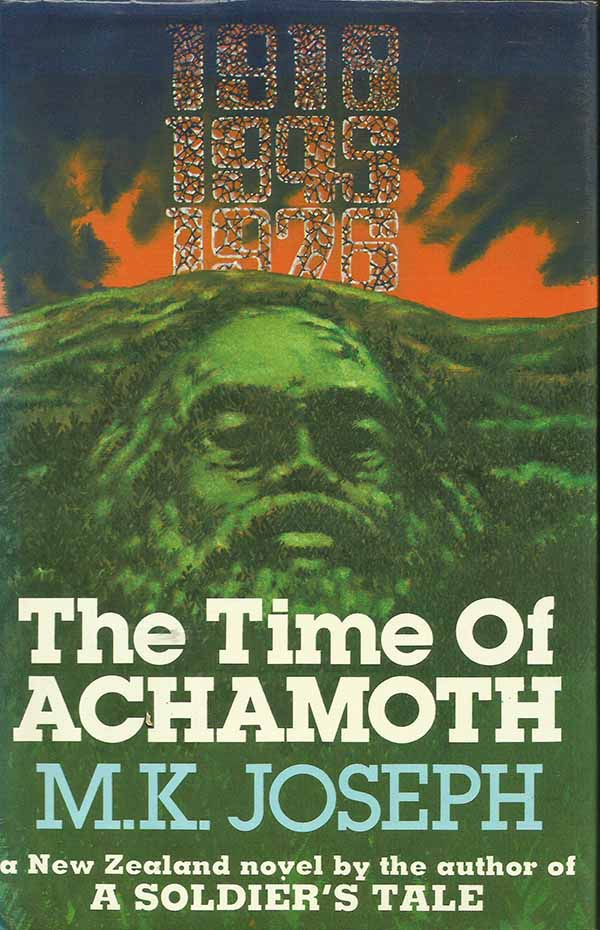
In the latest, online, version of John Clute’s Encyclopedia of Science Fiction entry on M. K. Joseph a very suggestive addition has been made. He remarks of Achamoth that ‘The cover image of Karl Marx is a McGuffin’. Certainly Errol McLeary’s jacket design for the original hardback edition is a striking one. I have to confess, though, that it never actually occurred to me that it was meant to be an image of Karl Marx until I reached the end of the book. I saw it as a portrait of some ancient patriarch of the forests, an interpretation helped by the words on the back cover: ‘a New Zealand novel by the author of A SOLDIER’S TALE’. It seemed, in fact, some kind of allusion to the natural world of New Zealand itself.
‘Don’t tell me Karl Marx was a Gnostic’, said the ambassador. …

‘I got the impression it was not the statue but the place. Something connected with the place’. …

Suddenly Iremonger spoke up. ‘Highgate Cemetery. I’ve been there. Morbid sort of place, full of great ugly Victorian vaults and catacombs. You could hide a small army there’. …

Anne shivered. ‘I wish it didn’t have to be a cemetery’ (165).[5]

A McGuffin – for those of you unfamiliar with the term – is Alfred Hitchcock’s name for a plot-driving device which seems to be at the centre of a narrative but is actually just a pretext for stringing together a series of compelling scenes.[6] So is Karl Marx’s image a McGuffin? For that matter, is the book’s whole Gnostic conspiracy theme, Achamoth, Madame Sophie, the Illuminati and all, simply there as a placeholder – a distraction from the real meaning of Joseph’s novel?

It’s worth noting just how late in the story the information about Achamoth himself starts to appear. Without the book’s title, and the last twenty pages, it would be virtually impossible to anticipate it from the complex series of time-travel scenes which have gone before. Certainly the variety and intensity of these individual vignettes seems more central to the overall effect of Joseph’s book than the rather reductive life-force against death-force struggle of the last few pages. What does come through clearly in the protagonist Holloway’s various ventures through time – to the Paris Commune in 1870, to a faux-medieval pageant in the early nineteenth century, to a book-burning future where undergraduates have set out to reverse the sexual revolution in the interests of greater social purpose – is a strong sense of the paradox of inherited European paradigms imposed on gradually emerging local individualities.

In this sense, The Time of Achamoth matches well with Joseph’s meditations on the subject in his ‘Mercury Bay Eclogue II’:
The farmer and his wife emerge
All golden from the ocean-surge
Their limbs and children speak
The legend of the Greek.[7]

Like Marxism (and Feudalism), even the sexual revolution can become a stifling orthodoxy, left unchecked. There may be even more to it than that, though.


Holly Willy is Free

Around the walls he had a vague impression of maps and charts, of shelves of books, of uncertain shadowy shapes covered by cloths. But what caught and held his attention was in the centre of the room. A figure was seated at a heavy desk, staring down into something which shone with an interior light. At first it seemed merely bulky and shapeless, a head framed in a straggle of white hair, a body huddled in some kind of loose dark cloak or robe. Then, as his eyes adjusted to the inverted light, the face defined itself, and it was Madame Sophie laying out the tarot cards by candlelight – Sophia, the Divine Wisdom, Achamoth, the last and greatest of the Illuminists, perhaps two centuries old, perhaps more, with a massive square face swollen with power and evil (176).

So begins the climactic confrontation at the heart of Joseph’s novel. On the one hand we have Mark Hollister, his rather faceless protagonist, veteran of numerous excursions into time past and time future; on the other, Achamoth, Master / Mistress of the Illuminati.

Achamoth (we now discover) has been behind the mysterious deaths of all the other time-travellers in the course of the narrative. When Hollister finally succeeds in catching up with the ‘Man Up Front, where all the orders come from’ (157), he discovers that the basic problem all along has been Gnosticism:
The basic Gnostic creed held that there was a Good God who was remote and unknown to man. The universe and all it contains was created by an inferior power … in order to scatter and imprison the various particles of spiritual light which come from the one God … Since the world is false, there is neither good nor evil in it, merely illusion. All things are permissible, but the best thing is to fling the world back in the false Creator’s face and die … It was not until the eighteenth century C.E. that a late Gnostic sect, the Illuminists, were able to conceive the possibility of hastening the destruction of the world. They took the name of Achamoth which, in some Gnostic systems, is also the Sophia or Wisdom of God’ (160).

Hollister’s mild protests against this grandest and most overarching of conspiracy theories are dealt with rapidly by the Man Up Front, in his android guise as a ‘lean, sunburnt ... young man ... in a plain smock and loose trousers’ (158):
Hollister remained silent for a while, digesting this. ‘Then what happens if we destroy this thing? Is man free? Is there no more evil?’

‘No no no no no. You have saw perchance, world is better. But come others. Is no devil to casting forth’. …

‘What sort of world do you live in?’ …

‘World is quietly, quietly. … Always afternoon. We are olding race, lowered fertility. Man survives. Many guesters come from new planets named such like Poenamo, Elsinore, Merdeka, Kamikaze’. …

An awful suspicion crossed Hollister’s mind, this young-old man tired of the long human story – ‘Are you by any chance’, he asked, ‘God?’

‘If I understand rightly, no no. But we believe Holly Willy is free’. He corrected himself after consulting the cube. ‘We believe free will is holy’ (161-62).

Holloway’s destruction of Achamoth is, therefore, in context, to be seen as a triumph of free will over determinism, of respect for life over the death principle.

If, however, one continues to entertain the notion of all these details about Gnosticism and the Illuminati as a kind of McGuffin: at best, camouflage for the larger intentions of his novel; at worst, active misdirection, it’s necessary to ask just what Achamoth is meant to symbolise? It’s true that, at least on first reading, he/she – ‘bulky and shapeless, a head framed in a straggle of white hair, a body huddled in some kind of loose dark cloak or robe … perhaps two centuries old, perhaps more, with a massive square face swollen with power and evil’ (176) – sounds rather like a reference to contemporary politics: a kind of awful amalgam of Rob Muldoon and Lyndon Johnson. It isn’t easy to erase those images of our ex-Prime Minister in drag, in his last years, as the narrator for a local production of The Rocky Horror Show!

Certainly there are clear allusions to recent history in the person of ‘Colonel Choy’, the South-East Asian leader Holloway (hypnotised by Achamoth) attempts to assassinate at the beginning of the novel. But given their tangential, non-specific nature, it’s hard to read this book as political in the same sense as Smith’s Dream or Broken October.

Unpacking the description a little further, though, one finds: ‘Two centuries old’ – hence a child of eighteenth century rationalism; ‘bulky and shapeless’ – a little like those ‘loose baggy monsters’ which constituted Henry James’s view of the nineteenth-century realist novel; ‘a massive square face swollen with power and evil’ – the choice of the adjective ‘square’ can hardly be seen as accidental here. Joseph was, after all, writing after the social, sexual and psychedelic revolutions of the 1960s What was the ‘squarest’ orthodoxy of all? The reductionist absolutes of the metonymic, social realist tradition in literature.

The death of Achamoth in Joseph’s novel, therefore (I would suggest), is meant to enact the symbolic death of Settler / Social Realism in fiction. This is, admittedly, a large claim, but it’s one which is perfectly consistent with Joseph’s revisioning of the pastoral tradition in such poems as “Mercury Bay Eclogue” (quoted above). Just as, there, “A shepherd on a bicycle / Breaks the pose of pastoral”, while the sun-tanned “farmer and his wife” seem to “speak / The legend of the Greek” rather than their own machine-based mythology, so
The surfboards and the fishing-lines
Tell that our life might be
One of simplicity.[9]

In other words, something real can be conveyed by a modern author who embraces such archaic, artificial, modes as pastoral (or, for that matter, realism), but only at the moment of rupture. The artistic restraints imposed by such classical, predetermined genres are valuable to us mainly in the form of dialectic: only at the moment we acknowledge their unreality are we able to grasp their underlying truth.

Consider again just why the certainties of Gnosticism are typed as ‘evil’ in Joseph’s extravagant plot: not simply because they are life-denying, but because:
Since the world is false, there is neither good nor evil in it, merely illusion. All things are permissible, but the best thing is to fling the world back in the false Creator’s face and die (160).

The ‘illumination’ promised by Gnosticism denies not only the simple virtues of beauty, love, and fellowship (the tools Hollister uses against Achamoth in the penultimate scenes of the novel), but also the possibility of any transcendence of the world’s veil of illusion.

It is, in effect, the world guyed so effectively by Curnow in his devastating ‘Dichtung und Wahrheit’ [Poetry and Truth] poem: ‘this man, or so the man I know said, fucked / And murdered a girl to save her from the others / Who would have fucked and murdered this girl / Much more painfully and without finer feelings’. That’s where realism [Wahrheit] gets you, if you eliminate the element of fantasy, imagination, inventiveness: poetic truth [Dichtung]. What better place for this symbolic conflict than the tomb of Karl Marx: the home of the Master of absolute faith in the inexorable laws of history? Everything partial, half-thought, half-felt, must dissolve under the searchlight of that brutal orthodoxy. Socialist Realism in fiction, then, can be seen as the logical culmination of the rationalist, Enlightenment frame of mind.


The Glow-worm Caves


The first fruits of this new dispensation in New Zealand fiction, this liberation from the chains of a narrowly defined Settler Realism, can be seen in Craig Harrison’s ‘empty world’ novel The Quiet Earth (1981). His protagonist, John Hobson (played memorably by Bruno Lawrence in Geoff Murphy’s 1985 film) wakes up in a world from which the rest of humanity has mysteriously disappeared. His phantasmagoric odyssey from Thames to Wellington takes him through the very heartland of provincial New Zealand realism, then straight into conflict with the Other: another survivor, a Māori soldier.

As the story proceeds, it becomes clearer and clearer to us how much of what Hobson sees is influenced by the experiences and paradigms inside his head: we are forced gradually to the conclusion that he is, at least to some degree, ‘creating’ the events he describes. Unlike the film, which ends with its protagonist sprawled on a beach in an alien world, the book ends with Hobson committing suicide – again. When he wakes up in the sunlit bedroom of the Thames motel where the story began, we realise, finally, the motivation for his reluctance to pull up the blind and expose himself once more to ‘the enormous light’.[10] He has been here before. He is enacting his own misanthropic, dying dream of a world without the pain of other people.

Joseph’s novel, too, begins and ends with the same scene in the Waitomo Glow-worm Caves. Holloway, attempting to kill Colonel Choy, meets his own later self, returning from his own more successful assassination of the monstrous Achamoth:
With a wrenching jolt he swung away into the greyness and his two timelines streamed and crossed. He was moving, floating, in the green spectral light of the ghost-cave, and himself was running towards himself along the duckboards, confused and wild with terror. It seemed to him that, as they passed, he made some sign of friendship or reassurance to that other earlier innocent self. Then the last jolt came and it was like dying (178).

The strength of the idea behind Harrison’s novel, then, is not so much in the use of Nietzsche’s ‘eternal return’ as a plot-structuring device, as the facility with which it enables him to discuss the racial, post-colonial themes so close to his heart. Far more effectively than in the more programmatic Broken October, Hobson’s suspicions, fears, and final downright homicidal ferocity against Apirana Maketu – note the closeness of that surname to mākutu [curse] – map paranoid Pākehā resentment of the other with deadly accuracy. Harrison’s novel is not solely about New Zealand and its discontents – its range is wider than that – but the precision of its local setting does play a part in lending it an almost mythopoeic force.


Mike Johnson’s Lear (1986), by contrast – subtitled ‘The Shakespeare Company Plays Lear at Babylon’ – eschews direct topographical precision in its evocation of a post-apocalyptic society of small villages clinging precariously to the banks of an unidentified ‘river’.[11] Johnson provides few further clues to the setting of his dark, Gothic yarn. It might as easily be taking place on the banks of Joseph Conrad’s Congo as the Wairoa or the Whanganui.

The one certainty in this shifting world is language. Johnson’s troupe of travelling players enact their chosen vehicle King Lear in their own lives as well as on stage, and their destinies are woven into their roles. Stage ‘Gloucester’ (a gambler and river-rat named Slink) is literally blinded on stage, then led to the edge of a jetty which mirrors Shakespeare’s cliff at Dover. The only difference is that when he jumps, he drowns. Cordelia is raped, Lear overthrown – new recruits for the company (perhaps most significantly) picked up from an audience which has witnessed real and stage mayhem with the same incomprehension.

Like Joseph’s book, the strength of Johnson’s lies in the fact that this fairly standard science fiction locale can be used by him to examine the sheer extent of our dependence on such predetermined literary (and cultural) paradigms for our survival. Johnson concludes his list of acknowledgments with one to ‘Phil Dick, who would have liked it’ – no doubt a reference to the latter’s classic post-Apocalyptic yarn Dr. Bloodmoney, or How We Got Along After the Bomb (1965), itself a kind of sequel / corrective to Stanley Kubrick’s Dr Strangelove (1964).

New World identities can take a long time to establish even partial independence from their Old World exemplars. Both Lear and Achamoth make a valiant attempt to clear away the sheer circumstantial detail of realism in the interests of seeing the post-colonial subject more plainly in this new, funhouse mirror of speculative fiction. As a result, they both are and are not specifically ‘New Zealand’ novels.

The speculative fiction canons they both employ so adroitly – time-travel, nuclear war, distorted consciousness – are familiar enough to aficionados of the genre. What is not so familiar is the idea of attaching them to local and regional questions of identity, rather than the ‘soulless cosmopolitanism’ more readily associated with science fiction as a global genre.


Like Joseph and Harrison, Phillip Mann is a UK import to New Zealand literature. His early works, The Eye of the Queen (1982) and the Master of Paxwax series (1986), all published by Gollancz, fit more readily into international than local canons of Science Fiction. Both are fascinating and inventive stories – as are his later works Wulfsyarn (1990) and A Land Fit For Heroes (1993-96) – but it would be rather a stretch to attempt to assimilate them to the ‘New Zealand speculative fiction’ label.

Pioneers (1988) is a different case entirely. In it Mann attempts to combine his ongoing interest in the Android theme – touched on lightly by Joseph in Holloway’s contacts with the ‘Man Up Front’ – with a strong sense of ‘New-Zealandness.’The narrator of Mann’s novel, Angelo, is a ‘part-human’ bred for the purpose of deep-space exploration, and now employed to bring back the ‘full-human’ pioneers sent out in the full flush of technological self-confidence to a post-apocalyptic Earth denuded of natural resources and biological diversity.

One of these pioneers, Murray, saves Angelo's life after a brawl with the ignorant full-humans who still linger in odd settlements here and there in the few habitable parts of Aotearoa – in this case, the resort-town of Rotorua. Angelo's partner Ariadne is not so lucky, and is killed in the fight. Or is she? Part of the pre-planning for Angel and Ariadne's expeditions is the provision of a fully-functional and periodically-updated clone for each of them. Now that he knows that Ariadne is dead, Angelo's dilemma is whether or not he should revive her clone. Angelo decides to do so, only to find that the clone denies any real identity between them:
I am not Ariadne. I might have been Ariadne. I have her memories but I don't have her experience. Memories aren't experience (227).[12]

‘Curiously in her anger she was identical to the Ariadne I remembered’, Angelo concludes, though he is willing to acknowledge a number of other character discontinuities between the two.

To say that Pioneers is about identity is a little bit like remarking that Camus’s Outsider is about existential doubt. Everything in the book seems designed to complicate our view of what it is to be ‘intelligent’, ‘conscious’, ‘sentient’ – let alone ‘human’.
The first thing an awakened intelligence does is ask questions (226).

The second thing, apparently, is to start to tell stories. Pioneer Murray claims:
Look, what I'm telling you is true. Heightened a little, that's the art of storytelling. But true all the same (330).

Angelo’s own view of the matter is slightly different:
I ... stared down at the milky rivers that wandered through the dark bush. We were already close to the volcanic region. I saw pits of yellow sulphur and dark green lakes which opened like holes in the bush. Vaguely, though I could not have given clear expression to the thought, I associated the suffering of the land with the grief that was now beginning to work though me (192).

The addition of a specific New Zealand-ness to Mann’s book has the effect of transforming it from a meditation on natural and constructed selves – fascinating enough, but not unfamiliar – to a powerful evocation of an immigrant’s experience of New Zealand itself.

Like Joseph and Harrison, Mann is specific about detail in a way that more ‘local’ writers such as C. K. Stead or Mike Johnson don’t really need to be. Is Ariadne’s clone, Aira, the same person as Ariadne? She is and she is not. So too, one is tempted to extrapolate, with the exiled and ‘home-grown’ self. As with Harrison, whose fascination with the dysfunctional race relations manifested in his adopted homeland (culminating in the strange Antarctic fantasy Days of Starlight) might have remained latent had he never left his native Yorkshire, Mann has found his overarching theme simply by changing place.

There’s something here akin to the poignancy of the ‘land of settlers / With never a soul at home’ evoked in Allen Curnow’s classic poem ‘House and Land’.[13] speculative fiction, then, has the advantage for aspiring fiction writers of allowing them to operate effectively without the entrance requirement of local childhood and formative experience demanded by Settler Realism in its purest, Sargesonian form.


Success Stories


Genre fiction has never really flourished in New Zealand: mainly, one has to admit, for economic reasons. Our writing has tended to be ‘literary’ because we lack a mass audience of consumers. Detective stories, thrillers, science fiction and fantasy novels: all have been and continue to be written here, but they have to compete for attention with the same small stock of book readers and buyers.

This lack of a pulp tradition might be seen, in some ways, as a weakness: we have no equivalents to Heinlein, Clarke, Asimov and the other giants of the speculative fiction form (in particular). On the other hand, this deficiency does mean that we have a tendency to judge books of this type by the highest cultural standards. Johnson’s book, I would argue, marks an important crossroads in New Zealand literature. Behind it lie the certainties of realist fiction: a literary mode dominated by the need not to ask questions, not to question the essentially artificial nature of any fictional projection, lest the illusion of verisimilitude, Coleridge’s ‘necessary suspension of disbelief’, be shattered.

In front of it stretches the proud, alternative tradition of New Zealand speculative fiction: composed mostly by otherwise mainstream writers with a definite social or political axe to grind, but also informed by the artificially repressed anti-realist tendencies in earlier works such as Robin Hyde’s Wednesday’s Children (1937) or Graham Billing’s Statues (1971).

As a result, it’s never really been necessary for New Zealanders to conduct those tiresome debates about whether or not Kingsley Amis or Doris Lessing or Margaret Atwood or other ‘serious’ writers are slumming when they turn their hand to speculative fiction, or simply ‘adapting’ the form to their own (by implication superior) literary purposes. A local legacy including Samuel Butler, C. K. Stead, and M. K. Joseph has never really needed to apologise for itself. Most of these triumphs still lay in the future when Joseph, just a couple of years before his death, published The Time of Achamoth. His book does, however, already show many of the characteristic hallmarks of New Zealand speculative fiction: strong ideological consciousness, technical inventiveness, and sensitive evocation of the details of New Zealand life and landscape. It may not consider race relations, the interfaces between language and lived experience, and the question of immigrant and ‘part-human’ identity with quite the same intensity and insight as (respectively) Harrison’s Quiet Earth, Johnson’s Lear and Mann’s Pioneers, but – as I’ve argued above – the adroitness with which it moves from local detail to science fiction inventiveness, from (if you prefer) the tenor of his narrative to its various McGuffins, has provided a powerful precedent for these three authors of the 1980s. It’s hard, too, to imagine the various dystopian texts which set out to interrogate the social costs associated with Roger Douglas’s and Ruth Richardson’s neo-liberal economic ‘reforms’ in the 1990s – John Cranna’s Arena, Rosie Scott's Feral City and Albert Wendt's Black Rainbow (all 1992), in particular – would ever have been written, let alone published, without these successful literary precedents.

Joseph’s Time of Achamoth concludes with a conversation between Hollister and his love-interest, Anne Faraday:
… Suppose your crazy story was true, though of course no-one could possibly believe it. Suppose that this time station or whatever it was really existed, but now its work here is done … They need a proper base – oh, maybe on some island somewhere. Now suppose there was a man, like it might be you, who’d done good work for them, but his potential is used up. … And suppose there’s someone else whose work for them is finished. So they leave – this other person – behind to look after him and see that he’s happy and doesn’t get into trouble’.

‘Do you suppose that it might be a permanent arrangement?’

‘It might be’.

He eased down on the accelerator and the car gathered speed, back toward the main highway, people, cities.

‘I think I’d like that, he said ‘very much’ (181).

It was, I think, important for Joseph to allow himself so unabashedly romantic a conclusion to so dark and self-doubting a story. Joseph’s new hero, unlike the protagonist of A Soldier’s Tale, gets to keep the girl and his new life, too.

That may sound like escapism, but that, too, is one of the purposes of fiction. It may be employed as a vehicle for social, political and aesthetic doctrines, but that does not exhaust its uses. Confusing its artificial, symbolic order with the sleight-of-hand which constitutes literary realism does, however, lead inevitably to such reductive absurdities. As Shakespeare reminded us long ago, ‘the truest poetry is the most feigning’. The rise of speculative fiction marks the moment when New Zealand fiction writers, as well as our poets, finally started to take this lesson to heart.


Notes:

1. A process documented in Alex Calder’s The Settler’s Plot: How Stories Take Place in New Zealand (Auckland: AUP, 2011).

2. Roger Robinson, ‘M. K. Joseph’. In The Oxford Companion to New Zealand Literature. Ed. Roger Robinson & Nelson Wattie, ed. (Melbourne: Oxford University Press, 1998): 276. [available online at: http://www.bookcouncil.org.nz/Writers/Profiles/Joseph,%20M.K%20(Michael%20Kennedy)].

3. Allen Curnow, Early Days Yet: New and Collected Poems 1941-1997 (Auckland: Auckland University Press, 1997), p.111.

4. John Clute, ‘M. K. Joseph’, in The Encyclopedia of Science Fiction, ed. John Clute & Peter Nicholls (1979, 2nd edition). Contributing Editor Brian Stableford. Technical Editor John Grant. 1993. Orbit (London: Little, Brown and Company (UK), 1999), p.650 (available online, in updated form, at: http://www.sf-encyclopedia.com/).

5. M.K. Joseph, The Time of Achamoth (Auckland & London: Collins, 1977). Page references will be given in parentheses following quotations from the novel.

6. In the movie North by Northwest, for instance, the ostensible plot (about a search for some stolen microfilm with ‘government secrets’ on it) has to seem circumstantial enough for viewers to take it seriously in context, but actually serves mainly as a mechanism for manoeuvring Cary Grant across 1950s America, dodging murderous crop-dusting planes one minute, hanging precariously off Mount Rushmore the next.

7. Jack Ross, ed. ‘Mercury Bay Eclogue I & II’, in Classic New Zealand Poets in Performance (Auckland: Auckland University Press, 2006) pp. 26-28 (p.28).

8. Henry James, The Art of the Novel: Critical Prefaces (New York & London: Charles Scribner’s Sons, 1947), p.84.

9. Ross, pp.27-28.

10. Craig Harrison, The Quiet Earth (Melbourne: The Text Publishing Company, 2013), p.4 & p.263.

11. Mike Johnson, Lear: the Shakespeare Company Plays Lear at Babylon (Auckland: Hard Echo Press, 1986) p.3.

12. Phillip Mann, Pioneers (London: Grafton, 1990). Page references will be given in parentheses following quotations from the novel.

13. Curnow, p. 235.


JNZL: Journal of New Zealand Literature


(1/3-27/4/16)

JNZL [Journal of New Zealand Literature] 34.2: New Writing 1975-2000. Edited by John Geraets. (Wellington: Victoria University, 2016): 61-80.

[5368 wds]


Friday

Poetry NZ Yearbook 2017: Editorial (2017)


Jack Ross, ed.: Poetry NZ Yearbook 2017 (March 2017)

Editorial:
Hands across the Tasman


My Mother feeding a wallaby (c.1939)


An interesting package arrived in my Massey University pigeonhole late last year. It was a large cardboard box packed full of books. They’d all come from the same publisher, Vagabond Press of Sydney (and Tokyo). Among others, there were ten small chapbooks from the decibel series (selected and edited by senior Australian poet Pam Brown), as well as six volumes of the Asia-Pacific Poetry series, a set of anthologies covering different poetries (in translation), each showcasing the work of three representative poets from a particular region.

There was also a bookmark at the bottom of the box. It read:
Please review our books. Shouting from the rooftops wasn’t as effective as we hoped.
I’ve done my best to respond to this heartfelt plea. I can’t promise to have included a review of every single title, but certainly the lion’s share are discussed here, along with the usual bumper crop of local books and journals.

More than a third of this issue is, in fact, devoted to reviews and essays, and that’s a trend I hope will continue. We can’t review everything, but the fact that we’ve been able to include discussions of poets from places as diverse as Australia, China and Slovenia — as well as New Zealand, of course — gives some indication of the kind of scope we aspire to.

The box of books was sent, I suspect, as a direct result of the contacts and friendships which have been growing up over the past few years between Australian and New Zealand poets. The work (among many others) of Michele Leggott at the New Zealand Electronic Poetry Centre and Anna Jackson at Victoria University in arranging symposia in Auckland, Wellington, Sydney and Melbourne has certainly made helped to make some of us more familiar with one another’s work.

I have to say I was blown away by the scope and self-confidence of the poets published by Vagabond Press (including, I should add, our own Stephanie Christie, whose work is discussed in greater detail in this issue in Lisa Samuels’ essay). No doubt it was Pam Brown herself who arranged to have them sent to me. It was great to see one of her own books in there as well.

It did get me thinking about the nature of the links between the two places, however. I myself am half-Australian (or so I like to claim). My mother was born and brought up in Chatswood, Sydney, and came over to New Zealand in her mid-twenties to get a job as a hospital house surgeon. She met my father in Hamilton, and the rest is history.

History of a kind, at any rate. While my father’s father, a Scot, was serving in minesweepers during World War I, my other grandfather fought as an Australian infantryman on the Western Front. I was lucky enough to meet him a few times on our trips across the Tasman, but not, alas, my Scottish grandfather, who died during World War II.

Australia is so different from New Zealand, in so many ways: so incomparably more ancient, so culturally distinct. True, growing up, Norman Lindsay’s Magic Pudding became as familiar to us as Alice in Wonderland (I continue to see it as just as great a work). I do find it interesting, though, that my mother still considers herself a proud Australian, despite having lived in New Zealand for sixty-odd years: more than twice as long as she lived in the country of her birth. Mind you, she cheers for the All Blacks over the Wallabies.

But there remains a deep Australianness in her: little things like the flat ‘a’s’ in branch and can’t, but also a stubborn frankness and refusal to mince words — none of the face-saving, mealy-mouthed timidity of so much New Zealand speech.

I was fortunate enough to be able to study in Scotland for four years in the late 1980s. Edinburgh remains (with Prague) one of the most beautiful cities I’ve ever seen. Perhaps the most important thing I learnt there was, however (as I put it in a poem at the time): ‘I am not / A Scot.’

My heritage is Scottish, my father’s parents were Scottish, but he was born in Rawene, in the Far North, and, as a result, I am a New Zealander in every way that counts.

Similarly, my mother’s Australian background has gifted me with various relatives and a number of fine memories from over there: the Blue Mountains from a distance, the grandeur of Sydney Harbour. But I’m not Australian.

I’ve been shocked by many acts of the Australian government over the past few years: the razor-wire fences holding in refugees, the prison camps at Nauru and elsewhere. It’s hard not to want to speak out about such things. But I take it for granted that that’s precisely what Australian writers and dissidents do all the time. We may not hear much of that on the TV here, but those voices are audible on some of the more adventurous news outlets available to us now in the digital age.

If they need any help with that, they have only to ask. But I don’t feel my sentimental Australianness gives me any right to butt in as some kind of self-appointed judge. It’s not as if we don’t have our own fair share of horrors to apologise for and attempt to atone for on this side of the sea that divides (and/or unifies?) us.


All of which brings me to my choice of a poet to feature in this issue. I first encountered Liz Morton when she sent me some poems out of the blue. This was before I’d started to edit Poetry New Zealand, but I think she’d been advised to by one of my Creative Writing students here at Massey.

There’s always a certain trepidation in looking at other people’s poetry for the first time. What if you don’t like it? What if you can’t think of anything to say? But I did like it. Somewhat to my surprise, I found that it really spoke to me.

That must have been some time in 2013, because shortly after that, and after meeting her in person, I asked her to read at our Open Day here at the Auckland campus. She read almost as beautifully as she wrote, and it came as little surprise when she won the New Voices Emerging Poet Competition later that year.

There’s an important balance we try to uphold in Poetry New Zealand between (as we say in our blurb): ‘the work of talented newcomers and developing writers as well as that of established leaders in the field’. This has been the case since the magazine’s inception, and it’s a principle which was observed faithfully by Alistair Paterson, my predecessor as editor.

The poet I encountered in 2013 could certainly have been called a ‘talented newcomer’: her work was powerful and raw and close to the bone, but not (perhaps) as nuanced as it has now become. While I suppose one should still refer to her as a ‘developing writer’, I see the poems she’s writing now as a solid contribution to the New Zealand poetic archipelago.

I guess it’s her blend of the personal and political that I find particularly relevant at present. It’s risky to comment on developing news stories, as she does in such poems as ‘Googling refugees’. ‘Who am I to talk?’ is the question that undercuts such pieces. But waiting until one has a bit of tranquillity to contemplate the experience (to paraphrase Wordsworth’s description of the lyric) unfortunately also often entails leaving it too late:
the children were flotsam.
... they were silty smiles
and ponytailed heads and cleft palates
and birth marks. they were real deal
children and, yes, we saved them

on the hard-drives of our smartphones
and uploaded them to YouTube.

it really was the least we could do.
I think that makes the point perfectly. We need to speak out, but we also need to be very, very careful just how we speak out. If that sounds somewhat less than stirring, not altogether resonant, well, hey, that’s poetry for you: always second-guessing itself.

Elizabeth Morton second-guesses herself with elegance and wit on the lip of an abyss of real, thoroughly lived-through experience. I hope it’s obvious by now that I go to her poems to learn, not to judge — and if I’d ever thought there was anything I could teach her, the illusion was a short-lived one: it lasted about as long as it took to open that first file of poems.


Speaking of judging, I think it’s now time to move on to the announcement you’ve all been waiting for (though no doubt most of you have already seen it online): the Poetry NZ Poetry Prize. It was a very hard job, with so many stellar entries, but I’ve ended up with the following choices:
First prize ($500):Emma Shi,
for ‘it’s okay to lie if you mean it’ (page 168 in this issue)
Second prize ($300):Devon Webb,
for ‘Note to Self’ (page 185)
Third prize ($200):Hayden Pyke,
for ‘You Say You Got to Leave Someone’ (page 154)
There’s a delicacy and beauty in Emma Shi’s work which leaves me in awe. I think I understand enough of what she’s driving at in this poem for it to terrify me, too. Pity and awe — isn’t that close to Burke’s definition of the sublime?

Devon Webb’s poem is more infectious and anthemic, but it conceals a certain subtlety beneath its apparent self-assurance: a very impressive debut in Poetry New Zealand for this young writer.

Hayden Pyke’s lyric is one of three interesting short poems he sent in. It seems to me to hit a lot of marks simultaneously, a considerable feat of legerdemain.


As part of the changes necessitated by the shift to our new publisher, Massey University Press, we will be selling each annual issue separately in future, and no longer as part of a one- or two-year subscription. Our existing obligations under the old subscriptions policy will, of course, be fulfilled, but Poetry New Zealand Yearbook will henceforth be sold through the MUP website, as well (of course) as in good bookshops everywhere.

Our thanks go out to all of those valiant subscribers who have kept the magazine afloat for so many years. It goes without saying that we’re still going to need your support to continue, but it now seems more practical to market each issue as a discrete item, rather than as part of a package.

You can find fuller details of all this on both our Poetry New Zealand website and the MUP website: www.masseypress.ac.nz.


And so, in conclusion, I’m very glad Pam sent me that box of books. I can’t promise to manage quite so many reviews in the future for any similarly enterprising small publishers, but I’ll certainly continue to do my best.

Shouting from the rooftops really doesn’t work very well long-term. All writers depend on getting sound, well-considered reviews from their peers, and I feel that’s at least as important a part of Poetry New Zealand’s remit as providing a showcase for so many poets, young and old (97 — by my count — in this issue alone).


(24/8-4/9/16)

Poetry New Zealand Yearbook 2017. ISBN 978-0-9941363-5-0 (March 2017): 14-19. [Available at: https://indd.adobe.com/view/c930aafe-caec-4567-a3e0-fd71a2f5c28c].

[1881 wds]


Poetry NZ Yearbook 2017