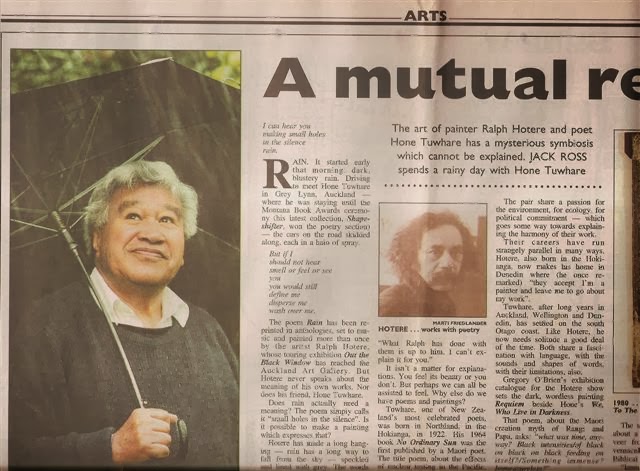
Hotere: Out the Black Window. Ralph Hotere’s Work with New Zealand Poets, Auckland Art Gallery Toi o Tāmaki – a City Gallery, Wellington Touring Exhibition (July 4th to September 6th, 1998).

Rise up my love, my fair one, and come away.
For, lo, the winter is past,
The rain is over and gone;
The flowers appear on the earth;
The time of the singing of birds is come,
And the voice of the turtle is heard in our land
The Song of Songs, which is Solomon’s. This passage (chapter 2, verses 10-12) is one of the most beautiful aubades, dawn-songs, ever written – who knows when, or by whom? Ralph Hotere has included some of the words on a vast dark canvas in one of the far rooms of his travelling exhibition Out the Black Window. It seems as good a test case as any.
Test case for what? Well, at the poetry reading held at the Auckland Art Gallery on Saturday, August 1st, there seemed to be a consensus that we – audience and poets – liked the paintings, but didn’t have much to say beyond that bare fact. Ian Wedde read out his superb “Pathway to the Sea,” and talked about cooking feeds of mussels on the beach. Hotere has a dark sense of humour, he told us, and a way with silence.
Cilla McQueen, who was married to the painter for twelve years (until 1986), read a number of poems, including the text she compiled from Gulf War commentaries in Time and Newsweek for use in his Song of Solomon (1991):
sharpbreak revenge warpath gas bodybag bodybag loopgas blitz pin
cluster destroy tactical moth atomicflame mother of germbattles shift
the flowers appear on the earth
There are fourteen couplets, for the fourteen stations of the cross, each followed by a fragment from the original Song. What McQueen referred to as this “conscious un-language” of war was, she said, designed to contrast with its lyric beauty.
I wondered how much of the conception of the painting was hers, and how much his. The answer was almost entirely his – “cross-pollination, not collaboration.” She could not tell me where the Arabic text just visible at the bottom of the picture came from. (My Arabic teacher, Mr. Alan Dabaliz, tells me that it translates roughly as “Libyans Unite!” Copied, perhaps, from some news bulletin?)
Gregory O’Brien’s exhibition catalogue claims that the “oily black inks” of the painting “evoke the oil slicks” of burning Kuwait, the “trails of dots … become tracer fire in the night sky,” and the “horizontal panels of white and black denote the desert landscape.” Perhaps so.
My problem is with this easy sense of an equation. Song of Solomon = beauty; Time Magazine = warspeak. The black is the oil; the fourteen numbers Christ’s passion; the white is the desert. I have no objections to didacticism in itself, but I want to know if what I’m looking at is an anti-war poster, or a work of lasting complexity. It’s a question of genre. The Gulf War’s been over for seven years now. Is Hotere’s work, then, so time-bound?
The poets are little help here. They (naturally enough) trust Hotere to handle the visual side, while he trusts them to handle the verbal. Does the juxtaposition of these two media: an already-written poem by Bill Manhire, or Cilla McQueen, or Hone Tuwhare, or Ian Wedde, with the unpainterly surfaces of Hotere’s scraps of metal, or canvas, or paper, work as the catalyst for an artistic fusion reaction? Or are we being sentimental to think so?
Nigra sum, sed formosa, filiae Ierusalem
I am black, but comely, O ye daughters of Jerusalem …
Look not upon me, because I am black,
Because the sun hath looked upon me:
The original Song of Solomon is not really so simple a work as analyses of the painting would make it appear. It is, it’s true, a marriage song, conveyed through a series of voices: The “dark but comely” Shulamite, her Beloved, the Choruses of her brothers and the daughters of Jerusalem. It’s a love poem, but it’s also about pain and misunderstanding. The Shulamite wanders through the city at night till “The watchmen … found me, they smote me, they wounded me; the keepers of the walls took away my veil from me.”
I charge you, O ye daughters of Jerusalem,
If ye find my beloved, that ye tell him,
That I am sick of love …
The second time I visited the exhibition there were groups of sixth and seventh form girls seated in front of the paintings, scribbling industriously in their bursary notebooks – a frame, a few lines, some words of text: “O Africa,” “Rain,” “Wulf.”
What do the words mean to them? Anything? Or do they take them on trust, like the rest of our incomprehensible charades of endlessly-deferred meaning? I fear I may be looking for a sense of closure unattainable in art or life, but I find it hard to assent to smug readings of these paintings of Hotere’s as mere proof of his being on the “right” side in a series of recent controversies. Song of Solomon may have been inspired by the Gulf War, but it seems to me as much about the complexities of love between two people as the jagged confrontation of two cultures: “Jealousy is as cruel as the grave: the coals thereof are coals of fire, which hath a most vehement flame.”
The last part of this strangest, most modern of poems assures us that:
Many waters cannot quench love,
Neither can the floods drown it
But what does it mean by that bitter coda: “If a man would give all the substance of his house for love, it would utterly be contemned”? That there are limits even to love?
If the poem matches the painting in complexity of levels, does that justify both? Is the fact that both are about light and dark, love and betrayal some kind of criterion of merit? – Libyans Unite! – Perhaps so. Perhaps that’s as close as I’ll get to an answer. It is, as I say, a kind of test case.
I’m going to be taking a lot more things on trust from now on.
(7/98)
Pander 5 (1998): 32-33.
[1037 wds]

Pander 5 (1998)
•