Showing posts with label JNZL. Show all posts

Tuesday

Teaching Late Curnow (2019)


JNZL 34.2: New Writing 1975-2000 (2016)

Teaching Late Curnow


Ways into the text


It can be quite a curious experience trying to teach classic New Zealand poems to local students. You tend to start off with an expectation of familiarity: not so much of knowledge of the work itself, as of at least some of its geographical and cultural background. I remember once hearing the late Kendrick Smithyman describe the experience of reading his early poem ‘Bream Bay’ — ‘What does a traveller see, looking north / from Brynderwen over the arc of Bream Bay’ — to an audience of Auckland University undergraduates.[1] They had absolutely no idea what he meant when he made a side-reference to the Marsden Point smelter having spoilt the view since he originally wrote it. He was therefore left with two alternatives: either he had to explain exactly what you do now see from the crest of the Brynderwyns when driving north, or else just let it go.

Choosing between those two alternatives—letting the poem speak for itself, or filling in each and every one of the references—does not get any easier over time. If you do explain them all, you can hear yourself gradually turning into the most dreaded of social types, the professional explainer. But then, by the same token, if you fail to explain them, you have to resign yourself to incomprehension: to your listeners missing a good deal of the point.

The situation becomes particularly difficult when you attempt to teach the poetry of Allen Curnow. When some pedant wrote in to the Listener to query the accuracy of the line ‘a scarlet geranium wild on a wet bank’ in Curnow’s classic poem ‘A Small Room with Large Windows’, claiming that the flower does not actually grow on wet banks, Curnow responded to the effect that: ‘irrespective of the customary behaviour of those plants in Wellington, there was, observable from the window of his house, “a scarlet geranium growing wild on a wet bank”’.[2] Furthermore, lest we be in any doubt as to where this observation took place, the new edition of his poems is careful to specify that ‘the location is the sitting room at 13 Herbert St., Takapuna’.[3] It is hard to imagine any poet giving more unequivocal directions about how to read their poems than that: Curnow has clearly cast himself as one of Marianne Moore’s ‘literalists of the imagination’, and his ‘imaginary gardens’ certainly appear to aspire to have real toads in them![4]

For the most part, however, Curnow survives for our students, as he does for the general reader, in the form of a few tags. People keep quoting these gnomic fragments, year after year, as if they were self-explanatory:
Not I, some child born in a marvellous year
Will learn the trick of standing upright here.
‘The Skeleton of the Great Moa in the Canterbury Museum, Christchurch’ (p. 99)

It was something different, something
Nobody counted on.
‘The Unhistoric Story’ (p. 56)

Simply by sailing in a new direction
You could enlarge the world.
‘Landfall in Unknown Seas’ (p. 95)
It is hard to think of another New Zealand poet, in fact — even Baxter or Tuwhare — who has gifted us with so many of these irreducible, teasing nuggets of wit.

Having had the rather unenviable experience of dragging successive classes through ‘A Small Room with Large Windows’ in our second-year Massey University Auckland Writers and Their Region course—What is a mangrove? ‘Why do they ‘truckle’? What is the exact point of the contrast between them and the ‘Seven ageing pine trees’? What are the ‘thousand diverse dullnesses’ that are being exploding by the exact details described at the end of the poem? etc. etc.—I have formed some rather anecdotal, but definitely experiential, ideas on the most effective ways to teach Curnow’s poetry—his later poetry, at any rate.


•


Late and early Curnow


That is if ‘A Small Room with Large Windows’ can really be said to rank as late Curnow. Where does ‘late Curnow’ actually begin? In terms of our Auckland Writers and Their Region course, the earlier South Island Curnow is postulated to have been succeeded by the later, Auckland-based Curnow after his move up here in the 1950s. Of course, it would be just as easy to claim that the break should be dated later than that. The work collected in Continuum (1988) overlaps with the end of the 1974 Collected Poems, but one could certainly contend that a modernising shift both in diction and treatment of his overriding concerns can be observed in all of the books after Trees, Effigies, Moving Objects (1972).

In any case, so far as our students are concerned, the later the better seems to be the rule of thumb when it comes to Curnow. But is this simply a by-product of my own enthusiasm for that remarkable series of books collected in Continuum: An Incorrigible Music (1979), You Will Know When You Get There (1982), The Loop in Lone Kauri Road (1986)? Might the earlier poems work just as well for them if I concentrated the same intensity of attention on them?

It is, in the final analysis, impossible to say. This is (at best) qualitative rather than quantitative research: tendentious and unscientific, as all such enquiries tend to be, but still valid within certain limits of definition. My own greater enthusiasm for Curnow’s later work can certainly not be counted out as a factor in the choices I have made while teaching him. Nevertheless, the arc of his poetry from first to last towards ever greater specificity and precision might be seen to explain this increased accessibility in his work after the (at least partial) hiatus of the 1960s.


•


Ways to discuss a poet


It is, I think, true to say that some poets’ work is easier to discuss in tutorials than others. All of us trained in the strange art of sitting around and simply talking around a poem—using the basic techniques of New Criticism, but hopefully avoiding some of its conceptual pitfalls—would surely have to agree with this assertion.

I have always found Kendrick Smithyman an excellent poet to anatomise in group surroundings. It is tempting to attribute this to his own decades-long bondage to the tutorial system at Auckland University. His poems from this era include so many intriguing details, so many diverse points of entry—surely that has something to do with his own repeated talkfests about Auden, Eliot and Hardy in so many small classes (limited, as a rule, to 20-odd students)? But then, many other canonical New Zealand poets are similarly rewarding when dissected in company. James K. Baxter’s ‘East Coast Journey’, Charles Brasch’s ‘View of Rangitoto’, R. A. K. Mason’s ‘Strange Memories of Earth’, Robin Hyde’s ‘Houses by the Sea’ — all of these can be made to intrigue students with a little prompting,; or so I myself have found, at any rate. None of those writers (so far as I’m aware) served their time as English tutors.

In fact, some of the most halting and end-stopped discussions I have had are of one of the New Zealand poets I admire most: Hone Tuwhare. There seems to be some sort of inhibition in our students when it comes to analysing the shifting registers and tones of voice in Tuwhare’s poetry. It is not that his poems don’t retain their effectiveness when read out loud, but that is where it seems to end. When one tries to go deeper, a certain feeling of breaking a butterfly on the wheel seems to stymie further discussion.

What, then, of Allen Curnow? It is tempting to draw some connection with the fact that Curnow was upstairs lecturing on poetry whilst Smithyman was downstairs running workshops on it, when it comes to comparing the effect of their poems on students. Kendrick’s, though baffling at times, have less of a tendency to intimidate. ‘A Small Room with Large Windows’, by contrast, leaves far less room for imaginative reconstruction in the reader’s own voice.

In my own case, I have had the most success with Curnow’s poems from the 1970s and 1980s, with their clear focus on quotidian detail. His larger, eschatological concerns are still there, but they are more adroitly concealed beneath the surface of the poem. Take ‘A Dead Lamb’ (1972), for instance:
Never turn your back on the sea.
The mumble of the fall of time is continuous.

A billion billion broken waves deliver
a coloured glass globe at your feet, intact.

You say it is a Japanese fisherman's float.
It is a Japanese fisherman’s float. ...

There is standing room and much to be thankful for
in the present. Look, a dead lamb on the beach. (p. 161)
That poem is a teacher’s gift, whether at a lecture, a seminar or a tutorial. What better articulation of late twentieth-century linguistic philosophy could be found than in those lines: ‘You say it is a Japanese fisherman’s float. / It is a Japanese fisherman’s float’? Is the point that it is that because you say it’s that—or is it an assertion of the possibility of identity between signifier and signified? And then there’s that dead lamb … Agnus dei qui tollis peccata mundi: or just a dead lamb? The point is that the speculation is an interesting one—it’s one that everyone, Christian, Agnostic or Atheist, can express an opinion on. And is there a connection there with the danger of turning your back on the sea? Is the presence of that dead lamb a fact of the same order as the Japanese fisherman's float (I have one at home, which I have occasionally brought along to class and brandished at this point in the discussion)? That is to say, is it simply a complication to an otherwise idyllic scene—or is it metaphoric of some larger, metaphysical danger, more than that offered by the mere possibility of drowning?

The sparseness of the diction leaves room for such speculations: it is, finally, the arrangement of phenomena in such poems that gives rise to such speculations, rather than the more heavyhanded hints in the language of his previous work. That’s not to say that he became an entirely new poet in the 1970s and 80s. His concerns, by and large, remained the same—those anxious anticipations of the next world, and consequent inability to take the values of this world seriously—but now those values were more clearly bound up with the lifestyle and seascapes of his second home,: that West Coast bach above Karekare Beach, situated bang in the middle of the loop on Lone Kauri Road.


•


You Will Know When You Get There


For a while it was possible to get instant product recognition for Karekare and even Lone Kauri Road simply by referring to Jane Campion’s 1993 film The Piano, but I am afraid that that has now become just one more high-culture footnote. West Coast beaches are still a good starting-point for most students, though (more so, at any rate, than the mangroves and salt flats of Shoal Bay).

The latest of his poems I teach is ‘The Game of Tag’, from Early Days Yet (1997). I use it when lecturing on poetic form in our first-year Creative Writing paper.
Seven thigh-thick
hamstring-high posts,

embedded two
metres and cemented

in, where the side
of the road burst

into bird space,
tree-toppling all

that plunging way
down. A clean-cut

horizon shapes
daylight. A gap. (p.301)
Do the students like it, or get it? It is hard to be sure. Certainly, there is not quite the same quick response they give to those wonderfully lucid Continuum poems. But it is fun to talk about it, to take them up Lone Kauri Rd, every precipitous twist and turn of it etched into clipped, claustrophobic couplets, and to watch the aging poet trying so hard to form a bond with his alter-ego, ‘my spray-gun-toting rival’, the AFRIKA POET tagger, who:
Gave

Death the fingers.
Shook the dreadlocks

from his eyes, for
his best shot.
‘Does it date?’ asked E. M. Forster anxiously of Christopher Isherwood, after allowing the latter to read the then unpublished manuscript of Maurice, his novel of forbidden love, abandoned by him some time in the Edwardian era. ‘Yes’, replied Isherwood, ‘but why shouldn’t it date?’ (Moskowitz 2018).[5] These ‘dreadlock’ lines of Curnow’s have dated also. They may sound a little dismissive, even a little patronising at first glance. But if you persevere with the poem, try to enter into its author’s world as he climbs the long slope, hypnotised by the signs of vehicular mayhem combined with the tagger’s obscurely allusive words, you begin to realise just how much he has conflated the two, how small the distance he maintains from this ‘rival’:
Where have they all
gone, with CICERO

BEASTIE and me
and which of us

leads the way down
post and plank not-

withstanding, car-
apaced in Korean

steel, to be wrapped
round a bole two

hundred years thick,
two hundred feet

below? One wild
wheelie and we’re off.
There’s been a car crash. That much is obvious. The heavily reinforced posts guarding one of the many precipitous corners on this most treacherous of roads were not sufficient to save whoever side-swiped them so disastrously, sometime since:
Rain-forest soon
repairs its ruins.

Dead men’s dental
records and cellphones

tell no lies. Rust
finishes the job

(almost). One chip
of red Perspex

under a stone
in the stream was

his (whose?) tail-light.
The tagger, ‘AFRIKA POET,’ came subsequently, adding his words to the ‘hefty planks’ mounted across the gap, and then again on the subsequent bends. Then he, too (the poet conjectures) signed off with ‘skid marks in the gravel.’

This kinship between the two, poet and tagger, both insisting on giving ‘death the fingers’—on murmuring ‘name upon name, / As a mother names her child’, as Yeats puts it in ‘Easter, 1916’[6]—on somehow finding some way to record the prior presence of those who trod this road before them, is profound, albeit still a little teasing:
A-F-R-I-K-A P-O-E-T

writes, and I quote
THANKS FOR THE TAG.
These two writers, the tagger of ’93 and the poet born in 1911, will never quite see eye to eye, but—in the end—they have a lot more in common than one might think. Both are engaged in fighting off death and oblivion with powerful incantations.

Certainly, many of the allusions and attitudes in Allen Curnow’s works have dated, and will continue to date—even in the poems of this later, reinvented self. But so what? There’s something deeply satisfying about those last two books of his, Early Days Yet and The Bells of Saint Babel’s—those final attempts to screw his own idiolect just a couple of turns tighter.

‘The Game of Tag’ remains one of my favourites among his later poems because the effort he makes to bridge the gap between then and now is so great, and yet the wry smile implicit behind the lines makes it clear how little faith he puts in success. However strong the words, death will still come for us all: but one can greet it on one’s feet or on one’s knees.

It may not be quite saving the best for last, but it seems to me considerably closer to it than any other New Zealand poet I know of has achieved so far.


•


Notes:

1. Kendrick Smithyman, Selected Poems, ed. Peter Simpson (Auckland: Auckland University Press, 1989), p. 25.

2. C. K. Stead, ‘Allen Curnow: Poet of the Real’, in Kin of Place: Essays on 20 New Zealand Writers (Auckland: Auckland University Press, 2002), p. 129.

3. Allen Curnow, Collected Poems, ed. Elizabeth Caffin and Terry Sturm (Auckland: Auckland University Press, 2017), p. 362.

4. Marianne Moore, The Poems of Marianne Moore, ed. Grace Schulman (London: Faber, 2003), p. 135.

5. Hannah Moskowitz, ‘Review of A Great Unrecorded History: A New Life of E.M. Forster, by Wendy Moffatt’, Queerly reads https://www.queerlyreads.com/home/2018/11/15/a-great-unrecorded-history-a-new-life-of-em-forster> [accessed 14 December 2018].

6. W. B. Yeats, The Variorum Edition of the Poems of W. B. Yeats, ed. Peter Allt and Russell K. Alspach (New York: Macmillan Publishing Company, 1973), p. 394.


JNZL: Journal of New Zealand Literature

•


(18-24/9/17; 8/10/18; 13-14/12/18)

JNZL [Journal of New Zealand Literature] 37.2: Remembering Curnow. Edited by Alex Calder. (Wellington: Victoria University, 2019): 92-102.

[2701 wds]


•


Sunday

The Time of Achamoth (2017)


John Geraets, ed.: JNZL 34.2: New Writing 1975-2000 (2016)

The Time of Achamoth:
M. K. Joseph and the Rise of New Zealand Speculative Fiction


M. K. Joseph: The Time of Achamoth (1977)


The Hole in the Zero

It’s an old country. One day out in the back of beyond you come across a small town, run-down because many of its young people have headed for the city. In an unpretentious building you discover a local art gallery-cum-museum. A solitary caretaker puffing a pipe turns on the lights and you are startled by the paintings on the walls... Here are old images of heaven and hell that now have a surreal air. You’d like to understand this odd iconography but the caretaker has a curiously literal approach – he tells local stories about the paintings as though he were pointing things out to you through a window.
(Roger Horrocks, ‘The Invention of New Zealand’, And/1 (1983)

Horrocks’ caretaker’s ‘curiously literal approach’ has prevailed for a long time in our discussions of – in particular – New Zealand fiction. The ‘surreal air’, certainly detectable in such mid-twentieth-century texts as Janet Frame’s Owls Do Cry (1957) or David Ballantye’s Sydney Bridge Upside Down (1968), could still be assimilated critically, albeit with a certain strain, into the essentially unmediated realism of the Settler Fiction tradition.[1] It wasn’t really until the 1970s that the first genuinely unassimilable fictional texts started to appear here. The straight Science Fiction of Pat Booth’s Long Night Among the Stars (1961) or M. K. Joseph’s The Hole in the Zero (1967) was succeeded by politically prescient thrillers such as C. K. Stead’s Smith’s Dream (1971 – memorably filmed as Sleeping Dogs) and Craig Harrison’s Broken October: New Zealand 1985 (1976 – based on his play Tomorrow Will Be a Lovely Day). Both were set in the very near future, and made little secret of their polemical intentions: in the case of Stead’s novel, to alert us to the dangers of a quasi-fascist dictatorship in New Zealand (provoked by the suppression of dissent during the Vietnam war); and, with Broken October, an outsider’s view – Harrison emigrated to New Zealand in 1966, in his mid-twenties – of the ongoing scandal of the dominant culture’s repression of Māori independent identity.

Both Stead’s and Harrison’s novels were interesting and thought-provoking, but neither was particularly inventive in formal terms. They didn’t suggest any larger dissatisfaction with realism as a dominant literary mode. The emergence of speculative fiction as a viable alternative genre in New Zealand over the last quarter of the twentieth century therefore requires a certain amount of explanation. How did we move from Stead’s and Harrison’s books to such complex and multi-layered texts as Mike Johnson’s Lear (1986) and Phillip Mann’s Pioneers (1988) – not to mention Harrison’s own later works The Quiet Earth (1981) and Days of Starlight (1988)?

A recent re-reading of M. K. Joseph’s 1977 novel The Time of Achamoth suggests at least a partial answer to the question. The attention of speculative fiction critics such as John Clute (in his magisterial Encyclopedia of Science Fiction) has tended, to date, to focus on Joseph’s more technically experimental text The Hole in the Zero (1967), largely overlooking Achamoth. Could the reason for that be as simple as the latter’s contemporary New Zealand setting? The Hole in the Zero, after all, takes place in the affectless reaches of Outer Space. Whatever the reason for this critical neglect, one might as easily argue that Achamoth’s sense of fusion between realism and speculative intent was a conceptual advance for Joseph, than a retreat from the repetitively symbolic patterning of The Hole in the Zero.

Certainly The Time of Achamoth, as a narrative, seems designed to challenge the need for unreflective realism in New Zealand fiction. I shall therefore be arguing here that taking a closer look at both the book and its author may help us to discern some general principles to apply in reading the later speculative fiction works of Harrison, Johnson, Mann, and their various successors. It might also help us to suggest reasons for this change in the fictional weather in the late 1970s and 1980s.


•


M. K. Joseph (1914-1981)


‘Many future tracers of trends and categories will have to start at or near M. K. Joseph’, commented Dennis McEldowney in his Listener obituary (Robinson & Wattie: 276).[2] That still seems a just assessment. He may have dropped from sight to some degree, but there’s much to be gleaned from the very varied body of work he left behind.

Born in Essex shortly before the outbreak of World War One, Michael Kennedy Joseph emigrated to New Zealand with his family in 1924. He completed his schooling at Tauranga Boys High and Auckland University College, where he completed an MA in English in 1934. He then returned to England to study at Merton College, Oxford, in 1936, graduating just in time to join the Artillery at the outbreak of World War Two. He returned to Auckland as a lecturer in English in 1946. His first major success as a writer came with the Second World War novel I’ll Soldier No More (1958), followed by a satire on Academic life (A Pound of Saffron, 1961), and another war story, A Soldier’s Tale (1976). The latter was brutally parodied by Allen Curnow in his poem ‘Dichtung und Wahrheit”:
A man I know wrote a book about a man he knew
And this man, or so the man I know said, fucked
And murdered a girl to save her from the others
Who would have fucked and murdered this girl
Much more painfully and without finer feelings …[3]

The tone of this poem shows – to say the least – that Curnow, perhaps our foremost literary connoisseur of physical and psychological cruelty, found Joseph’s book an easy target. Whatever straight experience-based realism had done for him previously was no longer working. His preoccupations had moved on, and while A Soldier’s Tale remains one of his most popular books, The Hole in the Zero (1967), one of his least popular, seems to have been the one that offered the more valid way forward.

John Clute calls The Hole in the Zero ‘a significant contribution to the field’ – an ‘examination of the metaphorical potentials of sf language and subject matter’, which:
begins as an apparently typical Space-Opera adventure into further dimensions at the edge of the Universe, but quickly reveals itself as a linguistically brilliant, complex exploration of the nature of the four personalities involved as they begin out of their own resources to shape the low-probability regions into which they have tumbled.[4]

It’s certainly ambitious enough as a novel, dispensing with most of the normal appurtenances of plot and characterisation to set up a kind of infinite regress of competing forces, embodied in megalomaniac financier Kraag, his neurotic daughter Helena, and her husband (heir-apparent to Kraag’s empire) Hyperion ‘Billy’ Merganser. While this may remind us, at times, of the similarly helter-skelter triangle of Ignatz, Krazy and Offisa Pupp in George Herriman’s surrealist comic strip Krazy Kat, there’s no denying the sheer originality of Joseph’s intentions.

Whether the end result is readable or not must remain a matter of taste. To me it would seem an immensely interesting but not entirely successful genre experiment. Which is one of several reasons I’ve found myself concentrating increasingly on its more nuanced successor The Time of Achamoth. It was not in ‘pure’ science fiction but in the strange combination of speculative and realist fiction pioneered in the latter novel, I would argue, that Joseph’s true distinction lies.


•


The McGuffin


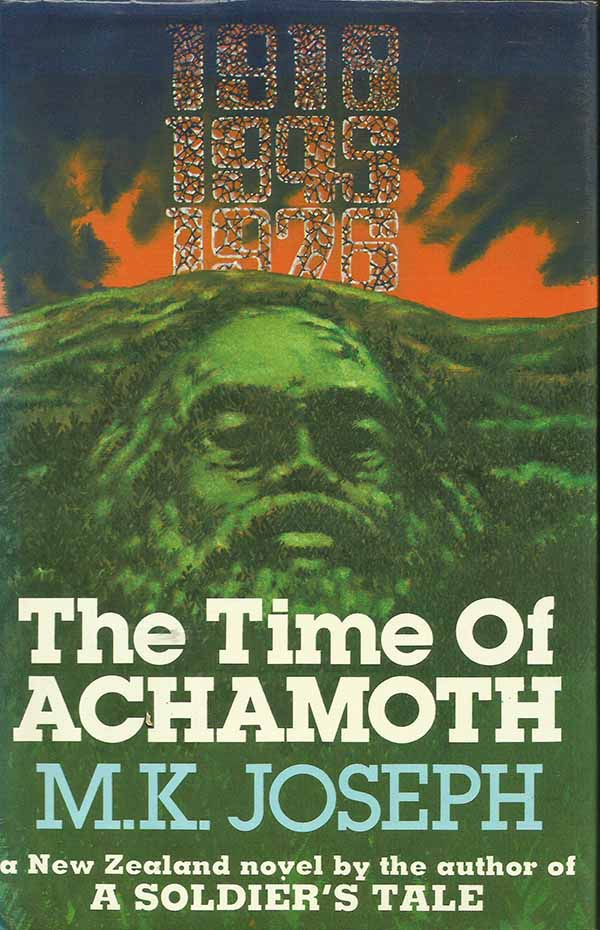
In the latest, online, version of John Clute’s Encyclopedia of Science Fiction entry on M. K. Joseph a very suggestive addition has been made. He remarks of Achamoth that ‘The cover image of Karl Marx is a McGuffin’. Certainly Errol McLeary’s jacket design for the original hardback edition is a striking one. I have to confess, though, that it never actually occurred to me that it was meant to be an image of Karl Marx until I reached the end of the book. I saw it as a portrait of some ancient patriarch of the forests, an interpretation helped by the words on the back cover: ‘a New Zealand novel by the author of A SOLDIER’S TALE’. It seemed, in fact, some kind of allusion to the natural world of New Zealand itself.
‘Don’t tell me Karl Marx was a Gnostic’, said the ambassador. …

‘I got the impression it was not the statue but the place. Something connected with the place’. …

Suddenly Iremonger spoke up. ‘Highgate Cemetery. I’ve been there. Morbid sort of place, full of great ugly Victorian vaults and catacombs. You could hide a small army there’. …

Anne shivered. ‘I wish it didn’t have to be a cemetery’ (165).[5]

A McGuffin – for those of you unfamiliar with the term – is Alfred Hitchcock’s name for a plot-driving device which seems to be at the centre of a narrative but is actually just a pretext for stringing together a series of compelling scenes.[6] So is Karl Marx’s image a McGuffin? For that matter, is the book’s whole Gnostic conspiracy theme, Achamoth, Madame Sophie, the Illuminati and all, simply there as a placeholder – a distraction from the real meaning of Joseph’s novel?

It’s worth noting just how late in the story the information about Achamoth himself starts to appear. Without the book’s title, and the last twenty pages, it would be virtually impossible to anticipate it from the complex series of time-travel scenes which have gone before. Certainly the variety and intensity of these individual vignettes seems more central to the overall effect of Joseph’s book than the rather reductive life-force against death-force struggle of the last few pages. What does come through clearly in the protagonist Holloway’s various ventures through time – to the Paris Commune in 1870, to a faux-medieval pageant in the early nineteenth century, to a book-burning future where undergraduates have set out to reverse the sexual revolution in the interests of greater social purpose – is a strong sense of the paradox of inherited European paradigms imposed on gradually emerging local individualities.

In this sense, The Time of Achamoth matches well with Joseph’s meditations on the subject in his ‘Mercury Bay Eclogue II’:
The farmer and his wife emerge
All golden from the ocean-surge
Their limbs and children speak
The legend of the Greek.[7]

Like Marxism (and Feudalism), even the sexual revolution can become a stifling orthodoxy, left unchecked. There may be even more to it than that, though.


•


Holly Willy is Free

Around the walls he had a vague impression of maps and charts, of shelves of books, of uncertain shadowy shapes covered by cloths. But what caught and held his attention was in the centre of the room. A figure was seated at a heavy desk, staring down into something which shone with an interior light. At first it seemed merely bulky and shapeless, a head framed in a straggle of white hair, a body huddled in some kind of loose dark cloak or robe. Then, as his eyes adjusted to the inverted light, the face defined itself, and it was Madame Sophie laying out the tarot cards by candlelight – Sophia, the Divine Wisdom, Achamoth, the last and greatest of the Illuminists, perhaps two centuries old, perhaps more, with a massive square face swollen with power and evil (176).

So begins the climactic confrontation at the heart of Joseph’s novel. On the one hand we have Mark Hollister, his rather faceless protagonist, veteran of numerous excursions into time past and time future; on the other, Achamoth, Master / Mistress of the Illuminati.

Achamoth (we now discover) has been behind the mysterious deaths of all the other time-travellers in the course of the narrative. When Hollister finally succeeds in catching up with the ‘Man Up Front, where all the orders come from’ (157), he discovers that the basic problem all along has been Gnosticism:
The basic Gnostic creed held that there was a Good God who was remote and unknown to man. The universe and all it contains was created by an inferior power … in order to scatter and imprison the various particles of spiritual light which come from the one God … Since the world is false, there is neither good nor evil in it, merely illusion. All things are permissible, but the best thing is to fling the world back in the false Creator’s face and die … It was not until the eighteenth century C.E. that a late Gnostic sect, the Illuminists, were able to conceive the possibility of hastening the destruction of the world. They took the name of Achamoth which, in some Gnostic systems, is also the Sophia or Wisdom of God’ (160).

Hollister’s mild protests against this grandest and most overarching of conspiracy theories are dealt with rapidly by the Man Up Front, in his android guise as a ‘lean, sunburnt ... young man ... in a plain smock and loose trousers’ (158):
Hollister remained silent for a while, digesting this. ‘Then what happens if we destroy this thing? Is man free? Is there no more evil?’

‘No no no no no. You have saw perchance, world is better. But come others. Is no devil to casting forth’. …

‘What sort of world do you live in?’ …

‘World is quietly, quietly. … Always afternoon. We are olding race, lowered fertility. Man survives. Many guesters come from new planets named such like Poenamo, Elsinore, Merdeka, Kamikaze’. …

An awful suspicion crossed Hollister’s mind, this young-old man tired of the long human story – ‘Are you by any chance’, he asked, ‘God?’

‘If I understand rightly, no no. But we believe Holly Willy is free’. He corrected himself after consulting the cube. ‘We believe free will is holy’ (161-62).

Holloway’s destruction of Achamoth is, therefore, in context, to be seen as a triumph of free will over determinism, of respect for life over the death principle.

If, however, one continues to entertain the notion of all these details about Gnosticism and the Illuminati as a kind of McGuffin: at best, camouflage for the larger intentions of his novel; at worst, active misdirection, it’s necessary to ask just what Achamoth is meant to symbolise? It’s true that, at least on first reading, he/she – ‘bulky and shapeless, a head framed in a straggle of white hair, a body huddled in some kind of loose dark cloak or robe … perhaps two centuries old, perhaps more, with a massive square face swollen with power and evil’ (176) – sounds rather like a reference to contemporary politics: a kind of awful amalgam of Rob Muldoon and Lyndon Johnson. It isn’t easy to erase those images of our ex-Prime Minister in drag, in his last years, as the narrator for a local production of The Rocky Horror Show!

Certainly there are clear allusions to recent history in the person of ‘Colonel Choy’, the South-East Asian leader Holloway (hypnotised by Achamoth) attempts to assassinate at the beginning of the novel. But given their tangential, non-specific nature, it’s hard to read this book as political in the same sense as Smith’s Dream or Broken October.

Unpacking the description a little further, though, one finds: ‘Two centuries old’ – hence a child of eighteenth century rationalism; ‘bulky and shapeless’ – a little like those ‘loose baggy monsters’ which constituted Henry James’s view of the nineteenth-century realist novel; ‘a massive square face swollen with power and evil’ – the choice of the adjective ‘square’ can hardly be seen as accidental here. Joseph was, after all, writing after the social, sexual and psychedelic revolutions of the 1960s What was the ‘squarest’ orthodoxy of all? The reductionist absolutes of the metonymic, social realist tradition in literature.

The death of Achamoth in Joseph’s novel, therefore (I would suggest), is meant to enact the symbolic death of Settler / Social Realism in fiction. This is, admittedly, a large claim, but it’s one which is perfectly consistent with Joseph’s revisioning of the pastoral tradition in such poems as “Mercury Bay Eclogue” (quoted above). Just as, there, “A shepherd on a bicycle / Breaks the pose of pastoral”, while the sun-tanned “farmer and his wife” seem to “speak / The legend of the Greek” rather than their own machine-based mythology, so
The surfboards and the fishing-lines
Tell that our life might be
One of simplicity.[9]

In other words, something real can be conveyed by a modern author who embraces such archaic, artificial, modes as pastoral (or, for that matter, realism), but only at the moment of rupture. The artistic restraints imposed by such classical, predetermined genres are valuable to us mainly in the form of dialectic: only at the moment we acknowledge their unreality are we able to grasp their underlying truth.

Consider again just why the certainties of Gnosticism are typed as ‘evil’ in Joseph’s extravagant plot: not simply because they are life-denying, but because:
Since the world is false, there is neither good nor evil in it, merely illusion. All things are permissible, but the best thing is to fling the world back in the false Creator’s face and die (160).

The ‘illumination’ promised by Gnosticism denies not only the simple virtues of beauty, love, and fellowship (the tools Hollister uses against Achamoth in the penultimate scenes of the novel), but also the possibility of any transcendence of the world’s veil of illusion.

It is, in effect, the world guyed so effectively by Curnow in his devastating ‘Dichtung und Wahrheit’ [Poetry and Truth] poem: ‘this man, or so the man I know said, fucked / And murdered a girl to save her from the others / Who would have fucked and murdered this girl / Much more painfully and without finer feelings’. That’s where realism [Wahrheit] gets you, if you eliminate the element of fantasy, imagination, inventiveness: poetic truth [Dichtung]. What better place for this symbolic conflict than the tomb of Karl Marx: the home of the Master of absolute faith in the inexorable laws of history? Everything partial, half-thought, half-felt, must dissolve under the searchlight of that brutal orthodoxy. Socialist Realism in fiction, then, can be seen as the logical culmination of the rationalist, Enlightenment frame of mind.


•


The Glow-worm Caves


The first fruits of this new dispensation in New Zealand fiction, this liberation from the chains of a narrowly defined Settler Realism, can be seen in Craig Harrison’s ‘empty world’ novel The Quiet Earth (1981). His protagonist, John Hobson (played memorably by Bruno Lawrence in Geoff Murphy’s 1985 film) wakes up in a world from which the rest of humanity has mysteriously disappeared. His phantasmagoric odyssey from Thames to Wellington takes him through the very heartland of provincial New Zealand realism, then straight into conflict with the Other: another survivor, a Māori soldier.

As the story proceeds, it becomes clearer and clearer to us how much of what Hobson sees is influenced by the experiences and paradigms inside his head: we are forced gradually to the conclusion that he is, at least to some degree, ‘creating’ the events he describes. Unlike the film, which ends with its protagonist sprawled on a beach in an alien world, the book ends with Hobson committing suicide – again. When he wakes up in the sunlit bedroom of the Thames motel where the story began, we realise, finally, the motivation for his reluctance to pull up the blind and expose himself once more to ‘the enormous light’.[10] He has been here before. He is enacting his own misanthropic, dying dream of a world without the pain of other people.

Joseph’s novel, too, begins and ends with the same scene in the Waitomo Glow-worm Caves. Holloway, attempting to kill Colonel Choy, meets his own later self, returning from his own more successful assassination of the monstrous Achamoth:
With a wrenching jolt he swung away into the greyness and his two timelines streamed and crossed. He was moving, floating, in the green spectral light of the ghost-cave, and himself was running towards himself along the duckboards, confused and wild with terror. It seemed to him that, as they passed, he made some sign of friendship or reassurance to that other earlier innocent self. Then the last jolt came and it was like dying (178).

The strength of the idea behind Harrison’s novel, then, is not so much in the use of Nietzsche’s ‘eternal return’ as a plot-structuring device, as the facility with which it enables him to discuss the racial, post-colonial themes so close to his heart. Far more effectively than in the more programmatic Broken October, Hobson’s suspicions, fears, and final downright homicidal ferocity against Apirana Maketu – note the closeness of that surname to mākutu [curse] – map paranoid Pākehā resentment of the other with deadly accuracy. Harrison’s novel is not solely about New Zealand and its discontents – its range is wider than that – but the precision of its local setting does play a part in lending it an almost mythopoeic force.


•


Mike Johnson’s Lear (1986), by contrast – subtitled ‘The Shakespeare Company Plays Lear at Babylon’ – eschews direct topographical precision in its evocation of a post-apocalyptic society of small villages clinging precariously to the banks of an unidentified ‘river’.[11] Johnson provides few further clues to the setting of his dark, Gothic yarn. It might as easily be taking place on the banks of Joseph Conrad’s Congo as the Wairoa or the Whanganui.

The one certainty in this shifting world is language. Johnson’s troupe of travelling players enact their chosen vehicle King Lear in their own lives as well as on stage, and their destinies are woven into their roles. Stage ‘Gloucester’ (a gambler and river-rat named Slink) is literally blinded on stage, then led to the edge of a jetty which mirrors Shakespeare’s cliff at Dover. The only difference is that when he jumps, he drowns. Cordelia is raped, Lear overthrown – new recruits for the company (perhaps most significantly) picked up from an audience which has witnessed real and stage mayhem with the same incomprehension.

Like Joseph’s book, the strength of Johnson’s lies in the fact that this fairly standard science fiction locale can be used by him to examine the sheer extent of our dependence on such predetermined literary (and cultural) paradigms for our survival. Johnson concludes his list of acknowledgments with one to ‘Phil Dick, who would have liked it’ – no doubt a reference to the latter’s classic post-Apocalyptic yarn Dr. Bloodmoney, or How We Got Along After the Bomb (1965), itself a kind of sequel / corrective to Stanley Kubrick’s Dr Strangelove (1964).

New World identities can take a long time to establish even partial independence from their Old World exemplars. Both Lear and Achamoth make a valiant attempt to clear away the sheer circumstantial detail of realism in the interests of seeing the post-colonial subject more plainly in this new, funhouse mirror of speculative fiction. As a result, they both are and are not specifically ‘New Zealand’ novels.

The speculative fiction canons they both employ so adroitly – time-travel, nuclear war, distorted consciousness – are familiar enough to aficionados of the genre. What is not so familiar is the idea of attaching them to local and regional questions of identity, rather than the ‘soulless cosmopolitanism’ more readily associated with science fiction as a global genre.


•


Like Joseph and Harrison, Phillip Mann is a UK import to New Zealand literature. His early works, The Eye of the Queen (1982) and the Master of Paxwax series (1986), all published by Gollancz, fit more readily into international than local canons of Science Fiction. Both are fascinating and inventive stories – as are his later works Wulfsyarn (1990) and A Land Fit For Heroes (1993-96) – but it would be rather a stretch to attempt to assimilate them to the ‘New Zealand speculative fiction’ label.

Pioneers (1988) is a different case entirely. In it Mann attempts to combine his ongoing interest in the Android theme – touched on lightly by Joseph in Holloway’s contacts with the ‘Man Up Front’ – with a strong sense of ‘New-Zealandness.’The narrator of Mann’s novel, Angelo, is a ‘part-human’ bred for the purpose of deep-space exploration, and now employed to bring back the ‘full-human’ pioneers sent out in the full flush of technological self-confidence to a post-apocalyptic Earth denuded of natural resources and biological diversity.

One of these pioneers, Murray, saves Angelo's life after a brawl with the ignorant full-humans who still linger in odd settlements here and there in the few habitable parts of Aotearoa – in this case, the resort-town of Rotorua. Angelo's partner Ariadne is not so lucky, and is killed in the fight. Or is she? Part of the pre-planning for Angel and Ariadne's expeditions is the provision of a fully-functional and periodically-updated clone for each of them. Now that he knows that Ariadne is dead, Angelo's dilemma is whether or not he should revive her clone. Angelo decides to do so, only to find that the clone denies any real identity between them:
I am not Ariadne. I might have been Ariadne. I have her memories but I don't have her experience. Memories aren't experience (227).[12]

‘Curiously in her anger she was identical to the Ariadne I remembered’, Angelo concludes, though he is willing to acknowledge a number of other character discontinuities between the two.

To say that Pioneers is about identity is a little bit like remarking that Camus’s Outsider is about existential doubt. Everything in the book seems designed to complicate our view of what it is to be ‘intelligent’, ‘conscious’, ‘sentient’ – let alone ‘human’.
The first thing an awakened intelligence does is ask questions (226).

The second thing, apparently, is to start to tell stories. Pioneer Murray claims:
Look, what I'm telling you is true. Heightened a little, that's the art of storytelling. But true all the same (330).

Angelo’s own view of the matter is slightly different:
I ... stared down at the milky rivers that wandered through the dark bush. We were already close to the volcanic region. I saw pits of yellow sulphur and dark green lakes which opened like holes in the bush. Vaguely, though I could not have given clear expression to the thought, I associated the suffering of the land with the grief that was now beginning to work though me (192).

The addition of a specific New Zealand-ness to Mann’s book has the effect of transforming it from a meditation on natural and constructed selves – fascinating enough, but not unfamiliar – to a powerful evocation of an immigrant’s experience of New Zealand itself.

Like Joseph and Harrison, Mann is specific about detail in a way that more ‘local’ writers such as C. K. Stead or Mike Johnson don’t really need to be. Is Ariadne’s clone, Aira, the same person as Ariadne? She is and she is not. So too, one is tempted to extrapolate, with the exiled and ‘home-grown’ self. As with Harrison, whose fascination with the dysfunctional race relations manifested in his adopted homeland (culminating in the strange Antarctic fantasy Days of Starlight) might have remained latent had he never left his native Yorkshire, Mann has found his overarching theme simply by changing place.

There’s something here akin to the poignancy of the ‘land of settlers / With never a soul at home’ evoked in Allen Curnow’s classic poem ‘House and Land’.[13] speculative fiction, then, has the advantage for aspiring fiction writers of allowing them to operate effectively without the entrance requirement of local childhood and formative experience demanded by Settler Realism in its purest, Sargesonian form.


•


Success Stories


Genre fiction has never really flourished in New Zealand: mainly, one has to admit, for economic reasons. Our writing has tended to be ‘literary’ because we lack a mass audience of consumers. Detective stories, thrillers, science fiction and fantasy novels: all have been and continue to be written here, but they have to compete for attention with the same small stock of book readers and buyers.

This lack of a pulp tradition might be seen, in some ways, as a weakness: we have no equivalents to Heinlein, Clarke, Asimov and the other giants of the speculative fiction form (in particular). On the other hand, this deficiency does mean that we have a tendency to judge books of this type by the highest cultural standards. Johnson’s book, I would argue, marks an important crossroads in New Zealand literature. Behind it lie the certainties of realist fiction: a literary mode dominated by the need not to ask questions, not to question the essentially artificial nature of any fictional projection, lest the illusion of verisimilitude, Coleridge’s ‘necessary suspension of disbelief’, be shattered.

In front of it stretches the proud, alternative tradition of New Zealand speculative fiction: composed mostly by otherwise mainstream writers with a definite social or political axe to grind, but also informed by the artificially repressed anti-realist tendencies in earlier works such as Robin Hyde’s Wednesday’s Children (1937) or Graham Billing’s Statues (1971).

As a result, it’s never really been necessary for New Zealanders to conduct those tiresome debates about whether or not Kingsley Amis or Doris Lessing or Margaret Atwood or other ‘serious’ writers are slumming when they turn their hand to speculative fiction, or simply ‘adapting’ the form to their own (by implication superior) literary purposes. A local legacy including Samuel Butler, C. K. Stead, and M. K. Joseph has never really needed to apologise for itself. Most of these triumphs still lay in the future when Joseph, just a couple of years before his death, published The Time of Achamoth. His book does, however, already show many of the characteristic hallmarks of New Zealand speculative fiction: strong ideological consciousness, technical inventiveness, and sensitive evocation of the details of New Zealand life and landscape. It may not consider race relations, the interfaces between language and lived experience, and the question of immigrant and ‘part-human’ identity with quite the same intensity and insight as (respectively) Harrison’s Quiet Earth, Johnson’s Lear and Mann’s Pioneers, but – as I’ve argued above – the adroitness with which it moves from local detail to science fiction inventiveness, from (if you prefer) the tenor of his narrative to its various McGuffins, has provided a powerful precedent for these three authors of the 1980s. It’s hard, too, to imagine the various dystopian texts which set out to interrogate the social costs associated with Roger Douglas’s and Ruth Richardson’s neo-liberal economic ‘reforms’ in the 1990s – John Cranna’s Arena, Rosie Scott's Feral City and Albert Wendt's Black Rainbow (all 1992), in particular – would ever have been written, let alone published, without these successful literary precedents.

Joseph’s Time of Achamoth concludes with a conversation between Hollister and his love-interest, Anne Faraday:
… Suppose your crazy story was true, though of course no-one could possibly believe it. Suppose that this time station or whatever it was really existed, but now its work here is done … They need a proper base – oh, maybe on some island somewhere. Now suppose there was a man, like it might be you, who’d done good work for them, but his potential is used up. … And suppose there’s someone else whose work for them is finished. So they leave – this other person – behind to look after him and see that he’s happy and doesn’t get into trouble’.

‘Do you suppose that it might be a permanent arrangement?’

‘It might be’.

He eased down on the accelerator and the car gathered speed, back toward the main highway, people, cities.

‘I think I’d like that, he said ‘very much’ (181).

It was, I think, important for Joseph to allow himself so unabashedly romantic a conclusion to so dark and self-doubting a story. Joseph’s new hero, unlike the protagonist of A Soldier’s Tale, gets to keep the girl and his new life, too.

That may sound like escapism, but that, too, is one of the purposes of fiction. It may be employed as a vehicle for social, political and aesthetic doctrines, but that does not exhaust its uses. Confusing its artificial, symbolic order with the sleight-of-hand which constitutes literary realism does, however, lead inevitably to such reductive absurdities. As Shakespeare reminded us long ago, ‘the truest poetry is the most feigning’. The rise of speculative fiction marks the moment when New Zealand fiction writers, as well as our poets, finally started to take this lesson to heart.

•


Notes:

1. A process documented in Alex Calder’s The Settler’s Plot: How Stories Take Place in New Zealand (Auckland: AUP, 2011).

2. Roger Robinson, ‘M. K. Joseph’. In The Oxford Companion to New Zealand Literature. Ed. Roger Robinson & Nelson Wattie, ed. (Melbourne: Oxford University Press, 1998): 276. [available online at: http://www.bookcouncil.org.nz/Writers/Profiles/Joseph,%20M.K%20(Michael%20Kennedy)].

3. Allen Curnow, Early Days Yet: New and Collected Poems 1941-1997 (Auckland: Auckland University Press, 1997), p.111.

4. John Clute, ‘M. K. Joseph’, in The Encyclopedia of Science Fiction, ed. John Clute & Peter Nicholls (1979, 2nd edition). Contributing Editor Brian Stableford. Technical Editor John Grant. 1993. Orbit (London: Little, Brown and Company (UK), 1999), p.650 (available online, in updated form, at: http://www.sf-encyclopedia.com/).

5. M.K. Joseph, The Time of Achamoth (Auckland & London: Collins, 1977). Page references will be given in parentheses following quotations from the novel.

6. In the movie North by Northwest, for instance, the ostensible plot (about a search for some stolen microfilm with ‘government secrets’ on it) has to seem circumstantial enough for viewers to take it seriously in context, but actually serves mainly as a mechanism for manoeuvring Cary Grant across 1950s America, dodging murderous crop-dusting planes one minute, hanging precariously off Mount Rushmore the next.

7. Jack Ross, ed. ‘Mercury Bay Eclogue I & II’, in Classic New Zealand Poets in Performance (Auckland: Auckland University Press, 2006) pp. 26-28 (p.28).

8. Henry James, The Art of the Novel: Critical Prefaces (New York & London: Charles Scribner’s Sons, 1947), p.84.

9. Ross, pp.27-28.

10. Craig Harrison, The Quiet Earth (Melbourne: The Text Publishing Company, 2013), p.4 & p.263.

11. Mike Johnson, Lear: the Shakespeare Company Plays Lear at Babylon (Auckland: Hard Echo Press, 1986) p.3.

12. Phillip Mann, Pioneers (London: Grafton, 1990). Page references will be given in parentheses following quotations from the novel.

13. Curnow, p. 235.


JNZL: Journal of New Zealand Literature

•


(1/3-27/4/16)

JNZL [Journal of New Zealand Literature] 34.2: New Writing 1975-2000. Edited by John Geraets. (Wellington: Victoria University, 2016): 61-80.

[5368 wds]


•


Monday

I dreamed your book was written … (2004)


Sarah Shieff, ed.: JNZL: Journal of NZ Literature 22 (2004)

I dreamed your book was written …

Young Knowledge: the Poems of Robin Hyde, edited & Introduced by Michele Leggott. Auckland: Auckland University Press, 2003. ISBN 1-86940-298-7. RRP $49.99.


Michele Leggott, ed.: Young Knowledge: the Poems of Robin Hyde (2003)


I dreamed your book was written, and that the great
So praised it. [p.343][1]

These lines, from ‘Fragments from Two Countries’ (written in China in 1938), encapsulate some of the complexities in coming to terms with Michele Leggott’s massive new edition of – if not Robin Hyde’s collected poems – at any rate the most substantial selection to date. Let’s try and unpack them a little.

The notes, available online at Leggott’s New Zealand Electronic Poetry Centre, quote from a 1936 journal fragment which implies that the ‘book’ in question would have been Harry Sweetman’s (nicknamed Haroun), generally assumed to be the original for Eliza Hannay’s Byronic lover Timothy Cardew in The Godwits Fly (1938):
… to read Haroun’s letter is to realise how much I have lost, how much gold has gone out of the world. This literary success, he’d have enjoyed it so much more than I. But he had not my malleability … and most of all, he didn’t live long enough, and was just too busy living, while he lasted, to turn into ink. [Notes, p.74][2]

The fragment of verse continues:
… In my green room, facing the hills,
Outstaring the cold Karori tombstones, the blinded moon,
Your eyes laughed, your two close hands were warm.
I was rested, after a long and weary running,
And leaned my head. …

There’s no competing with the dead – nothing in their subsequent career can contradict the bright promise of youth. He was always too busy to ‘turn into ink.’ That meagre reward was left to the industrious and prolific woman he left behind.
•


Recently I published a poem by Michele Leggott in brief, the literary journal I edit, in a special issue dedicated to the late lamented poet / playwright / publisher Alan Brunton. That poem was entitled ‘I dreamed your book was written and the great So praised it.’ It plays ingeniously on Wallis Budge’s translation of the Egyptian Book of the Dead, Brunton’s Flaubert play The Excursion (1982 / 2001), reprinted in that issue, and the circumstances of his own untimely death (‘You’re eating cakes at the captain’s table. You measure the speech of other hearts. You rewrite an old script’):
You are ambiguous, a hummingbird in a nest of sand. Wild Rose, you are a production in yourself.

Let my heart be with me in the House of Hearts. Let my heart-case be with me in the House of Heart-cases. I wear you in a silver ring about my neck. I listen for your call.[3]

I had no idea that the title was a (slightly edited) quotation from Robin Hyde until I read Young Knowledge. In this case, the ‘book’ might be interpreted as Brunton’s posthumously published Fq (2002), or perhaps some projected future edition of the collected works.

Iris (as Robin) on Harry (as Haroun) is one level of the poem, then. Reapplied (as Leggott did previously with a medley of lines from Robin Hyde and various other New Zealand woman poets in ‘Blue Irises’[4]), it becomes Michele Leggott on Alan Brunton.


•


And so? What point am I making? I guess that there has been a certain tendency, especially observable over the last couple of years (since the appearance of the Gloria Rawlinson / Derek Challis joint biography The Book of Iris in 2002), for others to write themselves into Robin Hyde’s story. I’m doing it myself, I hope more obliquely, by mentioning my first publication of Leggott’s Brunton poem.

Scholars and critics always do that to some extent, of course. Editors shape the destiny of the poets and writers they work on. T. S. Eliot helped to create the climate of opinion which canonised the metaphysical congeries of John Donne, shortly after Herbert Grierson had completed his painstaking edition of the Poetical Works. Nevertheless, there used to be a certain ideal of invisibility apparent in these matters (one of the comments quoted on the blurb of Geoffrey Keynes’s Oxford Standard Authors edition of Blake’s Complete Writings claims that it ‘might serve as a model of how a great editor is able to efface himself from his work’[5]).

Robin Hyde studies, to date, have been dominated by personal agendas. On the one hand there was the desire of Gloria Rawlinson, editor of the posthumous Houses by the Sea (1952), to write herself and her mother more centrally into the Robin Hyde story than the facts may have justified (‘.. in 1938 the Rawlinsons in fact received seven letters from Iris, but the text of the introduction to Houses by the Sea suggests that they received twenty-four…. Some of the reputed letters were not in fact letters at all but were reconstructions of articles written by Iris for a variety of … publications’[6]). Then there is her co-biographer Derek Challis’s rather more understandable aim to do justice to the posthumous reputation of the mother he hardly knew.

Where does Michele Leggott fit in?

Some aspects of the book’s design offer us a hint. ‘Donne’ and ‘Blake’ are in large capitals on the covers of the Oxford texts; ‘Grierson’ and ‘Keynes’ in far-smaller lower-case letters below. Michele Leggott’s name appears in the same size and style as Robin Hyde’s on the spine, front cover and title-page of this Auckland University Press paperback. In her introduction, Leggott further describes the work she has done as a ‘chronological presentation [my emphasis] of Robin Hyde’s poetry … derived from the 500-plus poems in her literary papers’ [p.6]. My own count of the poems included in the text runs to 337, or roughly two thirds of the material available. This number is, however, misleading. Many (perhaps most?) of the poems exist in multiple texts, and often (as Leggott’s notes make clear) the text presented is neither the one previously published in a periodical, nor one of those from Hyde’s own three volumes of poems (which themselves contain various repetitions and overlaps). Leggott’s dismissal of these books sounds a little brusque:
Hyde’s published books of poetry, The Desolate Star (1929), The Conquerors (1935), Persephone in Winter (1937) and Houses by the Sea (1952), have not been used as structural determinants here. The books are interesting artefacts, and are being digitally archived by the New Zealand Electronic Poetry Centre …, but there is too much indifferent material in them to justify a complete reprint when space is at issue and there are many uncollected poems that deserve attention. [p.7]

She concludes by remarking that: ‘A different configuration is needed to transmit the excitement of Hyde’s poetry and its relevance for a contemporary audience.’

The assumptions in that last sentence deserve further comment. First of all, we have the fact that Leggott believes that Hyde’s poetry is exciting, and thus justifies a careful and strategic ‘presentation’ to transmit that excitement (of course, it’s hard to imagine working for almost ten years – Leggott’s interest in ‘producing a substantial collection of the poems began,’ she tells us, ‘around 1994’ [p.6] – on a poet whose works did not excite one). Secondly, that the most crucial thing is to communicate that poetry’s ‘relevance for a contemporary audience.’

In other words, Leggott’s work on Hyde’s poems is not intended primarily as an archaeological presentation of the literary remains, but as a polemical argument in support of their continued relevance to modern readers. To return to our analogy with John Donne, Leggott’s attitude is closer to T. S. Eliot’s than Herbert Grierson’s (perhaps fittingly, given her own status as one of New Zealand’s finest contemporary poets).

Isn’t this getting perilously close to another famous editorial coalition, though – Alexander Pope’s eighteenth-century edition of Shakespeare, notorious even at the time for the poet’s tendency to choose whichever readings sounded best to him, regardless of textual evidence? Well, no. That description would (unfortunately) apply much more closely to the work of Gloria Rawlinson, editor of Houses by the Sea, and previous custodian of Hyde’s main poetic archive (now divided between Auckland University Library and Derek Challis’s private collection). Leggott provides a hair-raising account of Rawlinson’s apparent forgery – on her own typewriter – of a textual lacuna in the typescript of The Book of Nadath, and her list of mistranscriptions and ‘corrections’ in the poems of Houses by the Sea would in themselves justify this new edition of those poems:
For this edition, [Leggott assures us] every effort has been made to present the poems of Houses by the Sea as Hyde wrote them. Notes on the text … give textual and bibliographical details of each poem in Young Knowledge and provide descriptive commentary. [p.30]

The decision to post these notes online rather than including them in the book itself has (inevitably) raised some eyebrows. Are they so dispensable? Am I alone in wanting to read the two texts side by side? Time will tell whether other publishers follow the precedent that Leggott and Auckland University Press have set here, but one has to note in their favour that the notes, while bulky (they ran to 89 pages when I printed them out late last year, and further additions are promised) are easy to access and download. It is in fact far simpler to read them in this way than by leafing backwards and forwards in a doorstop-shaped text. It’s also exceptionally useful to have the complete texts of Hyde’s own three books of poems available in electronic form – a convenience that few publishers would have felt economically justified in including in a more conventional collected poems.

Robin Hyde, one should stress, is not Shakespeare. The time may come when an edition of her complete poems is considered desirable, but not yet. In any case, the materials for this now exist in the form of Leggott’s ‘comprehensive inventory of all known Hyde poems, their variants, physical locations and publication histories.’
This inventory, which updates and supplements Rawlinson’s 1959 lists, will eventually be made available online. [pp.6-7]


•


Michele Leggott, then, must certainly be seen as a bold and opinionated editor, one whose name and picture stand appropriately side-by-side with Robin Hyde’s on the cover of this painstakingly-compiled book. But then, so (for all their apparent self-effacement) were Herbert Grierson and Geoffrey Keynes. Both made controversial decisions (particularly when it came to the then almost standard practice of repunctuating the texts they were editing). All three (unlike Pope – or, alas, Gloria Rawlinson) have done their best to put on record the information on which they based their decisions. It would, in fact, be hard to fault Leggott’s practice in this respect (except by those unfortunate souls who neither possess nor have access to an internet connection). Having settled that point, however, the end result of her work, Young Knowledge itself, still needs to be assessed.

Does Robin Hyde seem a better poet now that so much more of the evidence is on display? Does this opportunity to see the bigger picture enable us to understand her better? My own answer (not to keep you in unnecessary suspense) is an emphatic ‘yes’.

The archaisms (‘But I am bowed like a reed, whose leaf is holden / Deep beneath the waters of troublous things’ [p.144]), the inversions (‘in twain was broken the sword of bitterness’ [p.80]), the florid lists of adjectives (‘The young stubborn smokes beneath old altars exuding’ [p.232] … in short, the imprecise wordiness of her poetry are still there, and are still irritating to those of us weaned on Modernist bite and precision.

While reading Young Knowledge, though, I also had the interesting experience of looking through the latest (2003) Library of America edition of Ezra Pound’s collected Poems and Translations, and some of the lamentable prentice verses included there made me think twice about directing too much harshness towards Hyde. True, Pound learnt more quickly than she did, but he had the help of Joyce and Eliot and even Ford Madox Ford, who once – allegedly – rolled on the ground on encountering the phrase ‘dim lands of peace’ in an early poem (‘that roll saved me three years’). Pound’s diagnosis of the central problem for early twentieth century English language poets: ‘After Browning and Swinburne – what?’ remains a valid and useful one. Browning had carried tangled thought, crabbed syntax, morbid psychology seemingly as far as it could go. Swinburne had done the same for euphony and word music. Which should one follow? And if the task was to combine them, how?

I suppose if I had to see Young Knowledge as having a plot, it would be how one goes from Walter de la Mare-ish verses about flowers and fairies to the sinewy, luminous word-pictures of ‘Houses by the Sea.’ The journey was clearly a difficult one, aided little by the Georgian-sympathising editors (John Schroder and Charles Marris) who had most influence on her. Fortunately it seems to have gone in parallel with her evolution of a flexible and vivid prose style. Towards the end, after the intensely instructive prose-poetry experiment of The Book of Nadath, her last poems from China and England do indeed show a poetry ‘as well written as prose’[7] (to adopt Pound’s famous definition).


•


The rock bounces in front of the car, a visiting card from the Gods. The rock is a text. It is also good copy. [p.6]

This passage, from Leggott’s introduction, gives us some useful hints on how to interpret the constant interchange between Hyde’s inner and outer worlds, on one side the “morphing array of autobiographical reference,” on the other the region of “authorial control” [pp.6-7]. It refers to an article she wrote for the Railways Magazine, describing a drive through the Buller gorge and the falling boulder which narrowly missed their service car:
… the boulder was a sizeable Might-Have-Been .. you know, one of those cost-free, pain-free adventure-without-tears incidents of which you can talk with pride. [p.3]

It’s a real event, subject to multiple interpretations (‘a text’), but it also helps to provide a central metaphor for her journey. The title of the article is ‘The Stone at the Centre’ – the surveyor’s stone set up in Nelson, but also this stone, not to mention the Greenstone of the Arahura tribes. This 1936 journey, combined with details from Charles Heaphy’s 1846 diary of a trip down the West Coast, went on inturn to inform the fragile, threatened paradise of the poem ‘Young Knowledge’:
There standing on the clifftops weighed his knowledge –
The thin precarious weight of early knowledge –
And staring in a sun, half steeled his heart
To tell the cities there was no such world. [p.207]

This contrast between inner and outer worlds (and the dangerous, yet necessary, passage from one to the other) is, then, the central subject of her poetry. Reality – real people, places, journeys: to the South Island, Sydney, China, England – provides the copy; Imagination – the inner world of symbols, dreams, fantasy, personal history – provides the motivating force; Language – increasingly subtle and adept control of her various media – is the bridge between the two. It is (no doubt) a familiar prescription, applicable to virtually any poet, but the results of her increasing control over these three regions were anything but familiar and commonplace. In a late poem like ‘The Verb,’ for example, she displays an almost post-modern sense of the Word as structural determinant:
Hooded, magnificently snake,
the Verb made rigid hissed their fate:
said he was God: divided and ruled
pronoun and noun by predicate,

viziered all cities under the sun
to turbanned Have, Known and Done:
(subject craving its flesh the object
cried to be nothing, or be one).

‘But the Verb loved them out of pride …’ [p.359]. The Verb represents the domination of tense, of time. In her poem, however, Hyde looks forward to a millennial revolution (‘like a guerrilla smile waiting’ [p.360]) restoring what simply is: the noun.
Seer here reaching one with seen,
flood-gates are done: down rips the green
triumph of sense through dry-boned valleys
where no Verb prompts us what we mean.

This spare, almost Blakean diction, leading to a celebration of ‘humanities: the stripped rivers of God,’ is both a vindication of and a natural outgrowth of her earlier stylistic experimentation. What she had evolved was not Modernist – in the sense that word might have been understood in the 1930s – but it was clear and direct (and thus ‘modern’). The complexities of ‘The Verb’ are complexities of thought and feeling, not language. Hyde, in 1939, is enlarging on themes adumbrated in the ‘Analysand’ dream poems of the early 30s [pp.135-45], but with far greater technical dexterity and address.

The real tragedy of Robin Hyde is that she stopped when she did. Her last poems are indeed her best. It seems dangerous to interpret her suicide too symbolically, to see her as a kind of proto-Sylvia Plath, heroine of the Resistance. Emotional fragility was indeed an important part of her personality, but what comes across far more often is emotional strength. Both as a writer and as a human being, she should be seen as a role model for life, not death.


•


To sum up, then, I see this as a most valuable book, and one which largely achieves Michele Leggott’s aim of persuading us both of the excitement and the continuing relevance of Robin Hyde’s poetry. The selection and the editorial apparatus are exemplary. What’s more, I feel a certain personal gratitude for being forced – somewhat against my will – to see the merits of Robin Hyde as a poet (I never felt any doubt about her abilities as a prose-writer). Together with the notes, which are certainly worth printing out and binding up with it, it deserves to become one of New Zealand’s few indispensable literary classics, along with the Collected Stories of Mansfield and Sargeson, the Collected Poems of Baxter and Curnow, and Janet Frame’s Autobiography.


Notes:

1. All page references to Young Knowledge: the Poems of Robin Hyde, ed. Michele Leggott (Auckland: Auckland University Press, 2003) are given in square brackets only, thus: [p. 343].

2. All page references to Notes for Young Knowledge: the Poems of Robin Hyde, ed. Michele Leggott (Auckland: Auckland University Press, 2003), available online at http://www.nzepc.auckland.ac.nz/authors/hyde, are given in this form: [Notes, p. 74].

3. Michele Leggott, ‘I dreamed that your book was written and the great So praised it’, brief 28 (October 2003) 103-4 (p.104).

4. Michele Leggott, DIA (Auckland: Auckland University Press, 1994), pp. 9-39.

5. Blake: Complete Writings with variant readings, ed. Geoffrey Keynes, 1966 (Oxford: Oxford University Press, 1979).

6. Derek Challis, ‘Introduction.’ In The Book of Iris, by Derek Challis & Gloria Rawlinson (Auckland: Auckland University Press, 2002), pp. xiv-xxii (p.xix).

7. Letter to Harriet Monroe (1915) – The Letters of Ezra Pound 1907-1941, ed. D. D. Paige (London: Faber, 1951), p.91.


(2004)

JNZL: Journal of New Zealand Literature 22 (2004): 180-90.

[3130 wds]


JNZL 22 (2004)


•