Showing posts with label Hone Tuwhare. Show all posts

Saturday

Notes on NZ Poetry: 9 (2012)


[Jacket 2]

There’s work yet for the living:
A Conversation with Hone Tuwhare


Hone Tuwhare: Mihi: Collected Poems (1987)


“Could you let the cat in?”

I turned. The cat (large, handsome, grey and white), was standing stretched against the glass of the French door, meowing in protest at the cold grey rain bucketing down outside.


The year was 1998. Gregory O’Brien’s exhibition Black Windows: Ralph Hotere’s Work with New Zealand Poets was touring the country, so there were quite a few out-of-towners up in Auckland. Somehow I’d wangled the job of interviewing iconic Maori poet Hone Tuwhare for the Sunday Star-Times, and I was pretty nervous about it.

He was staying with his friend (and biographer) Janet Hunt in Grey Lynn, one of the posher Auckland suburbs. There’d been a bit of a contretemps when I arrived, as they took me for a photographer rather than the interviewer, but we soon sorted that out.

The first thing I’d noticed was that he wouldn’t really answer questions. I tried to ask him about the various paintings Hotere had based on his poems. ““Every time he’s used something of mine the poems were written first,” Hone replied. “What Ralph has done with them is up to him. I can’t explain it for you.”

He was also quite deaf, and seemed to use this as a shield against foolish inquisitiveness. I worked out pretty quickly that one had to follow where he wanted the conversation to go, and that could be anywhere. “He’s one of our most political painters. I’ve always respected him for that.” That’s about as much as he would say on the subject of Hotere.

As the soaking wet cat came bustling in, he bent to give it a brief cuddle in passing.

“Do you have a cat of your own?” I asked.

“No,” he observed regretfully. “I’m away too much. From Kaka Point. It’s on the coast, as far south as you can get and still be in Otago. I feed the neighbour’s cats and dogs, though.”

“You must be like an uncle to them.”

This appeared to tickle his fancy. “Yes,” he chuckled, “double rations all around when Uncle Hone gets back.”


After a bit, I took out some books to show him, and that seemed to work rather better. He signed my copy of Mihi, his selected poems (with Hotere illustrations), and talked and read out some of the poems: the one on fellow poet – and fellow communist – R. A. K. Mason, for instance. He was interested to hear that I lived in the same place, Mairangi Bay, where he’d so often gone to visit Mason.

When he heard about the pollution problems we’d been having there, though, he was shocked. “You have to do something about it,” he said. “You can’t allow that to go on.” He showed a touching faith in my ability to effect change. Or perhaps it was that he wasn’t prepared to allow any slackness when it came to such assaults on the integrity of the land. The title poem of his first collection, No Ordinary Sun (1964) is, after all, about a palm tree poisoned by Atomic testing.

He seemed happy to talk on and on, and I tried to tape it all with my little dictaphone. It wasn’t till after I got home that I realised that it had stopped working about five minutes into out conversation, so all of that priceless detail was lost. Never mind. I do sometimes regret some of the readings he did for me that afternoon, though. He seemed to love sounding out the words.

Hone, who died in 2008, was definitely a political poet – one of the most radical in our history, in fact. It’s hard to know how he got away with it at times. He did have a kind of cuddly teddy-bear persona as loveable Uncle Hone which certainly fooled many people. I suppose as time went on it became less of an act and more a genuine part of his personality.

As a lone Maori poet among so many Europeans, as the one genuine leftist among so many conservatives, he certainly had a complex and difficult path to tread. The traces of it are all through his poems, which operate almost like linguistic cross-sections from hieratic to colloquial. He moved like a master through all the registers of English, from local NZld to the cadences of the King James Bible.

He can’t really be fitted neatly into my schema of “State-of-the-Nation poems.” To be honest, I think he would have thought the whole notion a little bit suss. I would like to quote from one of his poems, though: the elegy he wrote for that true original and good friend, Ron Mason:
Time has pulled up a chair, dashed
a stinging litre from a jug of wine.
My memory is a sluggard.

I reject your death, but can’t dismiss it.
For it was never an occasion for woman
sobs and keenings: your stoic-heart

would not permit it. And that calcium-covered
pump had become a sudden roadblock bringing
heavy traffic to a tearing halt.

Your granite-words remain.

I guess one might apply the same phrases to Hone’s own legacy: his poems, which are perhaps slightly less “austere fare” than Mason’s, “but nonetheless adequate for the / honest sustenance they give.”
Ad Dorotheum: She and I together found the poem
you’d left for her behind a photograph.
Lest you be a dead man’s
slave
Place a branch upon the
grave
Nor allow your term of
grief
To pass the fall of its
last leaf

‘Bloody Ron, making up to me,’ she said, quickly.
Too quickly.

Mason was a great Latinist, a profoundly learned man, who nevertheless worked most of his life as a labourer and landscape gardener – oh, and a radical unionist. Hone, too, was trained as a boiler-maker, and lived latterly between grants and residencies and jobs here and there up and down the country.
But Time impatient, creaks a chair. And from the
jug I pour sour wine to wash away the only land
I own, and that between the toes.

A red libation to your good memory, friend. There’s
work yet, for the living.

That “red libation” is exactly what it sounds. Mason visited China in the late 50s, and came back very impressed with what he’d seen. Hone, too, had pictures of Mao and Marx among the gallery of heroes on the wall of his little crib (South Island for “seaside cottage” – what we North Islanders would call a “bach”) at Kaka Point.

I think the real resonance of the poem lies in that last line and a half, though. I can’t say that I’ve done much to improve the pollution levels on Mairangi Bay beach (though it has got a bit better in the last ten years, I’m pleased to say). I still think about Hone every time I walk down there, though. “There’s work yet, for the living.”

As I left him that day, at the end of our long conversation, he pressed a bottle of wine on me. “For aroha,” he said. “A koha.”

The Maori word aroha translates as love, or amity; a koha is a gift, or an offering. He ended by asking me about my own writing, and told me I should send him my own first book of poems when it came out. I didn’t dare to, but wish now that I had.

I did send him my own gift a few weeks later, though, a copy of Mary Barnard’s version of Sappho, as he’d said he lacked a good translation of her poems. I met him in passing a couple of times after that (once when he was in Auckland for the launch of the CD of musical recordings of his poems), but we didn’t really have the chance to speak at any length.

I don’t think I’ll ever forget that rainy morning in Grey Lynn, though, the cosy kitchen table piled with magazines and books, Hone reading us out our horoscopes, Janet making us cups of tea, the cat meowing to be picked up, and that wonderful rich voice. A koha, for aroha.


(26/5/12)

Jacket2: Commentaries: 9 - Work yet for the living: Hone Tuwhare
[Available at: https://jacket2.org/commentary/there's-work-yet-living]

[1366 wds]


[Jack Ross: Notes on NZ Poetry (2012)]


Sunday

Janet Hunt & The Wizard (1999)


Pander 8 (July 1999)


Janet Hunt. Hone Tuwhare: A Biography. Auckland: Godwit, 1998; The Wizard. My Life as A Miracle. Christchurch: Canterbury University Press, 1998.


Janet Hunt: Hone Tuwhare: A Biography (1998)


At first sight, this might seem an odd coupling: The Wizard of Christchurch (aka Ian Brackenbury Channell) gestures out from the purple haze and poppy lettering of his glossy paperback in hat and staff and full regalia; Hone Tuwhare’s faun-like eyes gaze soulfully at the camera, with grainy black-and-white particularity, like a latter-day version of the Michael Joseph Savage icon which used to adorn so many mantelpieces up and down the country. And yet there are some interesting connections.

“For twenty-five years I had been marginalised and trivialised by my enemies,” the Wizard concludes his strangely disjointed yet poignant memoir, but:
My life has constantly surprised me so far. It may not be a miracle, as the title suggests (publishers, not authors choose titles), but it has been both funny ‘ha ha’ and funny ‘peculiar.’

The really funny thing about the book is that the man is deadly serious. He has, in fact, provided the bones of one of those classic British autobiographies: Edwin Muir’s The Story and the Fable (1940), or Stephen Spender’s World Within World (1951). His “enemies,” however – for which read publishers, whom he inveighs against throughout – continue to marginalise and trivialise him.

The book is festooned with photographs. On almost every page he is seen leering from some unlikely angle, surrounded by foes and acolytes. The text has been divided up into bite-sized chunks, with headings such as “Cursed!” or “The Wizard in Cyberspace.” It’s all an awfully jolly romp, as the press releases emphasise. “Here’s something to make you smile,” the Canterbury University Press circular begins, going on to list the major “selling points:”

  • The first-ever book about one of our cultural icons and tourist attractions.
  • Full of hilarious anecdotes and illustrations.
  • Lavishly illustrated and designed.
  • An ideal gift book.


The wizard’s own philosophy, a curious mixture of Playpower and The White Goddess, which he is allowed four pages to expound near the end of “his” book, perhaps hardly deserves much more space, but the reader ends up feeling curiously dissatisfied. His buck-hungry publishers have conspired to keep us at arms-length from the anguished human merchandised as “the Wizard,” while the man himself has refused to write the Barry Crump-ish laugh-a-minute memoir they required of him. What could have been a book has ended up as a curiosity.

The reason this is of more than passing interest is because the same thing applies, in a rather different way, to Janet Hunt’s memoir of another one of our “cultural icons” (not yet “tourist attractions,” one hopes). In fact, those “selling points” could be repeated almost verbatim. Here, though, the conflict is not between a subject who wanted to write one way, and whose publishers packaged him another: here we find what is, essentially, an illustrated introduction to Tuwhare’s life and works, aspiring simultaneously to be a serious biography and critical study.

“Is that so bad?” you ask. No, of course not. Janet Hunt’s book became indispensable the moment it was published. It’s a mine of information, and does, indeed, introduce us to one of New Zealand’s favourite poets with economy and wit. The author has designed her own book, which explains the lovingly ingenious layout of some of the pages, artfully combining manuscripts and printed transcripts of poems with photographs and commentary. All of these virtues should be stressed at once before any reservations are expressed.

However (there’s always a “however”), one begins to get an uneasy sense of hagiography quite early in the piece. Has Tuwhare ever been a scallywag? Has he ever made any unfortunate choices? You wouldn’t think so from the book. An uncomfortable air of pious incense, combined of Pakeha reverence for “Maori spirituality,” and sentimental middle-class regard for free-spirited Poets, pervades all discussion of the numerous complex and controversial movements with which Tuwhare has been associated over the years.

This is what I mean about the conflict of intentions. For a children’s picture-book (a New Zealand equivalent to that famous pamphlet about Walt Whitman which labelled him once and for all as The Good Grey Poet), or even a coffee-table “portrait,” such carping would be inappropriate and out-of-place. But Janet Hunt, I suspect, wants to have her cake and eat it too. She wants to write a “serious” book about Tuwhare which proves him right at every turn. And, after all, we have to remember that he’s still alive, still active as a writer, and her principal collaborator in putting the book together.

Patrick White, who was able to read his biographer David Marr’s final text (which he’d helped compile) shortly before he died, allegedly burst into tears, declaring himself “the monster of the world.” Hone Tuwhare can have had no such epiphany. The old fox had done it again. No serious enquiry into his private life, politics, or even means of subsistence over the years was able to break through the golden calm. And yet my feeling about the Patrick White biography is that it enabled us to see him, finally, as a good, though complex and self-excoriating man. My reaction to the Tuwhare book is that, while it tells me a lot about the external circumstances of his life and writings, his true greatness as a poet and goodness as a man (which is quite possibly the conclusion we’ll come to anyway) remain to be explored by a more acerbic pen.

Janet Hunt’s book is obviously far better and far more worthy of attention than the Wizard’s, but both are, unfortunately, instances where the (necessary?) conflict between commercial packaging and artistic intention has leant too far towards the former – blunting, rather than sharpening, the point of these two very dissimilar works. I fear it’s a sign of things to come.


The Wizard: My Life as a Miracle (1998)


(14/7/99)

Pander 8 (1999): 32.

[976 wds]


Pander 8 (1999)


Tuesday

Hotere: Out the Black Window (1998)


Pander 5 (Spring 1998)


Hotere: Out the Black Window. Ralph Hotere’s Work with New Zealand Poets, Auckland Art Gallery Toi o Tāmaki – a City Gallery, Wellington Touring Exhibition (July 4th to September 6th, 1998).


Greogry O'Brien: Hotere: Out the Black Window (1998)


Rise up my love, my fair one, and come away.
For, lo, the winter is past,
The rain is over and gone;
The flowers appear on the earth;
The time of the singing of birds is come,
And the voice of the turtle is heard in our land

The Song of Songs, which is Solomon’s. This passage (chapter 2, verses 10-12) is one of the most beautiful aubades, dawn-songs, ever written – who knows when, or by whom? Ralph Hotere has included some of the words on a vast dark canvas in one of the far rooms of his travelling exhibition Out the Black Window. It seems as good a test case as any.

Test case for what? Well, at the poetry reading held at the Auckland Art Gallery on Saturday, August 1st, there seemed to be a consensus that we – audience and poets – liked the paintings, but didn’t have much to say beyond that bare fact. Ian Wedde read out his superb “Pathway to the Sea,” and talked about cooking feeds of mussels on the beach. Hotere has a dark sense of humour, he told us, and a way with silence.

Cilla McQueen, who was married to the painter for twelve years (until 1986), read a number of poems, including the text she compiled from Gulf War commentaries in Time and Newsweek for use in his Song of Solomon (1991):
sharpbreak revenge warpath gas bodybag bodybag loopgas blitz pin
cluster destroy tactical moth atomicflame mother of germbattles shift


the flowers appear on the earth

There are fourteen couplets, for the fourteen stations of the cross, each followed by a fragment from the original Song. What McQueen referred to as this “conscious un-language” of war was, she said, designed to contrast with its lyric beauty.

I wondered how much of the conception of the painting was hers, and how much his. The answer was almost entirely his – “cross-pollination, not collaboration.” She could not tell me where the Arabic text just visible at the bottom of the picture came from. (My Arabic teacher, Mr. Alan Dabaliz, tells me that it translates roughly as “Libyans Unite!” Copied, perhaps, from some news bulletin?)

Gregory O’Brien’s exhibition catalogue claims that the “oily black inks” of the painting “evoke the oil slicks” of burning Kuwait, the “trails of dots … become tracer fire in the night sky,” and the “horizontal panels of white and black denote the desert landscape.” Perhaps so.

My problem is with this easy sense of an equation. Song of Solomon = beauty; Time Magazine = warspeak. The black is the oil; the fourteen numbers Christ’s passion; the white is the desert. I have no objections to didacticism in itself, but I want to know if what I’m looking at is an anti-war poster, or a work of lasting complexity. It’s a question of genre. The Gulf War’s been over for seven years now. Is Hotere’s work, then, so time-bound?

The poets are little help here. They (naturally enough) trust Hotere to handle the visual side, while he trusts them to handle the verbal. Does the juxtaposition of these two media: an already-written poem by Bill Manhire, or Cilla McQueen, or Hone Tuwhare, or Ian Wedde, with the unpainterly surfaces of Hotere’s scraps of metal, or canvas, or paper, work as the catalyst for an artistic fusion reaction? Or are we being sentimental to think so?
Nigra sum, sed formosa, filiae Ierusalem
I am black, but comely, O ye daughters of Jerusalem …
Look not upon me, because I am black,
Because the sun hath looked upon me:

The original Song of Solomon is not really so simple a work as analyses of the painting would make it appear. It is, it’s true, a marriage song, conveyed through a series of voices: The “dark but comely” Shulamite, her Beloved, the Choruses of her brothers and the daughters of Jerusalem. It’s a love poem, but it’s also about pain and misunderstanding. The Shulamite wanders through the city at night till “The watchmen … found me, they smote me, they wounded me; the keepers of the walls took away my veil from me.”
I charge you, O ye daughters of Jerusalem,
If ye find my beloved, that ye tell him,
That I am sick of love …

The second time I visited the exhibition there were groups of sixth and seventh form girls seated in front of the paintings, scribbling industriously in their bursary notebooks – a frame, a few lines, some words of text: “O Africa,” “Rain,” “Wulf.”

What do the words mean to them? Anything? Or do they take them on trust, like the rest of our incomprehensible charades of endlessly-deferred meaning? I fear I may be looking for a sense of closure unattainable in art or life, but I find it hard to assent to smug readings of these paintings of Hotere’s as mere proof of his being on the “right” side in a series of recent controversies. Song of Solomon may have been inspired by the Gulf War, but it seems to me as much about the complexities of love between two people as the jagged confrontation of two cultures: “Jealousy is as cruel as the grave: the coals thereof are coals of fire, which hath a most vehement flame.”

The last part of this strangest, most modern of poems assures us that:
Many waters cannot quench love,
Neither can the floods drown it

But what does it mean by that bitter coda: “If a man would give all the substance of his house for love, it would utterly be contemned”? That there are limits even to love?

If the poem matches the painting in complexity of levels, does that justify both? Is the fact that both are about light and dark, love and betrayal some kind of criterion of merit? – Libyans Unite! – Perhaps so. Perhaps that’s as close as I’ll get to an answer. It is, as I say, a kind of test case.

I’m going to be taking a lot more things on trust from now on.


(7/98)

Pander 5 (1998): 32-33.

[1037 wds]


Pander 5 (1998)


Friday

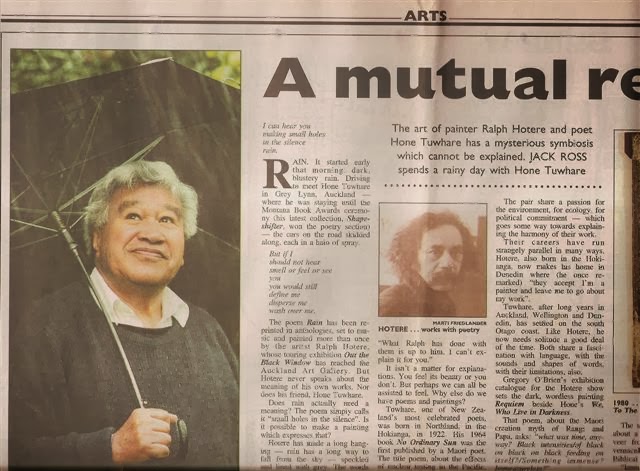
A Mutual Respect: Hotere and Tuwhare (1998)


Sunday Star-Times (2/8/98)

A Mutual Respect:
Ralph Hotere and Hone Tuwhare

Hotere: Out the Black Window. Ralph Hotere’s Work with New Zealand Poets. Auckland Art Gallery / Toi o Tāmaki, 4 July – 9 September.


I can hear you
making small holes
in the silence
rain.


Rain. It started early that morning: dark, blustery rain. As I drove to meet Hone Tuwhare in Grey Lynn, where he was staying until the Montana Book Awards ceremony (his latest collection, Shape-shifter, won the poetry section this year), I could barely see the other cars on the road. They skidded along, each in their own halo of spray.
But if I
should not hear
smell or feel or see
you

you would still
define me
disperse me
wash over me

The poem “Rain” has been reprinted in anthologies, set to music, and painted more than once by the artist Ralph Hotere, whose touring exhibition Out the Black Window is now on show in the Auckland Art Gallery. But Hotere never speaks about the meaning of his own works. Nor, I soon discovered, does his friend, Hone Tuwhare.

Does rain actually need a meaning? The poem simply calls it “small holes in the silence.” Is it possible to make a painting which expresses that? Ralph Hotere has made a long hanging – rain has a long way to fall from the sky – speckled and lined with grey. The words of the poem, at the bottom, are scrawled, stencilled, smudged in a series of different letterings.

“Every time he’s used something of mine the poems were written first,” Hone told me. “What Ralph has done with them is up to him. I can’t explain it for you.” I can’t explain it either. It isn’t really a matter for explanations. You feel its beauty or you don’t. But perhaps we can all be assisted to feel. Why else do we have poems and paintings?

Hone Tuwhare, one of New Zealand’s most celebrated poets, was born in Northland, in the Hokianga, in 1922. His 1964 book No Ordinary Sun was the first ever published by a Maori poet. The title-poem, about the effects of nuclear testing in the Pacific, is the subject of another memorable painting in Hotere’s exhibition.

“He’s one of our most political painters,” Hone said. “I’ve always respected him for that.” The two men share a passion for the environment, for ecology, for political commitment, which goes some way towards explaining the harmony of their work.

Their two careers have run strangely parallel in many ways. Hotere, also born in the Hokianga, now makes his home in Dunedin where (he once remarked) “they accept that I’m a painter and leave me to go about my work.” Hone, after long years in Auckland, Wellington, Dunedin, has settled on the South Otago coast. Like Hotere, he now needs solitude a good deal of the time. Both artists share a fascination with language, with the sounds and shapes of words – with their limitations, also.

Gregory O’Brien’s exhibition catalogue for the Hotere show sets the dark, wordless painting “Requiem” beside Hone’s “We, Who Live in Darkness.” That poem, about the Maori creation myth of Rangi and Papa, asks “what was time, anyway? Black intensities / of black on black on black feeding on itself? / Something immense? Immeasureless?”

As Hone read the poem aloud to me (his usual response to any question about them), he paused on the last word. “‘Immeasureless’ isn’t correct, they tell me – not good grammar.” The same thing has been said about a lot of his poems. They veer from pub language, Kiwi vernacular, to Shakespearean or Biblical rhetoric.

“Immeasureless” does stop us short, make us think about those “intensities of black on black” – the same blackness brooding in the heart of Hotere’s painting. In the poem “Hotere,” Hone said:
… when you score a superb orange
circle on a purple thought-base
I shake my head and say: hell, what
is this thing called aroha

Like, I’m euchred, man. I’m eclipsed?

The language is careful, precise – but local. That question mark at the end is not, Hone remarked to me, to show doubt, but because “Kiwi kids always go up at the end of a sentence.”

“I thought he’d hate the poem. But when he saw it he really liked it; he wanted to use it in his exhibition.”

We live in a dark world: “a visual kind of starvation,” as Hone puts it. South Africa, the Springbok tour, the French nuclear tests, the Aramoana smelter, these are some of the issues which Hone and Hotere have dealt with together. Hotere paints on old bits of corrugated iron and canvas which have been discarded as rubbish; Hone writes, at times, in a kind of disposable street language. Perhaps what they finally have in common is that they are trying to salvage something for us. And not all the paintings are black.

As I ended my long conversation with Hone Tuwhare he pressed a bottle of wine on me as a parting gift. “Are you sure?” I asked, uncertain. “It’s a koha,” he said, “for aroha.” Read his poems; look at Ralph’s pictures. What is this thing called aroha?


(16/7/98)

Sunday Star-Times (August 2, 1998): F7.

[857 wds]


Sunday Star-Times (2/8/98)